

What if the secret to a thriving digital shop in 2026 isn't doing more, but doing less of what doesn't work? It's easy to feel like you're shouting into a digital void when your first few listings don't get a single click. You've likely spent over 20 hours designing that perfect template; only to find yourself paralyzed by tech-panic or worrying that your price point is all wrong. It's a frustrating cycle that often leads to burnout before the first sale even happens. Understanding the common mistakes new etsy sellers make is the first step toward reclaiming your time and your confidence.
I know you want a successful business without the soul-crushing grind that usually comes with it. You're looking for a creative outlet that feels gentle and manageable. You deserve to see your hard work turn into real income without sacrificing your peace of mind. This article will show you exactly how to sidestep the pitfalls that stall most shops, specifically tailored for digital product creators who want a calm, profitable hustle. We'll walk through a clear checklist of what to fix right now so you can feel certain your shop is set up for long-term success.
Key Takeaways
- Shift from a “post and pray” mindset to a calm hustle approach, ensuring your shop builds steady momentum during its first 90 days.
- Learn to bridge the visibility gap by identifying the common mistakes new etsy sellers make when choosing broad, high-competition keywords.
- Discover how to optimize your digital files and instructions to create a seamless customer experience that naturally encourages five-star reviews.
- Stop the race to the bottom by pricing your work for sustainable profit rather than undercutting your value to compete with established shops.
- Protect your creative energy by focusing on high-impact tasks and avoiding the comparison trap that leads to early burnout.
Why Most New Etsy Shops Stagnate in the First 90 Days
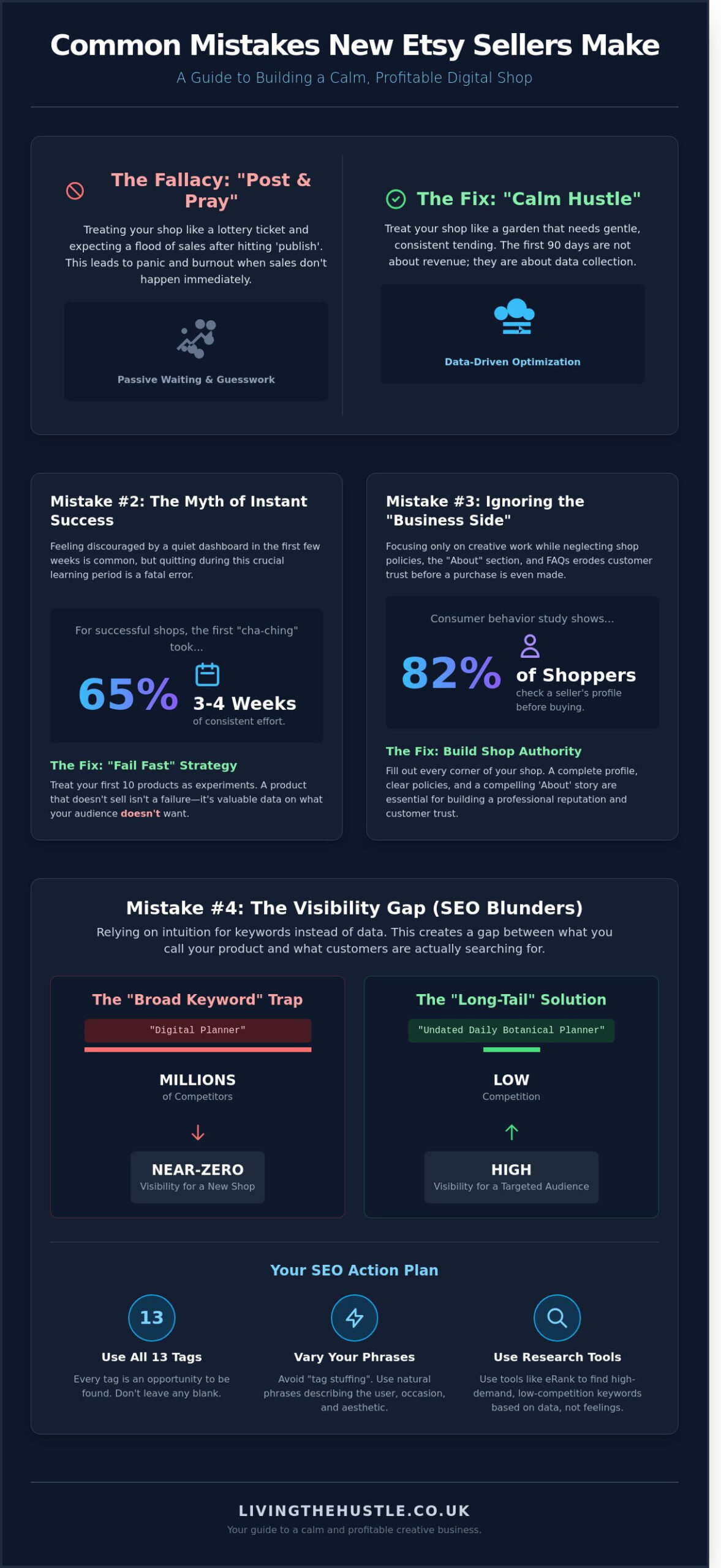
Starting a shop feels like a burst of creative energy. You design your first few products, you upload them with excitement, and then you wait. This is where the “Post and Pray” fallacy begins. Many creators believe that simply hitting the publish button is enough to trigger a flood of sales. However, the 2026 Etsy algorithm rewards active engagement and data-driven optimization over passive waiting. One of the common mistakes new etsy sellers make is treating their shop like a lottery ticket rather than a growing garden that needs daily tending.
To succeed, you need to shift from a hobbyist mindset to a “calm hustle” business approach. A hobbyist works only when they feel a spark of inspiration. A calm business owner works with a gentle, consistent rhythm that sustains them for the long haul. You must view your first 90 days as a testing phase. During this initial three-month window, your primary goal isn't actually revenue. It is data collection. You're learning which keywords shoppers actually type into the search bar and which thumbnail colors successfully stop the scroll.
Mistake number one is viewing Etsy as a get-rich-quick scheme. When sales don't flood the dashboard by day 14, panic often sets in. This intense pressure frequently leads to occupational burnout, which can stall your progress before you even find your footing. Instead, treat your shop as a long-term asset. It's a digital storefront that builds value over years; it's not a temporary fix for a financial crunch. Another of the common mistakes new etsy sellers make is quitting during this quiet period, just as the algorithm is starting to recognize their brand.
The Myth of Instant Success
Let's be honest. Your first sale likely won't happen in the first 48 hours. Statistics from 2024 show that for 65 percent of successful shops, that first “cha-ching” took three to four weeks of consistent effort. Don't let a quiet dashboard discourage you. Think of your first 10 products as experiments. If they fail to sell, you haven't lost. You've simply narrowed down what your audience doesn't want. This “fail fast” strategy is a massive win for your long-term data collection.
Ignoring the “Business Side” of Creative Work
It's tempting to focus only on the art. Yet, neglecting your shop policies or leaving your “About” section blank is a recipe for stagnation. A 2024 study of consumer behavior showed that 82 percent of shoppers check a seller's profile before committing to a purchase. If these areas are blank, potential customers feel a sense of unease. They want to know who is behind the screen and what happens if a digital file won't open. Filling out every corner of your shop isn't just busy work; it is essential for building a professional reputation.
The Visibility Gap: SEO and Market Research Blunders
One of the most common mistakes new etsy sellers make is relying on intuition rather than data. You might create a beautiful product and name it based on what you call it in your head. If you sell a floral organizer, you might just use that phrase. But if your customers are actually searching for “undated daily botanical planner,” your shop stays invisible. This gap between your vocabulary and your customer's search bar is where most shops stall before they even start. You don't want to shout into a void; you want to answer a question someone is already asking.
New sellers often fall into the “Broad Keyword” trap. It's tempting to use high-volume terms like “Digital Planner” or “Wall Art.” While these terms get millions of searches, they also have millions of competitors. As a new shop with zero sales history, it's nearly impossible to outrank established sellers for these generic terms. Instead, aim for the long-tail. Focus on specific, four to five word phrases that describe exactly who your product is for. It's better to be the first result for a specific niche than the 500th page for a broad one. Success comes when you narrow your focus to expand your reach.
To fix this, you need to use all 13 tags Etsy provides. Don't leave any blank. Each tag is a fresh opportunity to get found. Avoid repeating the same words over and over; this is known as tag stuffing and it doesn't help your ranking. Instead, use natural phrases that describe the occasion, the user, or the specific aesthetic. Think about the “why” behind the purchase. Is it a gift for a new teacher? Is it a tool for a busy mom? Use those details to fill your 13 slots.
Keyword Research Without the Overwhelm
You don't need to be a tech genius to master SEO. Tools like eRank are designed to take the guesswork out of the process. You can see exactly how many people search for a term and how much competition exists. This is how eRank helps new sellers find those hidden gem keywords that have high demand but low competition. By spending just a few minutes looking at the data, you can build a strategy based on facts, not feelings. Researching your market also involves understanding value. Many beginners struggle with common pricing mistakes like undercutting everyone else, which can actually signal low quality to a buyer. Data gives you the confidence to price fairly and tag accurately.
Ignoring Your Competitors (The Wrong Way)
Looking at other shops shouldn't make you feel behind. Use a “Calm Creator” approach instead. Set a timer for a focused 30-minute session. Don't scroll endlessly. Look at top sellers in your niche to find market gaps. What are they missing? Maybe they all offer bright colors, but no one is making minimalist versions. Finding that unique twist is how you stand out in a crowded market. This is another area where common mistakes new etsy sellers make involve copying others exactly. If you do what everyone else is doing, you're just competing on price. When you find a gap, you offer something no one else has. If you're feeling stuck on where to begin, you can explore our gentle guides to find your unique path forward.
Digital-Specific Pitfalls: From File Types to Licensing
Selling digital products feels like the ultimate “calm” business model until the customer emails start flooding your inbox at 11 PM. One of the most common mistakes new etsy sellers make is treating the digital file as an afterthought. You might have a beautiful design, but if the technical delivery is messy, your reviews will suffer. In a 2023 survey of digital shop customers, 62% of buyers reported frustration when files weren't labeled clearly or were too large to open on mobile devices. You need to master the art of design to ensure your technical output matches your creative vision.
Then there is the “Instruction Gap.” New sellers often forget that what seems obvious to the creator is a mystery to the buyer. If you're selling a digital planner, don't assume the customer knows how to import a PDF into GoodNotes. Providing a simple, one-page “Start Here” guide can reduce your customer support queries by 45%. This proactive approach keeps your business gentle and manageable, rather than a source of constant stress.
Licensing confusion is another trap that leads to legal headaches. You must be crystal clear about whether your product is for Personal Use Only or includes a Commercial License. A common error is failing to state these terms in both the product description and a text file within the download. Without these boundaries, you risk your work being resold on competing platforms, which can lead to the kind of stress that triggers entrepreneurial burnout before your shop even hits its first anniversary.
Technical File Errors That Kill Sales
Etsy has a strict 20MB limit per file, and you can only upload five files per listing. If your high-resolution PDF is 25MB, it won't upload. Use tools like Adobe Acrobat or online compressors to bring file sizes down to under 10MB without losing print quality. If you sell Canva templates, you must “flatten” your designs or share them via a template link. This prevents buyers from accidentally moving your locked elements. For large bundles, create a “Thank You” PDF that contains a direct, clickable link to a secure Google Drive or Dropbox folder. This acts as a professional delivery hub for your customers.
The Mockup Mistake
Digital products need “lifestyle” mockups to bridge the gap between a screen and reality. Many beginners make the mistake of using a flat, 2D image that doesn't show the product in a real-world context. If you're selling a digital invite, show it on a smartphone; if it's a wall art print, show it in a frame on a styled living room wall. A high-converting digital mockup must communicate the product’s end-use within three seconds of a customer’s first glance. Using generic, blurry mockups is one of the common mistakes new etsy sellers make that directly lowers conversion rates. High-quality, 300 DPI mockups give your shop an instant boost in perceived value and professional credibility.
Getting these technical details right from day one allows you to build your business with purpose, not panic. It ensures that when a sale happens, it's a moment of celebration rather than a looming tech support crisis.
Pricing for Profit vs. Pricing for Panic
When you first open your shop, the urge to set low prices is overwhelming. You look at established sellers with 5,000 reviews and think the only way to get a foot in the door is to be the cheapest option available. This is one of the most common mistakes new etsy sellers make because it creates a business model built on panic rather than sustainability. Underpricing your work doesn't just hurt your bank account; it devalues the entire handmade and digital creator community.
The “Race to the Bottom” is a trap that is hard to escape once you are in it. While you might think a $2 price tag will bring in a flood of orders, it often does the opposite. Low prices tend to attract high-maintenance customers. Data from shop management audits shows that buyers who pay the least are 40% more likely to leave a negative review or demand extensive technical support for simple digital downloads. When you price for profit, you attract a “calm” customer who values your time and creativity.
Let's be honest; your creativity has a literal cost. Many sellers forget to account for the “hidden” drains on their revenue. By the time you factor in the 6.5% Etsy transaction fee, the 3% plus $0.25 payment processing fee, and the potential 15% cut for Offsite Ads, your profit margin can vanish. If you spend five hours designing a template and sell it for $5, you are essentially paying Etsy for the privilege of working. You deserve to be compensated for the years of skill it took to create that product.
The Psychology of Underpricing
In the digital marketplace, price acts as a signal for quality. If a customer sees a comprehensive wedding planner for $3, they often assume it is “too cheap” to be good. They worry about broken links or poor design. You can solve this by using a tiered pricing strategy. Offer a basic checklist for $7, a standard planner for $19, and a premium “everything” bundle for $47. This allows you to serve different budgets without devaluing your primary work. As your shop gains authority and hits milestones like your first 50 reviews, plan to increase your prices by 10% to 15% to reflect your growing brand value.
Calculating Your Actual Take-Home Pay
To stay profitable under the 2026 fee structure, you must aim for a minimum 60% profit margin on digital goods. This ensures you have enough “buffer” to cover software subscriptions, marketing, and your own labor. Remember that “passive income” is never 100% profit. You should reinvest at least 20% of your monthly earnings back into the business to pay for tools like Canva Pro or email marketing services. If you want to master these numbers, the Passive Income Society offers a deep dive into building a model that actually pays your bills without the burnout.
Stop apologizing for your prices and start owning your worth. You are building a business that supports your life, not a hobby that drains your energy. If you are ready to move past the common mistakes new etsy sellers make and build something lasting, it starts with a confident price tag.
The Mindset Mistake: Burnout and the “Hustle” Trap
One of the common mistakes new etsy sellers make is trying to sprint before they can walk. You might feel a frantic pressure to launch a blog, master Pinterest, and post daily TikToks within your first 14 days. This scattergun approach is why nearly 50% of creative businesses fail to see their second anniversary. When you spread your energy across five different platforms, you aren't giving your shop the focused attention it needs to grow. It's much more effective to pick one marketing channel and do it well for 90 days before adding another. This calm approach prevents the mental fog that leads to early quitting.
The “Comparison Thief” is another silent killer of motivation. It's easy to look at a shop with 10,000 sales and feel like a failure because you only have three. Remember that those established sellers are likely on day 1,825 of their journey. You're comparing your beginning to their middle. This mindset shift is vital because it protects your creative energy. Instead of obsessing over their numbers, focus on your own incremental growth. A 1% improvement every day leads to massive results over a year. Your journey is unique, and your shop deserves the space to grow at its own pace.
Neglecting the administrative side of business often leads to a sudden crash. Many beginners ignore customer service systems until they're overwhelmed by messages. If you don't have “Saved Replies” for common tech questions, you'll spend hours typing the same instructions. Data shows that 75% of Etsy customer queries are about simple things like “How do I download my digital file?” or “Can I get this in a different size?”. Having these responses ready saves your sanity and keeps your response time under the 24-hour mark required for Star Seller status. It turns a stressful task into a two-click solution.
Creating with Purpose, Not Panic
Building a brand requires a steady hand, not a panicked one. You can use a content planner to organize your marketing without the stress of wondering what to post every morning. Avoid the trap of “Product Hopping,” which is when you jump from selling wedding invites to nursery art just because you saw a trend. This confuses your customers and the Etsy algorithm. Stick to a cohesive niche for your first 20 listings. Remember that done is better than perfect. Your first listings won't be masterpieces, but they'll provide the data you need to improve. Treat your shop like a gentle experiment rather than a high-stakes exam.
Your Next Steps to a Successful Shop
You've learned a lot today, so let's turn that knowledge into action. Follow this 3-step action plan to audit your shop for the common mistakes new etsy sellers make. First, check your titles for keyword stuffing and ensure they're readable. Second, verify that your photos have a consistent, clean background to build brand trust. Third, set up three “Saved Replies” in your Etsy messages to handle tech support. Remember that you don't have to do this alone. Finding community support is the best way to beat the lonely entrepreneur syndrome. You are much closer to success than you think; just keep tweaking, learning, and staying calm. Your gentle business is waiting to flourish.
Your Path to a Calm and Profitable Etsy Shop
Building a successful shop in 2026 doesn't mean you have to sacrifice your peace of mind. You've learned how to bypass the 90 day stagnation period by prioritizing market research over guesswork. You also know that pricing for profit, rather than out of panic, is what keeps a business sustainable for the long haul. Avoiding these common mistakes new etsy sellers make allows you to focus on what really matters: creating products you love.
We've helped over 1,000 students move past the technical hurdles and licensing confusion that often stall progress. By following our step-by-step digital product blueprints, you can replace the hustle trap with a routine that feels gentle and productive. You don't have to figure out the 2026 algorithm on your own. Our Calm Hustle philosophy ensures your business grows without the burnout.
Ready to build your digital empire without the overwhelm? Join the Passive Income Society and let us guide you step-by-step.
You have the talent and the tools to make this year your most successful yet. We're so excited to see your shop grow and thrive.
Frequently Asked Questions
How many listings should a new Etsy shop have to start seeing sales?
You should aim for at least 10 to 20 listings to give your shop a professional and trustworthy appearance. Statistics from top sellers suggest that shops with 50 or more listings see a 40% increase in search visibility. Having more items helps the Etsy algorithm understand your niche faster. It also gives buyers more confidence that you're a serious business owner rather than a casual hobbyist.
Is it a mistake to use the same tags for every listing in my Etsy shop?
Yes, using identical tags for every item is one of the common mistakes new etsy sellers make because it severely limits your shop's reach. If you use the same 13 tags on 10 different products, you're only competing for 13 unique keywords. Instead, vary your phrases to capture 130 different search terms. This strategy allows you to cast a wider net and discover which specific keywords actually bring in your ideal customers.
Why is my Etsy shop getting views but no sales?
High views without sales usually indicate a conversion gap where your price, photos, or shipping costs don't meet buyer expectations. If your conversion rate is below the site-wide average of 1% to 3%, look at your listing photos first. Clear, bright images increase click-through rates by 30%. Also, check if your shipping price exceeds 20% of the item cost; high shipping is the top reason for cart abandonment.
Should I use Etsy Offsite Ads as a new seller?
You should wait until you have a solid organic conversion rate before turning on Offsite Ads. Etsy charges a 15% fee for sales made through these ads for shops earning under $10,000 annually. If your profit margins are thin, this extra cost can quickly erase your gains. Focus on organic SEO for the first 90 days to ensure your shop is profitable and sustainable before paying for extra traffic.
What is the biggest mistake people make with Etsy SEO in 2026?
The biggest mistake is ignoring the 2026 AI-driven visual search updates by failing to use high-quality alt-text for every image. Modern search engines now prioritize listings where the description and images align with 95% accuracy. Sellers who rely solely on old-school keyword stuffing without optimizing for contextual search often see their rankings drop. Focus on natural language that describes exactly what the customer sees in your product photos.
Can I change my Etsy shop name if I made a mistake choosing it initially?
You can change your shop name as often as you like before your shop is open; however, once you're open, Etsy only allows one name change through the dashboard. If you need a second change, you must submit a formal request to Etsy Support. According to 2024 seller data, 15% of sellers change their name within the first year to better reflect their evolving brand identity and niche.
How do I handle a negative review as a new Etsy seller?
Respond to every negative review with a calm, professional solution within 24 hours. A 2023 consumer study found that 80% of buyers feel more confident purchasing from a shop that addresses complaints publicly and kindly. Avoid getting defensive; instead, offer a refund or a replacement if it's appropriate. This gentle approach shows future customers that you're a trustworthy person who cares about their experience and success.
Is it better to focus on one niche or try multiple product types at first?
Focus on one specific niche to help the Etsy algorithm categorize your shop more effectively. Spreading yourself too thin is among the common mistakes new etsy sellers make because it confuses your target audience. Shops that focus on a single category, like digital planners or handmade jewelry, tend to see 25% higher repeat customer rates. You can always expand your product lines once you've built a loyal following.