

Does the idea of building a digital product business feel both exciting and completely overwhelming? You see the potential for passive income and creative freedom, but then the panic creeps in. Which tools should you use? What if you pick a product that nobody buys? The question of how to create digital products to sell can quickly feel less like a fun project and more like a mountain of tech headaches and design decisions you aren't ready to make.
Let’s take a deep breath together. What if building this business could feel calm, clear, and totally achievable? This guide is your gentle first step. We’ll walk through a simple, repeatable process for creating and selling digital products from scratch-no design experience or tech genius required. Forget the overwhelm. By the end of this article, you will have the confidence and the exact roadmap to build a business that brings you income without sacrificing your peace. Let's get started.
Key Takeaways
- Start by identifying your ‘Zone of Genius' to find profitable product ideas people already want, avoiding the common mistake of designing first.
- Learn how to use simple tools like Canva to design beautiful, functional products with confidence, even if you have zero design experience.
- Discover the essential steps for how to create digital products to sell successfully, from writing high-converting listings to pricing for value, not just competition.
- Uncover a simple strategy to scale your calm business by turning your first low-cost product into a full suite of profitable offers.
What are digital products and why they are the ultimate ‘Calm Hustle'
Feeling overwhelmed by the idea of starting a business? What if you could build something that adds to your life, not your stress? Welcome to the world of digital products-the foundation of a truly calm and sustainable hustle.
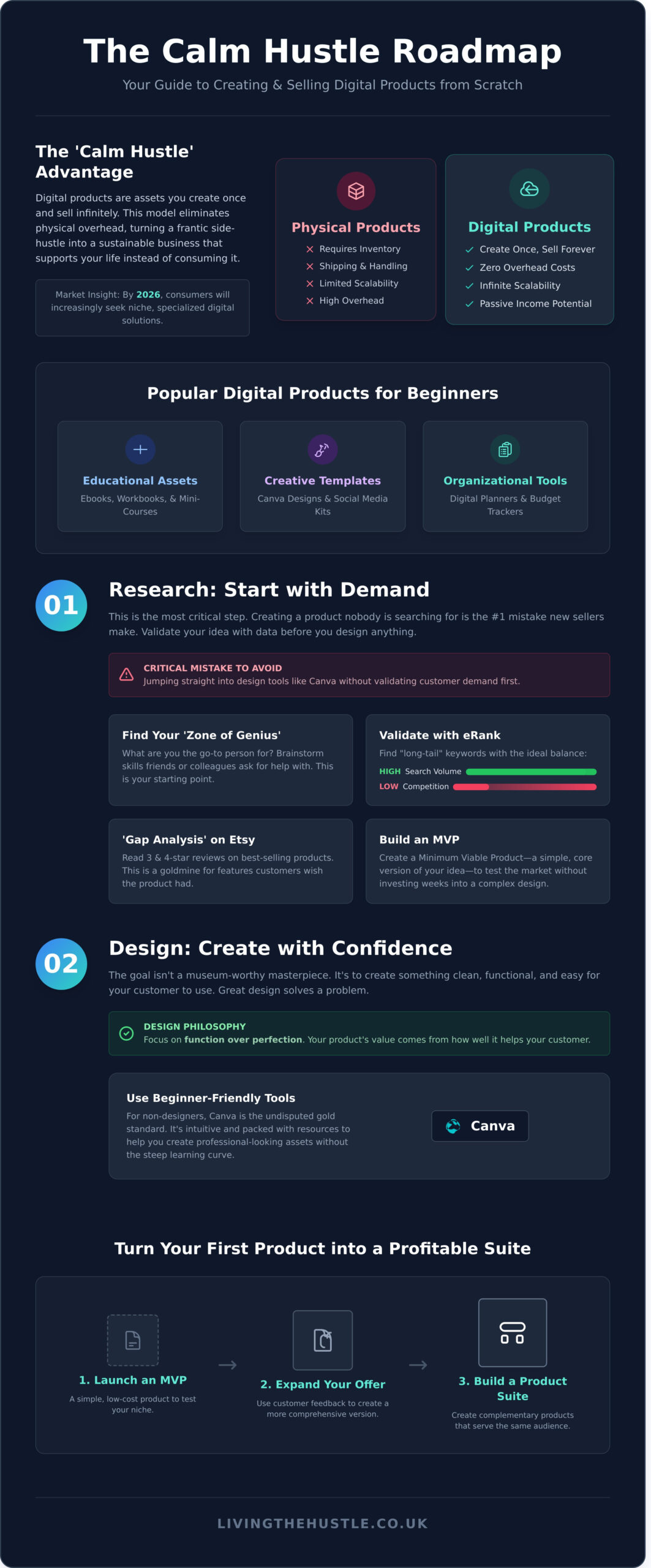
At their core, digital products are intangible assets you can sell online again and again. Unlike physical goods that require inventory, shipping, and handling, digital downloads have nearly zero overhead and infinite scalability. There are no boxes to pack and no post office runs. This simple difference is what transforms a frantic side-hustle into a ‘Calm Hustle'-a business that supports your life instead of consuming it.
As we look toward 2026, the market is shifting. Consumers are tired of one-size-fits-all solutions and are actively searching for niche, specialized digital tools that solve their unique problems. This is where you come in.
Popular types of digital products for beginners
Getting started doesn't have to be complicated. The first step in learning how to create digital products to sell is choosing an idea that feels manageable and genuinely helpful. Focus on simple solutions that solve a specific problem. Here are a few popular starting points:
- Educational Assets: Ebooks, simple workbooks, and mini-courses that teach a skill or solve a pain point.
- Creative Templates: Canva designs, social media kits, and branding assets that save your customers time.
- Organizational Tools: Digital planners, budget trackers, and habit logs that bring order and calm to daily life.
The passive income potential in 2026
Let’s be honest: “passive income” isn't instant. It’s the result of thoughtful, upfront work. The beauty of the ‘create once, sell forever’ model is that your effort is front-loaded. You build the asset, and then it can generate income for years with minimal maintenance, freeing you from trading time for money. This approach allows for sustainable growth, not overnight, unrealistic wealth.
Ultimately, a digital product is the bridge between your expertise and someone else's problem.
Step 1: Researching high-demand ideas without the guesswork
Feeling that creative spark? It’s tempting to jump straight into Canva and start designing. But let’s be honest-this is the #1 mistake new sellers make. Creating a beautiful product that nobody is searching for is a fast track to frustration. The secret to learning how to create digital products to sell successfully is to start with research, not design.
Begin by looking inward at your ‘Zone of Genius.' What do friends, family, or colleagues already ask you for help with? Are you the go-to person for amazing party planning checklists, organized spreadsheets, or beautiful social media graphics? This is your starting point.
Your unique skill is the ‘what,' but data tells you ‘who' wants it and ‘how' they're looking for it. By using simple research tools, you can validate your idea with real customer demand, giving you the confidence to create something people are already eager to buy.
Using eRank to find winning keywords
Tools like eRank are your best friend for taking the guesswork out of your niche. You can see how many people are searching for a term (search volume) versus how many sellers are using it (competition). Look for ‘long-tail' keywords-longer, specific phrases that signal a customer is ready to buy. For example, instead of “planner,” you might find a sweet spot with “printable weekly planner for moms.” For a complete walkthrough, check out our deep-dive guide on eRank for Etsy sellers.
Validating your product on Etsy and beyond
Once you have a keyword-backed idea, head to marketplaces like Etsy. Study the best-selling listings. What features do they include? How are they priced? Read the reviews-especially the 3 and 4-star ones. This ‘Gap Analysis' is a goldmine, revealing what customers wished the product had. While analyzing top sellers is great for inspiration, it's crucial to create something uniquely yours. This is a good time to get familiar with the basics of safeguarding your intellectual property to protect your hard work. Finally, consider creating a ‘Product MVP' (Minimum Viable Product)-a simple version of your idea to test the market without sinking weeks into a complex design.
Step 2: Designing your digital product with confidence
Does the thought of design make you want to close your laptop? Let’s be honest-for many new creators, this is the most intimidating step. But we’re not aiming for a museum-worthy masterpiece. We’re designing with purpose, not panic. The goal is to create something clean, functional, and easy for your customer to use. When you're figuring out how to create digital products to sell, remember that great design solves a problem, it doesn't just look pretty.
Your best friend on this journey will be a user-friendly tool. For beginners, Canva is the undisputed gold standard. It’s intuitive, packed with resources, and built to help non-designers create professional-looking assets without the overwhelm of complex software.
Of course, Canva is just one of many tools available. For comprehensive comparisons of design software, marketing platforms, and other essential services, you can discover SuggestMeTech and find the perfect fit for your business needs.
Canva basics for digital product creation
Getting started in Canva is simple. The first step is setting the right dimensions. Are you creating a printable planner? Use A4 or US Letter size. A digital presentation? Opt for a 16:9 ratio. Getting this right from the start saves a lot of headaches. To keep your products looking cohesive, use the Brand Kit feature to save your chosen colors and fonts, ensuring every product you create feels like it’s part of a polished collection. For a deeper dive, our guide to The Art of Design will help you master the craft.
Creating a ‘Signature Style' without a design degree
You don’t need formal training to develop a beautiful aesthetic. Just follow the 2-Font, 3-Color Rule: pick two complementary fonts (one for headings, one for body text) and a simple palette of three colors. This simple constraint prevents visual clutter and instantly makes your work look more professional. While Canva templates are a fantastic starting point, the key is to infuse your unique value. A stand-out product is simply one that solves a specific problem faster or more effectively than a free alternative.
Finally, let's cover two crucial details: legalities and user experience. Always ensure any fonts or graphics you use come with a commercial use license-this is non-negotiable for selling products. To delight your customers, make your files truly user-friendly. This means adding clickable hyperlinks in your PDFs, creating editable fields for digital planners, and exporting in a high-quality, easily accessible format. These small touches build trust and lead to glowing reviews.
Step 3: Listing and pricing your product for maximum sales
You’ve created your beautiful digital product-congratulations! Now comes the part that can feel a little overwhelming: putting it out into the world. But don’t worry. Creating a listing isn't about complicated sales tactics; it's about calmly and clearly communicating the value you've packed into your creation. This is where we turn your hard work into a gentle, consistent stream of income.
A high-converting listing has three core parts: a clear title, descriptive tags, and compelling product mockups. Your title and tags should use the exact words your ideal customer is searching for. But your mockups? They are your silent salesperson. A great mockup doesn't just show your planner or template; it shows it in a beautiful, aspirational setting, helping the customer visualize the calm and organization it will bring to their life. In many ways, the mockup is more important than the product itself.
When it comes to pricing, please resist the urge to join the ‘race to the bottom.' Competing on price is exhausting and rarely sustainable. Instead, focus on value-based pricing. Ask yourself: What problem does my product solve? How much time, stress, or money does it save my customer? Price your product based on the transformation it provides, not the hours it took you to create. This is a crucial mindset shift when learning how to create digital products to sell for profit.
Writing descriptions that connect and convert
Your listing description is your chance to connect. Focus on benefits (how it helps) over features (what it is). Instead of “10-page PDF,” say “Your complete guide to a stress-free week.” Address common worries head-on. A simple line like, “No special software needed-just open and use!” can ease a buyer's mind. For a full breakdown of the journey, see our Passive Income Society Review.
The power of the ‘Thank You' file
Your work isn’t over once the customer clicks ‘buy.’ The delivery file (often a PDF with the download link) is a golden opportunity to build your brand. Instead of just a link, include a heartfelt thank you, a gentle prompt to leave a review if they loved their purchase, and links to your other products. By setting up automated delivery on a platform like Etsy or Gumroad, you create a seamless experience that builds loyalty and encourages repeat customers-all while you sleep.
Scaling your business: From first sale to full-time income
Congratulations! You've made your first sales, which is a huge milestone. Now, the real journey begins: turning that initial spark into a sustainable business. The first step is to look back at your first 30 days. What sold well? What sat on the virtual shelf? Understanding this data is the foundation of learning how to create digital products to sell that your audience truly wants.
Once you know what's working, you can build a ‘Product Ladder'. This strategy is about creating a clear path for your customers. Someone might start with a £5 printable planner (your entry-level offer). If they love it, they'll be much more likely to buy your £50 comprehensive digital workbook next. This builds trust and gently guides customers toward higher-value products without a hard sell.
As you grow, it's vital to build an email list. This is your direct line to your audience, a space you own away from the changing algorithms of Etsy or social media. It's how you build a real community. This, combined with creating simple processes, is how you transition from a constant ‘hustle' to a calm, automated ‘system' that gives you your time back, much like how specialized systems for Garden Watering can automate a daily chore and reclaim your energy.
Eventually, you might consider moving from a marketplace to your own dedicated storefront, which offers more control over your brand. This is a significant step, and for those who want expert guidance on platforms like Shopify, specialists such as NB eCommerce & Design can help build a professional and scalable online shop.
Marketing your products without the burnout
Forget trying to be on every platform. The key to calm marketing is choosing one channel and doing it well. For digital products, Pinterest is a powerhouse. It acts like a visual search engine, driving passive traffic to your shop for months. Focus your energy there first, and remember that you can build your brand without the overwhelm by being strategic, not busy.
Choosing your next growth path
When you have consistent sales and understand your customers, you can explore bigger models. Are people asking for more designs? A template shop might be your next step. Do you have knowledge to share on a recurring basis? A subscription could be perfect. It's about listening to your audience. If templates feel like the right fit, our Template Creators Society can show you the way.
Remember, scaling your business doesn't happen overnight. This entire guide on how to create digital products to sell is about taking small, intentional steps. Your gentle next step is simply to look at your data, listen to your customers, and decide on one thing you can do to move forward. You've got this.
Your Calm Digital Journey Starts Now
You now hold the roadmap. This guide has walked you through the gentle, achievable steps to turn your passion into a profitable digital product. From finding that perfect idea without the guesswork to designing with confidence, you've seen that learning how to create digital products to sell is about purpose, not panic. You have what it takes to build a calm, sustainable business you truly love.
Feeling that spark of excitement but wishing you had a guide by your side? If you’re ready for more step-by-step support designed for total beginners-no design or tech experience required-I invite you to take your next step. We focus on sustainable growth and the ‘Calm Hustle' approach, ensuring you build a business without the burnout.
Ready to build your digital empire? Join the Passive Income Society today!
Your first sale is closer than you think. You have the knowledge and the creativity. Go bring your amazing ideas to life.
Frequently Asked Questions
Do I need to be a graphic designer to sell digital products?
Absolutely not! This is a common myth that causes so much overwhelm. User-friendly tools like Canva are made for beginners, offering thousands of templates you can easily customize. You can start with simple, text-based products like checklists or planners and build your confidence from there. Focus on creating value for your customers first; your design skills will grow with practice. Your unique ideas are what truly matter.
What are the most profitable digital products to sell in 2026?
While trends change, evergreen products are always a calm place to start. In 2026, look for continued growth in educational templates (for Notion or Google Sheets), niche-specific ebooks or workbooks, and specialized digital planners. Niche entertainment, like curated music platforms, is also a growing area; if you're interested in that space, you can check out PWRPLY for inspiration. A rising area is AI prompt guides for specific industries. The key isn't chasing a fleeting trend but finding a specific problem you can solve for your audience. That is where sustainable profit is found.
How much money does it cost to start a digital product business?
This is the best part of your new hustle-it costs very little to start! You can begin for free using tools like Canva's free plan. Your main costs will be small platform fees, like Etsy's $0.20 listing fee. As you grow, you might invest in a pro software subscription ($15/month) or premium fonts. Learning how to create digital products to sell doesn't require a huge budget, just your time and creativity.
Is Etsy too saturated for new digital product sellers?
It can feel that way, but “saturated” doesn't mean “impossible.” Think of it as a busy market with room for everyone who has a unique stall. The secret is to find a specific, underserved niche instead of selling generic products. With strong branding, beautiful mockups, and smart SEO, your products can stand out and connect with the right buyers. Don't let the fear of competition stop you from starting your journey.
For a great example of a business that thrives by serving a specific audience with digital books, you can check out Plume Charmers.
Can I create digital products on my phone or do I need a computer?
While you can do some basic design on your phone, a computer is highly recommended for a calmer, more efficient workflow. Creating, organizing files, and uploading listings is much easier on a larger screen with a proper keyboard and mouse. Using a computer will help you avoid frustration and allow you to use more powerful design features, giving your products a more professional finish. Think of it as your business command center, and if you're in the market for a new one, resources like laptastic.com can help you find the right fit.
How do I protect my digital products from being stolen or copied?
Worrying about theft can be a source of panic, but there are simple, gentle steps you can take. Always include a clear “Terms of Use” file stating your products are for personal use only. You can also watermark your listing images (never the final product file!) to deter copying. For high-value items like ebooks, consider password-protecting the PDF. Focus on building a strong brand and loyal customer base; that's something no one can ever copy.
How long does it take to make your first sale with digital products?
Let's be honest: there is no magic timeline. Your first sale could happen in a day or it could take a few months. It depends on factors like your niche's demand, how well you've optimized your listings with SEO, and if you're promoting your shop. The most important thing is to stay consistent and patient. As you continue to list new items and refine your process, you will build momentum. Celebrate every small win and trust the process.