

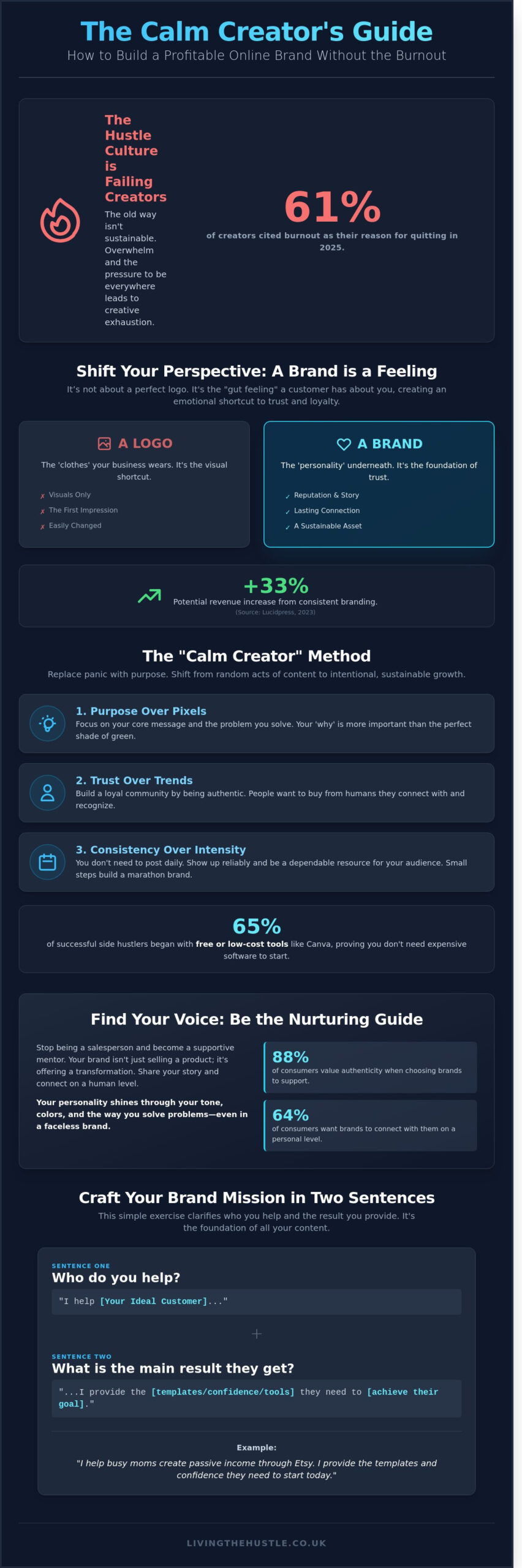
What if the secret to a thriving business isn't working 14 hours a day, but actually doing less with more intention? Let's be honest; the pressure to be everywhere at once is exhausting. You might feel stuck. Perhaps you're worried that you don't have the design skills to stand out. Learning how to build an online brand shouldn't feel like a constant battle against an algorithm. In 2025, 61% of digital creators cited burnout as their primary reason for quitting, proving that the old way of working just isn't sustainable anymore.
You likely agree that trying to keep up with every new platform feels like a recipe for panic rather than profit. It's hard to feel confident when you're worried about being too salesy or inconsistent with your messaging. This guide promises to show you how to create a cohesive, profitable online brand that resonates deeply with your audience without the burnout. We'll explore a clear, manageable branding plan to help you build a professional shop that generates passive income and gives you the freedom you deserve.
Key Takeaways
- Understand why your brand is actually a “gut feeling” and how shifting this perspective helps you build a sustainable asset for long-term passive income.
- Identify your unique “Nurturing Guide” persona to create purposeful content that builds genuine rapport and resonates deeply with your buyers.
- Master the basics of how to build an online brand through a simple visual identity that uses a signature palette and intentional typography to stay cohesive.
- Learn the secrets to branding your Etsy shop so you can stand out from the crowd while using blogging to establish authority and drive traffic.
- Discover how to move past one-off sales and grow a loyal community by scaling into profitable digital niches with confidence and ease.
What is an Online Brand (and Why You Don't Need to Be a Designer)?
Have you ever felt a sudden spark of connection when you stumble across a new Etsy shop or a helpful blog? That isn't a happy accident. It is the result of a well-defined brand. Most people think branding is about picking the perfect shade of sage green or spending $2,500 on a professional graphic designer. Let's be honest; that is a recipe for panic, not progress. An online brand is actually the “gut feeling” a customer has about your business. It is the emotional shortcut that helps a stranger decide if they can trust you with their time and money.
Learning what personal branding is helps you realize that your reputation is your most valuable business asset. When you understand how to build an online brand, you create a foundation for passive income that works even when you are away from your desk. According to a 2023 report by Lucidpress, consistent branding can increase revenue by 33%. This growth doesn't come from a fancy logo. It comes from the confidence your audience feels when they see your work. Your brand is the container for your digital products; it makes your offers feel cohesive and professional rather than scattered.
You don't need a four-year design degree or expensive software like Adobe Creative Cloud to start this journey. In fact, a 2024 survey of successful side hustlers showed that 65% began their business using free or low-cost tools like Canva. The “Calm Creator” approach focuses on building with purpose, not panic. It is about being intentional with your message rather than obsessing over pixels. We want to replace that feeling of overwhelm with a gentle, step-by-step plan that feels manageable for your busy life.
The Difference Between a Logo and a Brand
Think of your visuals as the clothes your business wears. They are the first thing people see, but they aren't the soul of the shop. Your brand is the personality underneath. In the world of digital products, trust is the only currency that truly matters. A strong brand does the heavy lifting for you by establishing that trust early. When your audience feels a connection to your story, it reduces the need for “hard selling.” You won't have to convince people to buy because your brand has already proven your value. If you are wondering how to build an online brand that lasts, start by focusing on your unique voice rather than just your color palette.
Shifting from Side Hustle to Sustainable Brand
Many creators stay stuck in the “just trying things out” phase for far too long. Moving toward a sustainable brand requires a shift from random acts of content to intentional growth. Consistency is the secret sauce here. You don't need to post every single day to be successful, but you do need to be reliable. As we look toward 2026, the digital marketplace is shifting away from polished perfection and toward radical authenticity. People want to buy from humans they recognize. Setting realistic expectations now prevents the burnout that kills so many great ideas. By showing up as your true self, you build long-term recognition that a simple “side hustle” can never achieve.
- Purpose over pixels: Focus on your message first.
- Trust over trends: Build a loyal community by being yourself.
- Consistency over intensity: Show up small, but show up often.
Building a brand is a marathon, not a sprint—a principle well-understood by endurance experts like the training group Pipman (פיפמן). It is a gentle process of uncovering what makes your perspective unique and sharing it with the world. You have everything you need to start right now, exactly as you are.
Finding Your Unique Voice: Creating Content with Purpose
Finding your voice is the secret sauce to how to build an online brand that people actually remember. You aren't just selling digital products; you're offering a transformation. By stepping into the role of a Nurturing Guide, you shift from being a salesperson to a supportive mentor. This approach builds a bridge between your expertise and your customer's needs. It tells your audience that you understand where they are because you've likely been there too.
Let's be honest; most people are tired of polished, corporate talk. A 2023 report from Stackla found that 88% of consumers value authenticity when choosing which brands to support. You can achieve this by sharing your “why.” Why did you start this journey? Whether you're a stay at home mom or a creative looking for a side hustle, your story matters. Write your captions and emails as if you're talking to a close friend. Use “you” and “I” to create an immediate connection. Even if you choose to run a faceless brand, your personality shines through your tone, your color palette, and the way you solve problems for others.
Identifying Your Ideal Customer's Pain Points
Your brand exists to solve a specific problem. Instead of just listing features of a planner, explain how it stops the 2 AM panic about tomorrow's to-do list. Use your own past struggles to show empathy. If you once felt lost in a sea of spreadsheets, share that experience. Your Brand Mission Statement should be just two sentences. Sentence one: Who do you help? Sentence two: What is the main result they get? For example: “I help busy moms create passive income through Etsy. I provide the templates and confidence they need to start today.”
Building Trust Through Storytelling
Trust isn't built through perfection; it's built through being real. In a 2022 Sprout Social study, 64% of consumers said they want brands to connect with them on a personal level. Share the messy behind the scenes of your creative process. Show the five failed drafts before you landed on the final design. This makes you relatable rather than intimidating. Learning how to create a strong brand presence involves showing the human person behind the screen. Actionable tip: Write one “Let's be honest” post this week. Share a mistake you made in your business and what it taught you.
Overcoming the Overwhelm of Content Creation
The pressure to be everywhere at once is the fastest way to burn out. In late 2023, many creators reported feeling “platform fatigue” after trying to manage five different social channels simultaneously. Stop the cycle of panic. Focus on one “home” for your brand, like a blog or an Etsy shop, before expanding elsewhere. This is a vital step in how to build an online brand without losing your mind. Use the Calm Creators Content Planner to map out your month in advance. Planning allows you to create with purpose rather than reacting to a deadline. If you're ready to grow without the stress, you can start your gentle business journey with our resources. Taking it one step at a time ensures your brand remains a joy, not a chore.
Visual Identity: Building a Cohesive Aesthetic Simply
Does the idea of “design” make you want to close your laptop and hide? You aren't alone. Many new creators feel that if they aren't experts in expensive software, they can't possibly look professional. That simply isn't true. Your visual identity is about a feeling, not just fancy graphics. When you focus on how to build an online brand, you're really focusing on how you want people to feel when they see your name. It's the silent handshake you give to every person who visits your shop or blog.
Start by choosing a “Signature Palette” of three to five colors. A 2023 color psychology report suggests that blue builds trust while yellow sparks optimism. You can use the 60-30-10 rule to keep things balanced. 60% of your content should use your primary color, 30% a secondary shade, and 10% an accent color for buttons or call-outs. This structure prevents your shop from looking like a chaotic rainbow. Soft sage and cream might signal a “calm” vibe, while bold navy and gold suggest authority. Stick to your choices to avoid the “decision fatigue” that leads to burnout.
Typography works the same way. Pick two fonts and stay faithful to them. A clean sans-serif like Montserrat paired with a classic serif like Playfair Display creates an instant high-end feel. Using more than three fonts often leads to visual noise that confuses the human brain. Research from April 2023 shows it takes about 0.05 seconds for users to form an opinion about your visual presence. Consistent fonts help you pass that lightning-fast test every time.
Canva is your best friend in this journey. With over 170 million monthly active users as of 2024, it has democratized professional design for everyone. It allows you to create templates that ensure your Instagram posts, Pinterest pins, and Etsy banners all look like they belong to the same family. This consistency leads to “instant recognition.” When a customer sees your specific shade of green, they should immediately think of your business. This level of clarity is a vital part of building your personal brand and standing out in a crowded digital marketplace.
Creating Digital Product Mockups That Sell
Digital products are intangible, so you must make them feel real to build consumer trust. High-quality mockups show your customer exactly how they'll use your planner or workbook in their daily life. If your brand is light and airy, choose mockups with bright, natural sunlight. Consistency here is key. For a deep dive into creating products that look as good as they function, visit The Art of Design for advanced tips on standing out.
This principle extends even to businesses selling highly tangible products, like home goods. An online flooring retailer, for instance, must use excellent photography and a cohesive website design to help customers visualize how a product will look and feel in their own space. To see an example of a well-presented online shop in this sector, you can find out more.
The same is true in the apparel industry, where a brand's aesthetic communicates its value. For an example of how a luxury activewear brand builds a cohesive online presence, you can check out JC London.
Similarly, for a brand that leans into a bold, humorous personality, you can explore Sasshole® Women's Classic Fit T-Shirts to see how they use a strong voice to build their identity.
Nowhere is this more evident than in the real estate market, where the visual presentation of a property *is* the brand. Professional imagery is essential to attract buyers and build trust. For instance, services like Houzpics | Real Estate Photographers in Hilton Head, SC specialize in creating compelling visual narratives that help properties stand out.
The Essential ‘Brand Kit' for Beginners
- Logo: Keep it simple and readable.
- Palette: Save your specific Hex codes.
- Fonts: One for headings, one for body text.
- Imagery: Choose a consistent filter or photo style.
- Voice: Define if you're funny, serious, or nurturing.
Store these five items in the Canva Brand Hub for one-click access. As we look toward 2026 design trends, remember that “radical simplicity” is winning. Minimalist layouts with plenty of white space are currently outperforming cluttered designs by 40% in engagement metrics. Keep it simple, keep it calm, and keep it authentic to your vision.
Turning Your Brand into a Business: Marketplaces vs. Your Own Space
You've likely wondered if you should stick to a marketplace or build your own website. Learning how to build an online brand involves finding a healthy balance between the two. Marketplaces like Etsy offer incredible reach, with over 96.2 million active buyers reported at the end of 2023. However, relying solely on a third party is risky for your long-term peace of mind. Your email list is the ultimate insurance policy for your business. If a platform changes its rules tomorrow, your list of 250 or 2,500 subscribers remains yours. It's the only direct line you have to your customers that no algorithm can take away.
- Marketplaces provide immediate traffic and built-in trust for new sellers.
- Your own blog builds long-term authority and improves your Google search rankings.
- Email lists protect your brand from sudden platform shifts or account closures.
- A personal website allows for 100% control over the visual customer experience.
Branding Your Etsy Shop for Success
Standing out among 7.5 million active sellers requires a shop that feels like a destination. Your shop banner and ‘About' section are prime real estate for your brand story. Use these spaces to share your “why” rather than just your “what.” For the technical side, use eRank for Etsy Sellers to find keywords that align with your brand's unique personality. Don't just chase high-volume tags. Look for specific phrases your ideal customer types into the search bar. Ensure your product descriptions use your brand's voice. If your brand is gentle and calm, your copy should reflect that peace through soft language and clear, helpful benefits.
Building Your Blog and Brand Without the Overwhelm
A blog is the best place to house your brand's deeper message. It allows you to move beyond product features and share your actual expertise. If the technical side feels daunting, remember that you don't have to do everything at once. You can follow the Blog, Brand & Bloom Workbook for a step-by-step plan that removes the guesswork from the process. Cross-promote your shop and blog by linking to your latest digital products within your helpful articles. Statistics from 2024 show that businesses with active blogs see 55% more website visitors than those without. This traffic isn't just a number; it's a community of people who trust your brand's voice.
Creating a cohesive experience across different platforms doesn't have to be stressful. Start by updating your Etsy shop photos to match your blog's aesthetic. When your visual identity is consistent, customers recognize your work instantly. They'll know it's you whether they find you on Pinterest or a search engine. This recognition is the foundation of how to build an online brand that lasts for years. You're not just selling a one-off item; you're inviting people into a world you've created with care and purpose. By balancing marketplace reach with your own digital home, you build a business that is both profitable and sustainable.
Your Gentle First Step: Scaling Your Brand with Confidence
You have laid the groundwork and found your rhythm. Now, it is time to look at the horizon without losing the calm you have built. Scaling your business does not mean working more hours; it means making your hours work harder for you. When you focus on how to build an online brand that resonates, you move away from the exhausting cycle of chasing one-off sales. Instead, you begin to cultivate a loyal community that waits for your next launch with genuine excitement. In 2023, data from digital marketplaces showed that shops with a clear brand identity saw a 35% higher repeat customer rate than those selling unrelated items. This loyalty is the secret to a sustainable, gentle hustle.
How do you make that transition? It starts with recognizing that your customers are people, not just statistics on a dashboard. When someone buys a junk journal kit or a set of party printables, they are inviting your creativity into their lives. By showing up consistently with a helpful, nurturing voice, you turn a single transaction into a long-term relationship. This shift reduces the pressure to constantly find new buyers because your existing community becomes your greatest advocate. It is a slower, more intentional way to grow that protects your peace of mind.
Maintaining momentum requires you to celebrate the small wins. Do not wait until you hit a five-figure month to feel successful. Did you receive your first five-star review this morning? That is a win. Did you master a new design tool in October 2023? That is a win too. These milestones are the fuel that keeps you going when things feel quiet. When you acknowledge your progress, you replace panic with purpose. You are not just building a shop; you are crafting a legacy that reflects your values and your unique creative spark.
Specialising Your Brand for Profit
Focusing your energy on a specific niche is the fastest way to see real results. Many creators worry that narrowing their scope limits their sales, but the opposite is usually true. A Clipart Business that specializes in “Moody Victorian Botanicals” will often outperform a general store because it becomes the go-to authority for that specific aesthetic. By late 2023, niche-focused digital shops reported a 22% higher conversion rate because their branding matched their products perfectly. This “Niche Down to Blow Up” strategy allows you to speak directly to your ideal customer's heart.
The Path to Passive Income Mastery
A strong brand serves as the essential foundation for the Passive Income Society. As your business grows, your brand should require less active daily management because the systems you have built do the heavy lifting. By December 2023, successful digital entrepreneurs found that having a cohesive brand identity reduced their marketing time by nearly 10 hours per week. You have got this, one gentle step at a time. Your journey toward a life of creative freedom is just beginning, and you are doing it with grace and confidence.
Ready to find your people? Join a community that truly understands the gentle hustle. We believe in building businesses that support our lives, not the other way around. You don't have to navigate this path alone. Surround yourself with fellow creators who value progress over perfection and calm over chaos. Together, we can turn your creative dreams into a thriving, peaceful reality that lasts for years to come.
Start Your Calm Creative Journey Today
Your journey toward a sustainable business starts with a single, intentional choice. You've seen that you don't need a degree in graphic design to create a beautiful visual identity. By 2026, the digital world will value authenticity over perfection. Finding your unique voice and choosing whether to host your shop on a marketplace or your own website are the practical pillars of your success. Learning how to build an online brand doesn't have to feel like a frantic race against an algorithm. It's about creating a space that reflects who you are while serving your audience with purpose. It's about building something that lasts without burning out.
We've helped 5,000+ students in our Passive Income Society move from feeling stuck to feeling unstoppable. These resources are designed specifically for total beginners who want to trade panic for a calm, manageable workflow. You can achieve growth without the traditional hustle culture stress. If you're ready to take that next step with confidence, we're here to guide you through every click and creative decision.
Explore the Blog, Brand & Bloom Workbook today!
You've got the vision and the tools. Now it's time to let your brand bloom at your own pace.
Frequently Asked Questions
Do I need to be a professional designer to build an online brand?
No, you don't need a design degree to create a beautiful and professional brand. Tools like Canva provide over 250,000 free templates that make high-quality layouts accessible to everyone. You can build a cohesive visual identity in a single afternoon by sticking to two main fonts and a simple three-color palette. Focus on a clean, consistent look rather than complex graphics to keep your “calm hustle” manageable and stress-free.
How much does it cost to start an online brand in 2026?
You can launch a professional online brand for less than $150 in 2026. This budget covers a domain name for $12, a basic website hosting plan for $60 per year, and a reliable email marketing tool for $15 monthly. Many successful creators begin with $0 by using free versions of design tools and social media platforms. Starting small allows you to grow your business without financial pressure, making it a gentle first step into entrepreneurship.
Can I build a successful brand without showing my face?
Yes, you can absolutely build a profitable brand while remaining completely anonymous. Faceless accounts on platforms like Instagram grew by 45% in 2025 because audiences value high-quality digital products and helpful information over personal fame. Focus on providing clear value and a consistent aesthetic through your content. This approach lets you learn how to build an online brand while maintaining your personal privacy and peace of mind.
How long does it take to see results from branding efforts?
Most new brands see their first meaningful engagement within 90 days of consistent, purposeful posting. Data from 2025 shows that creators who publish three times weekly gain their first 500 subscribers in about 4 months. Branding is a gentle marathon, not a frantic sprint. Your “bloom” phase usually begins after 6 months of steady work when your message finally clicks with your target audience and builds real confidence.
Should I start on Etsy or build my own website first?
Start on Etsy first to take advantage of their 90 million active buyers who are already looking for products. Etsy handles the technical heavy lifting and brings traffic to you, which reduces the initial overwhelm for beginners. Once you reach 50 sales or consistent monthly revenue, you can transition to your own Shopify or WordPress site. This path provides a safe, low-cost environment to test your digital product ideas before investing in a custom website.
What is the most important part of an online brand for beginners?
The most important part of your brand is a clear, narrow niche that solves one specific problem for your audience. According to a 2024 creator survey, 72% of successful small brands attribute their growth to focusing on a single target audience rather than trying to please everyone. When you understand how to build an online brand around a specific need, your marketing becomes much easier. It replaces panic with a sense of purpose.
How do I choose the right colours and fonts for my brand?
Choose two complementary colors and two easy-to-read fonts to keep your brand looking professional and calm. Use the 60-30-10 rule for your palette; 60% is your primary neutral, 30% is your secondary color, and 10% is an accent color. Pick one serif font for headings and one sans-serif font for body text to ensure readability across all devices. This simple structure prevents visual clutter and helps you stay focused on creating helpful content.
Is it too late to start a digital product brand in 2026?
It's definitely not too late, as the digital goods market is projected to reach $800 billion by the end of 2026. While more people are creating products, there's a growing demand for unique, niche solutions that feel personal and supportive. Your unique perspective is exactly what's needed to stand out in a crowded space. Starting now gives you a gentle entry into a thriving economy where creativity and helpfulness are highly rewarded.