

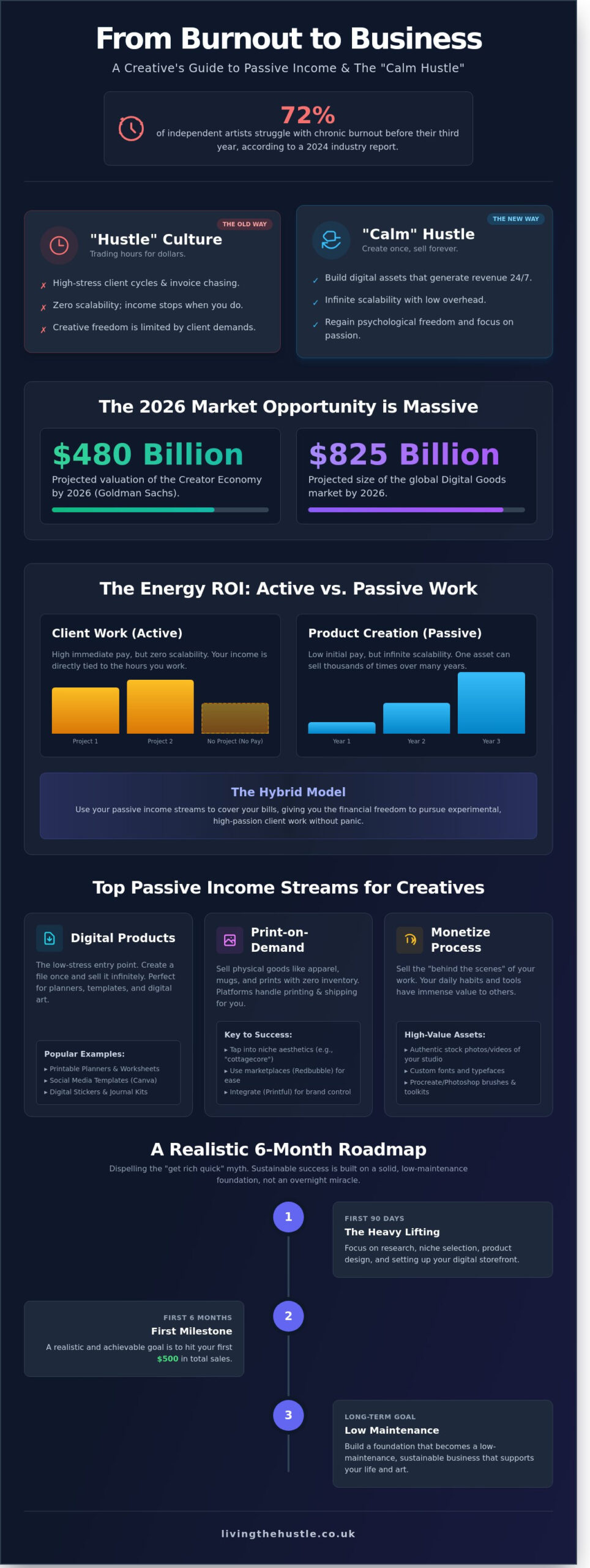
What if the most profitable day of your week was the one where you never actually opened your laptop? Let's be honest; the constant cycle of “final_final_v3” revisions and the 45 day wait for freelance invoices is exhausting. It's no wonder that a 2024 industry report found 72% of independent artists struggle with chronic burnout before their third year. You want to create, but the financial instability of freelance life makes it hard to focus on your art. Exploring passive income for creatives is the gentle shift you need to move from panic to peace.
We agree that you deserve a business that supports your life rather than consuming it. This article will show you how to build a calm hustle by turning your existing skills into digital assets that sell while you're resting. You'll discover how to bypass the tech-phobia and set up systems that generate steady revenue without the typical “hustle culture” stress. We're exploring 15 sustainable ideas tailored for the 2026 market, ranging from automated workshops to evergreen templates, so you can finally focus on your passion projects with total confidence.
Key Takeaways
- Learn how to trade the burnout of hustle culture for a “calm hustle” that turns your unique artistic talents into a sustainable, long-term business.
- Explore the most effective streams for passive income for creatives, from low-overhead digital downloads to inventory-free print-on-demand.
- Identify whether you are a “maker” or a “mentor” to choose the specific revenue path that best aligns with your personality and goals.
- Follow a gentle roadmap to uncover the “hidden gems” already on your hard drive and conduct market research without the panic.
- Discover how to simplify your journey and move from a simple side project to a flourishing creative empire that supports your life.
What is Passive Income for Creatives in 2026?
Have you ever felt like you're on a creative treadmill that never stops? You finish one client project, and before you can even celebrate, you're hunting for the next. In 2026, the definition of passive income for creatives has evolved into something much more sustainable. It's the “create once, sell forever” philosophy. Instead of trading every hour for a paycheck, you build digital assets that work for you while you sleep, travel, or simply take a nap.
We've moved away from the aggressive “hustle until you drop” culture of the early 2020s. Now, we embrace the “Calm Hustle.” This movement focuses on building a business that supports your life rather than consuming it. By 2026, the creator economy is projected to reach a valuation of $480 billion according to Goldman Sachs. This growth is driven by a massive demand for unique, human-centered art in a world increasingly filled with generic AI content. Tech barriers have vanished; tools that used to require a degree are now accessible to anyone with a laptop and a spark of curiosity.
The real win isn't just the money. It's the psychological freedom. When your bills are covered by your shop, you can finally say “no” to draining clients. You reclaim your creative spark and start making art for the joy of it again. It's about creating content with purpose, not panic.
The Difference Between Active and Passive Creative Work
Active work is your typical freelance gig. If you don't show up, you don't get paid. Passive work involves a different energy ROI. You might spend 20 hours creating a single template, but that template can sell 5,000 times over the next three years. Many artists feel a strange sense of guilt about this, as if work must be “hard” to be valuable. We need to reframe this. You aren't being lazy; you're being efficient with your talent.
- Client Work: High immediate pay, but zero scalability.
- Product Creation: Low immediate pay, but infinite scalability.
- The Hybrid Model: Use your passive income for creatives to fund your experimental passion projects.
If you're feeling stuck, starting with a Calm Creators Content Planner can help you map out this transition without the overwhelm.
Dispelling the “Get Rich Quick” Myth
Let's be honest; building a sustainable shop takes real work. The “set it and forget it” promise you see on social media is usually a lie. A better goal is “low maintenance.” You'll spend your first 90 days doing the heavy lifting: researching niches, designing products, and setting up your storefront. Don't expect a $10,000 month right away. A realistic goal for your first six months is hitting your first $500 in total sales. It's about building a foundation that lasts. You can check out our passive income review to see how different paths stack up for your specific goals.
The Best Passive Income Streams for Artists and Designers
Digital downloads remain the gold standard for building a calm, low-overhead business. You create the file once and sell it thousands of times while you sleep. By 2026, the global digital goods market is projected to reach $825 billion, offering a massive opportunity for anyone willing to share their unique style. This model removes the panic of shipping deadlines and inventory management, making it a perfect gentle first step for busy creatives.
Digital Products: The Low-Stress Entry Point
Etsy is a fantastic place to start because the audience is already there looking for inspiration. In 2024, digital products were a major driver of the platform's $13 billion in gross merchandise sales. You don't need a massive portfolio to begin. Focus on high-utility items that solve a specific problem for your customers. To ensure your work doesn't get lost in the crowd, consider exploring The Art of Design to help you create products that truly resonate with buyers.
- Printable Planners: Daily organizers or educational resources for parents.
- Social Media Templates: Helping small businesses maintain a professional look on Canva.
- Digital Stickers: A popular choice for the growing community of digital journalers.
Print-on-Demand and Merchandising
Print-on-Demand (POD) allows you to sell physical goods like apparel or home decor without holding any stock. Platforms like Society6, Redbubble, and Printful handle the printing and shipping for you. In 2026, success in POD relies on tapping into specific niche aesthetics. Trends like “cottagecore” or “dark academia” saw a 150% increase in Pinterest searches recently, proving that focused styles sell better than generic designs. You can choose a “marketplace” model like Redbubble for ease, or an “integrated” model using Printful on your own website for more brand control.
Monetising Your Creative Process
Don't overlook the value in your daily studio habits. Selling the “behind the scenes” of your work as stock photography or video is a brilliant way to generate passive income for creatives. Many brands now pay for authentic, “lo-fi” content that shows a real artist at work. If you prefer technical design, creating custom fonts or typefaces is a high-reward niche with less competition than standard illustration. For those who love drawing small, decorative elements, you can build a thriving business with the Clipart Shop Profits programme.
Teaching your craft is another sustainable path. By 2026, the e-learning market is expected to surpass $460 billion. Sharing your skills through a pre-recorded mini-course or a series of tutorials allows you to help others while building your own authority. It's about working smarter, not harder, to create a life you love. If you're feeling ready to take that next step, you might find a passive income review helpful to see which path fits your current lifestyle best.
Choosing Your Path: Digital Products vs. Teaching
Deciding how to build passive income for creatives starts with a simple question: do you want to be the “maker” or the “mentor”? In 2024, the global creator economy reached a valuation of 250 billion dollars, proving there is plenty of space for both paths. However, your personality determines which one feels like a calm hustle and which one feels like a heavy chore. It's about finding a rhythm that fits your life without adding to your overwhelm.
The Maker path focuses on the output. You create a digital asset once and sell it thousands of times. If you enjoy the quiet flow of designing without the pressure of being “on camera,” this is your lane. The time-to-market is incredibly fast. You can design a digital template and have it live on a storefront in under 24 hours. In contrast, the Mentor path involves teaching others your craft. This typically requires a 40 to 60 hour initial time investment to film lessons or write a curriculum; however, it often commands price points 10 times higher than a single digital download.
Before you commit to a strategy, take the “Interest Test.” Ask yourself: can I talk about this specific niche for 15 minutes straight without any notes? If the answer is no, you'll likely face burnout before your first 90 days are up. Choosing a topic you genuinely love is the secret to creating passive income for creatives that actually lasts.
The Maker Path: Selling Digital Assets
This path is perfect if you value complete anonymity and high-volume sales. You don't need to show your face to succeed. You'll spend your time monitoring trends and optimizing SEO to ensure your products get found. For example, using tools like eRank for Etsy sellers helps you find exactly what customers are searching for right now. It's a highly scalable model because once the file is uploaded, the delivery is 100 percent automated.
- Pros: Total privacy; easy to automate; low barrier to entry.
- Cons: Requires consistent trend monitoring to stay competitive.
- Ideal for: Introverted designers or those starting a clipart business.
The Mentor Path: Selling Your Knowledge
If you love explaining the “how-to” behind your art, the mentor path builds a powerful personal brand. While it requires being the face of your business and managing a community, the deep impact you make is incredibly rewarding. You can turn your skills into a signature course or a digital workbook. Many creators use reels to revenue strategies to connect with their audience. This path offers more stability through higher profit margins, even if you have a smaller customer base.
- Pros: Higher price points; builds lasting authority and trust.
- Cons: Requires ongoing community engagement and “showing up.”
- Ideal for: Experienced creatives who find joy in helping others grow.
The Calm Hustle Roadmap: From Creative Spark to First Sale
Moving from a vague idea to a functioning shop feels like a giant leap, but it’s actually just a series of small, gentle steps. Building a sustainable stream of passive income for creatives doesn't require a 40-hour work week or a massive marketing budget. You can start exactly where you are right now with what you already have. Most artists have at least 12 to 15 unfinished designs or templates sitting in old folders; these are your “hidden gems” waiting to be polished.
Your first task is a digital audit. Open those dusty folders and look for files that solve a problem or spark joy. Once you’ve found 5 potential products, it’s time to validate them. Use eRank for Etsy to see exactly what shoppers are typing into the search bar. This removes the guesswork and replaces it with data. You aren't just “making art” anymore; you're creating solutions that people are actively searching for in 2024.
Finding Your Profitable Niche
Success happens when you hit the “Sweet Spot” formula: High Demand + Low Competition + Your Joy. Instead of being a generalist, focus on a specific problem. A 2023 market analysis showed that niche digital products, like “budget planners for freelance photographers,” convert 2.5 times better than generic “planners.” When you solve a specific pain point, you stop competing on price and start providing unique value. This clarity is the secret to building long-term passive income for creatives without the burnout.
Creating and Branding Your Shop
Building a Blog and Brand doesn't have to be a tech nightmare. Start by choosing three core colors and one clean font to keep your shop looking professional. Consistency is your best friend, but perfection is your enemy. You only need 5 to 10 listings to launch a credible shop. Use a Calm Creators Content Planner to organize your workflow so you aren't scrambling for ideas. Remember, your first listing doesn't need to be a masterpiece; it just needs to be live.
Building Your Creative Empire with Living the Hustle
Building a business shouldn't feel like a frantic race against the clock. Most people treat their creative hobbies as a side hustle that adds more stress than joy. We believe in a different approach. By focusing on sustainable passive income for creatives, you can move away from trading your time for every single penny. It's about creating assets once and letting them work for you while you sleep, travel, or spend time with your family.
The Passive Income Society simplifies this journey for total beginners. You don't need to be a tech expert to succeed. Data suggests that 70% of new creators quit within their first 90 days due to information overload. Our community provides the antidote to that panic. You'll find a supportive group of peers who understand your struggles, ensuring you never have to build in isolation. Community is the secret ingredient that turns a lonely project into a thriving, sustainable business that supports your actual life.
Specialised Training for Specific Niches
General advice often leads to general results. That's why we offer deep dives into profitable niches like Junk Journals, Party Printables, and digital Template businesses. If you want a clear path, the Passive Income Society is the ultimate roadmap for your journey. Real creatives are already seeing results. For example, one member, Sarah, achieved 45 sales in her first month by focusing on specific party themes. These success stories prove that with the right guidance, financial freedom is a realistic goal for any artist or designer.
Next Steps: Your 30-Day Action Plan
Ready to start? Don't let passive income for creatives stay a distant dream. Follow this calm, manageable schedule to launch your shop in just one month:
- Days 1-7: Research and Niche Selection. Look at current trends for 2026. Use tools to find gaps in the market where your unique style can shine.
- Days 8-21: Product Creation and Testing. Design your first five digital products. Focus on quality over quantity and ask for feedback from a trusted peer.
- Days 22-30: Shop Setup and Launch. Open your Etsy or Shopify storefront. Optimise your listings and celebrate your very first upload.
Your gentle first step starts today. You have the talent; now you just need the system. Let's build something beautiful together without the burnout.
Start Your Journey Toward Creative Freedom
Ready to turn your artistic spark into a steady stream of revenue? By 2026, the digital landscape will offer more opportunities than ever for artists to thrive without the typical burnout. You've explored 15 sustainable ways to diversify your income, from launching digital templates to sharing your unique expertise through online teaching. Building a business doesn't have to mean sacrificing your peace or working 80 hour weeks. It's about choosing a path that respects your energy and scales with your ambition.
Finding the right source of passive income for creatives is the first step toward a life of calm hustle. Whether you're a total beginner or a seasoned designer, the shift from trading time for money to building digital assets is transformative. Our Most Popular Course has already helped over 5,000 students navigate this transition with step-by-step guidance that removes the guesswork. You can start small, focus on sustainable growth, and watch your creative empire flourish at your own pace.
Join the Passive Income Society and start your gentle creative journey today! You've got the talent, and we've got the roadmap to help you share it with the world.
Frequently Asked Questions
Can I really make passive income if I am not a professional graphic designer?
Yes, you can absolutely build a successful business without a formal design degree. About 70% of top-selling printable shops on Etsy are run by self-taught creators using user-friendly tools like Canva or Templett. These platforms provide the structure you need to create beautiful, functional products that solve real problems for your customers.
Focus on your unique perspective rather than technical perfection. If you can organize a schedule or write a helpful checklist, you have the skills to start. Your empathy for your audience's needs is often more valuable than a graphic design certificate.
How much does it cost to start a passive income business as a creative?
You can launch your business for less than $50. An Etsy shop costs only $0.20 to list a single item, and a basic Canva Pro subscription is roughly $12.99 per month. This low barrier to entry makes passive income for creatives one of the most accessible ways to build a sustainable side hustle in 2026.
Starting small allows you to test your ideas without financial stress. You don't need expensive software or high-end hardware to see results. A simple laptop and a reliable internet connection are the only major requirements for your first few sales.
Is Etsy too saturated for new creative shops in 2026?
No, because the platform's buyer base continues to grow by over 10% each year. While there are 7.5 million active sellers, most successful new shops thrive by targeting “micro-niches” rather than broad categories. Instead of selling general planners, focus on a specific group like “budget trackers for first-year teachers.”
Saturation is just a sign of high demand. By bringing your specific voice and a fresh aesthetic to a specialized corner of the market, you can stand out easily. There is always room for a shop that provides genuine value and a personal touch.
Which digital product is the easiest to start selling today?
Digital checklists and one-page PDF trackers are the simplest products to create and sell. You can design a high-quality habit tracker or a grocery list template in under 45 minutes. These items are popular because they offer immediate solutions to everyday chaos without requiring complex instructions.
Starting with a single-page download helps you learn the delivery process without feeling overwhelmed. Once you feel confident with one product, you can expand into multi-page workbooks or more detailed templates. It's all about taking that first gentle step.
How many hours a week do I need to spend on my passive income shop?
Expect to spend 5 to 10 hours a week during your first 90 days. This time is spent researching niches, creating your first 20 listings, and setting up your shop's SEO. Once your foundation is built, you can maintain your shop in as little as 2 hours a week.
This “calm hustle” approach ensures you build a business that serves your life instead of consuming it. You can batch your creative work on a Saturday morning and let the automated systems handle the rest. Consistency matters much more than long, exhausting hours.
Do I need a blog or social media following to sell digital products?
You don't need an existing audience to start making sales. Marketplace platforms like Etsy or Creative Market have over 96 million active buyers who are already searching for products like yours. By using smart passive income for creatives SEO strategies, you can put your work directly in front of people ready to buy.
Marketing can feel like a heavy burden when you're just starting. Lean on the built-in traffic of established marketplaces first. This allows you to focus on creating great products while the platform handles the hard work of finding your customers.
What happens if someone steals or copies my digital designs?
You can protect your work by filing a DMCA takedown notice through the platform where the infringement occurred. Major sites like Etsy or Shopify have dedicated systems for this, and 95% of clear copyright violations are resolved within 48 hours. It's a standard part of doing business online that shouldn't cause you panic.
Most creators never experience serious theft, but it's good to be prepared. Including a simple “Terms of Use” page in your download folder helps educate customers on what they can and cannot do. Focus on your growth rather than worrying about the few people who don't follow the rules.
How do I handle the “tech” side of delivering digital files to customers?
Modern platforms handle 100% of the file delivery automatically. When a customer completes their purchase, the system sends them a secure link to download their files instantly. You don't need to manually email anyone or understand complex coding to make this work.
This automation is what makes the income truly passive. Whether you're sleeping, traveling, or spending time with family, the tech works quietly in the background. It provides a seamless experience for your customer and total peace of mind for you.