

What if your Etsy shop could feel like a quiet, successful boutique instead of a crowded, noisy marketplace? With over 7.5 million active sellers currently on the platform, trying to rank for broad terms like “digital art” often leads to frustration rather than sales. You have likely spent hours perfecting a product only to see it buried on page 20 of the search results. It is completely normal to feel overwhelmed by technical SEO tools or feel like you are wasting time on keywords that never convert.
I agree that the constant pressure to hustle harder shouldn't mean sacrificing your mental well-being. This guide will show you exactly how to find long tail keywords for etsy using a gentle, step-by-step approach that clears the technical fog. You will learn how to discover low-competition phrases that act as a direct bridge to your ideal customers. We are going to explore a simple three-part framework to build a keyword list that brings in steady sales without the search-engine stress.
Key Takeaways
- Understand why long-tail keywords are the secret to reaching high-intent buyers who are looking for exactly what you offer.
- Follow a gentle, three-step method to learn how to find long tail keywords for etsy using simple “seeds” and specific modifiers.
- Approach research tools like eRank with confidence, focusing on beginner-friendly features that keep your process calm and manageable.
- Learn the “keyword-first” design secret to stop guessing and start creating products that solve real search queries.
- Establish a sustainable routine for refreshing your SEO every 90 days to ensure your digital shop thrives for the long haul.
What are Long-Tail Keywords and Why are They Your Etsy Secret Weapon?
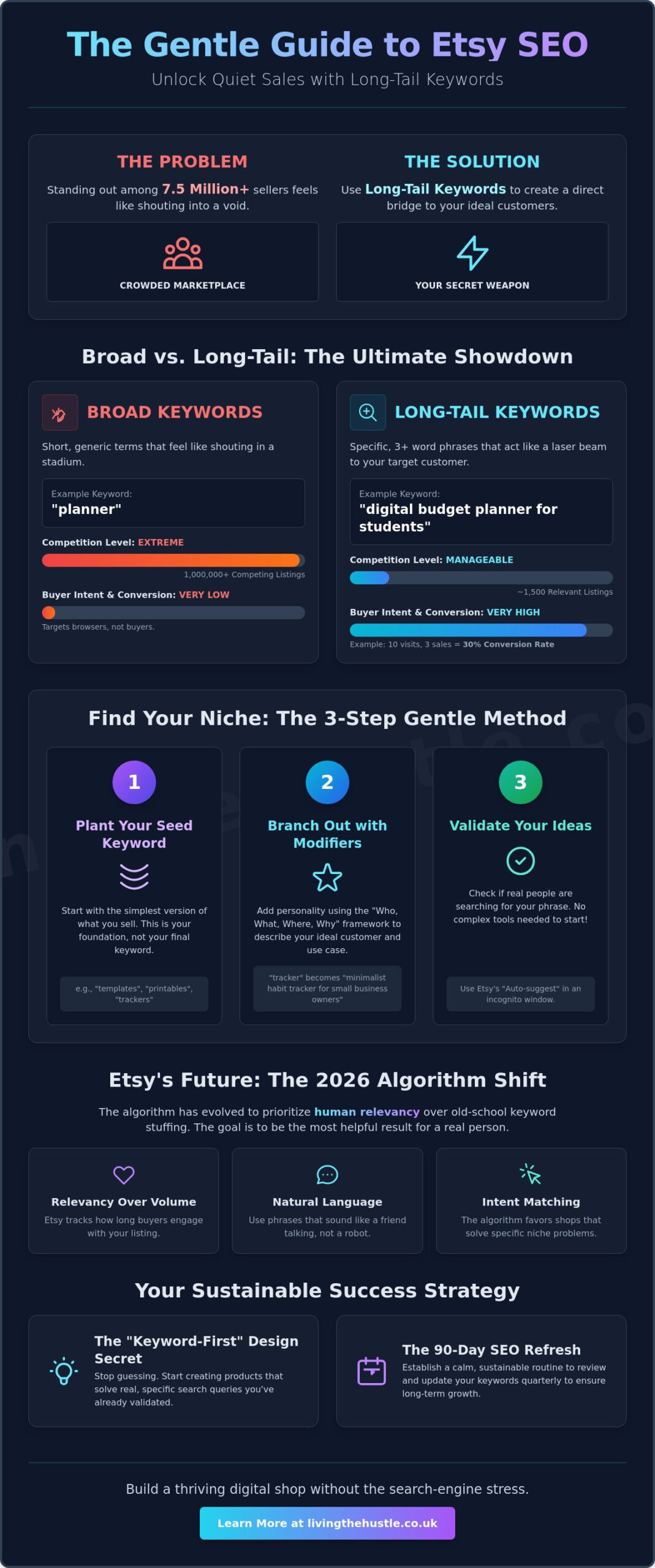
Let's be honest, trying to get your digital products seen on Etsy can feel like shouting into a void. You put in the hard work to create something beautiful, but the views just don't follow. This usually happens because you're targeting broad terms that are far too competitive. To grow your shop without the constant stress of “hustle culture,” you need to understand What are Long-Tail Keywords and how they function in a modern marketplace. These are specific phrases, usually containing three or more words, that shoppers type when they're ready to make a purchase.
A broad keyword like “planner” is a shot in the dark. A long-tail keyword like “digital budget planner for students” is a laser beam. Learning how to find long tail keywords for etsy is the difference between a shop that sits empty and one that hums with consistent, quiet activity. For digital product sellers, these phrases are a secret weapon. They allow you to bypass the noise and connect with buyers who are looking for exactly what you've made. This approach creates “Calm Competition.” Instead of fighting 500,000 other listings for a generic term, you might only compete with 1,500 highly relevant ones. It's easier to rank, easier to stay there, and much more rewarding for your mental well-being.
Broad vs. Long-Tail: A Simple Comparison
Think of broad keywords like shouting in a crowded stadium. Everyone is making noise, and nobody can truly hear your message. Long-tails are like a quiet, focused conversation in a local coffee shop. You're speaking directly to someone who has a specific need. The math of conversion supports this gentle approach. You might get 1,000 visits from the word “art,” but if those people are just browsing, your sales will stay at zero. If you get 10 visits for “boho nursery wall art printables,” and 3 people buy, your conversion rate is 30%. High intent always beats high volume. This follows the “Search Funnel” logic. Curiosity starts with broad searches, but the actual transaction happens when the search becomes specific.
The 2026 Etsy Algorithm Shift
By 2026, Etsy's search engine has evolved to prioritize human relevancy over old-school keyword stuffing. The algorithm now uses semantic search to understand the “why” behind a query. It looks for natural phrasing and how well your listing answers a buyer's specific problem. If you're feeling overwhelmed by these technical changes, using a tool like eRank for Etsy sellers can help you visualize these trends without the guesswork. The goal in 2026 isn't to trick a machine, but to be the most helpful result for a real person.
Contextual SEO is the strategic alignment of your product's unique purpose with the specific intent of a buyer, serving as the primary key to Etsy visibility in 2026.
- Relevancy over volume: Etsy now tracks how long a buyer engages with a listing after searching.
- Natural language: Phrases should sound like something a friend would say, not a list of tags.
- Intent matching: The algorithm favors shops that consistently solve specific niche problems.
When you master how to find long tail keywords for etsy, you stop guessing and start growing with confidence. You aren't just chasing traffic; you're building a bridge to the people who need your digital creations.
The 3-Step ‘Gentle Research' Method to Find Your Niche
Finding the right path for your shop doesn't have to feel like a marathon. Many sellers get stuck trying to find 100 keywords in a single afternoon, which leads to instant burnout. Instead, we use a gentle approach. This method focuses on finding a handful of high-quality phrases that actually connect with your dream customers. Learning how to find long tail keywords for etsy is about depth, not just volume. You only need a few strong pillars to support a successful listing.
Step 1: Planting Your Seed Keyword
Your seed keyword is the simplest version of what you sell. Don't overthink this part. If you're a digital creator, your seed might be “templates,” “printables,” or “trackers.” It's the foundation of your search. However, a seed keyword like “planner” is far too broad to use on its own. In 2024, the term “planner” might return over 1,000,000 results on Etsy. That's why your seed is just a starting point. It's the root that allows your specific long-tail phrases to grow into something visible.
Step 2: Branching Out with Modifiers
Now, let's add some personality to that seed. We use the “Who, What, Where, Why” framework to expand. Think about the aesthetic, the specific occasion, or the target audience. For example, “tracker” becomes “minimalist habit tracker for small business owners” or “budget tracker for wedding shower planning.” These modifiers turn a generic word into a specific solution. By combining 3 to 5 words, you create a phrase that feels natural and descriptive. This process of finding long-tail keywords for Etsy helps you stand out in a crowded marketplace by speaking directly to a shopper's intent.
Step 3: Validating Your Ideas Simply
The final step is checking if real people are actually looking for your idea. You don't need expensive software to start. Open an incognito window in your browser to see unbiased results. Type your phrase into the Etsy search bar and look at the “Auto-suggest” dropdown. If Etsy suggests it, people are searching for it. Look for “low-hanging fruit” where the search results are under 1,000 listings. This lower competition gives your shop a 75% better chance of appearing on the first page compared to high-volume terms. If you want to dive deeper into the data without the stress, you might find my guide on using eRank for Etsy sellers helpful for your journey. This simple validation ensures you're spending your energy on products that people actually want to buy.
Using eRank and Tools Without the Overwhelm
Many sellers feel a flicker of panic when they first open a research tool. It is okay to feel that way. Instead of viewing data as a complicated math test, try thinking of eRank as a supportive partner in your creative process. When you are learning how to find long tail keywords for etsy, you don't need to master every single feature at once. Start by focusing on the Keyword Tool for specific ideas you already have, or use the Keyword Explorer to see what the broader market is doing today. These tools are designed to give you clarity, not more work.
Interpreting the data is simpler than it looks. The Keyword Cloud is just a visual map of what shoppers are typing into the search bar. If a word appears large and bold, it means it is a popular term. You don't need a math degree to understand the Stats section, either. You are simply looking for a balance between high search volume and manageable competition. For a gentle walkthrough of these features, my guide on eRank for Etsy Sellers will help you feel right at home with the interface.
Finding ‘Hot' Keywords with Trend Buzz
Success often comes down to timing. You want to spot seasonal trends before they reach their peak so your listings have time to settle in. For instance, searches for “digital advent calendars” typically begin their upward climb in October. By analyzing historical data, you can see these patterns 60 days before the holiday rush starts. If you create digital items, remember to use the category filters to remove physical product noise. This keeps your research clean and relevant. Look closely at the Average Clicks metric to gauge interest. If a keyword shows 400 searches but 550 clicks, it means shoppers are actively browsing multiple options, which is a great sign for your shop.
The ‘Keyword Shuffle' Technique
Don't let high-competition terms like “planner” or “wall art” discourage you. Instead, use the keyword shuffle to find “long-tail siblings.” This is a core part of how to find long tail keywords for etsy that actually lead to sales. If a broad term is too crowded, look at the Related Searches table in eRank. You might find specific phrases like “neutral nursery wall art” or “adhd daily habit tracker” that have much lower competition.
Your goal is to find the Sweet Spot. This involves looking for keywords that meet three simple criteria:
- Healthy Demand: At least 100 to 200 searches per month.
- Low Competition: Fewer than 2,000 competing listings if possible.
- High Engagement: A click-through rate that shows buyers are actually taking action.
By focusing on these specific phrases, you give your products a much better chance of appearing on the first page. It is about working with purpose, not panic.
Keyword-First Design: Creating Products People are Already Seeking
Let's be honest; most of us start our Etsy journey by making something we love. We spend three days in Canva perfecting the margins of a floral journal, only to realize later that nobody is actually searching for it. The biggest mistake you can make is creating a product first and then trying to force keywords to fit it. This approach often leads to the “post and pray” method, which is the opposite of a calm, sustainable business.
When you understand how to find long tail keywords for etsy before you start designing, you're essentially building a product roadmap. Your keyword list tells you exactly what the market wants, from the color palette to the functional layout. Validating your idea involves looking at the search volume and competition for a phrase like “minimalist teacher grade tracker” instead of just “planner.” If the data shows demand, you can design with confidence, knowing a hungry audience is waiting on the other side of your “Publish” button.
Matching Aesthetic to Search Intent
If a customer searches for a “Boho Digital Planner,” they are looking for earthy tones, soft textures, and perhaps a handwritten font style. If your product uses neon colors and bold, modern typography, you've missed the mark. Buyers make split-second decisions based on visual alignment with their search query. According to Etsy’s 2023 Seller Handbook insights, listings that visually match the specific “vibe” of a search term see higher engagement rates.
- Use long-tail keywords to choose your hex codes; “Sage Green” or “Dusty Rose” are design instructions, not just tags.
- Select fonts that echo the keyword; a “Vintage Wedding Invitation” requires serif fonts, not a tech-heavy sans-serif.
- Specificity in design reduces the bounce rate, as customers immediately feel they've found the exact solution they envisioned.
Filling the ‘Gaps' in the Market
To truly stand out, you must analyze the top 10 search results for your chosen long-tail phrase. Look closely at the best-sellers and ask: “What is missing here?” Perhaps the current options are too cluttered, or they don't include a specific page for habit tracking that reviewers are mentioning. You can position your product as the gentle solution to these specific frustrations.
If you notice that the top results for “A5 Daily Productivity Sheets” only offer portrait orientation, creating a landscape version could be your winning edge. This isn't about reinventing the wheel; it's about making a slightly better, more thoughtful wheel for a specific group of people. By addressing these gaps, you move away from high-pressure competition and into a space where your product is the obvious choice. This is the core of how to find long tail keywords for etsy that actually convert into sales.
Bridging the gap between a great keyword and a beautiful product is where the magic happens. If you want to refine your creative process further, you can learn more through The Art of Design, which focuses on creating digital products that truly resonate with your audience.
Ready to turn your research into beautiful, high-converting products? Explore The Art of Design today.
Building a Sustainable SEO Strategy for Long-Term Calm
SEO isn't an overnight switch you flip. It's more like planting a garden. You've learned how to find long tail keywords for etsy, but now you must give those phrases space to grow. Most successful digital shops see significant traction only after 3 to 6 months of consistent effort. Data from search experts suggests that organic rankings often take 90 to 180 days to fully stabilize. This is why we focus on a calm approach rather than a frantic one.
Many sellers fall into the trap of the “set and forget” myth. While you shouldn't tinker with your listings every day, a gentle refresh every 90 days keeps your shop relevant. Use this time to look at your Etsy Search Analytics. If a specific keyword hasn't brought a single click in three months, it's a sign to try a different long-tail variation. This isn't a failure; it's just a soft adjustment to stay aligned with what customers want.
Where to Place Your Long-Tail Keywords
Once you understand how to find long tail keywords for etsy, your next step is strategic placement. Etsy's algorithm prioritizes the first few words of your title. This is the “Exact Match” rule. If your phrase is “minimalist budget planner printable,” put those words at the very beginning. It helps the algorithm and the customer see exactly what you're selling in less than two seconds.
- The 13 Tags: Use every single slot. If a long-tail phrase is over 20 characters, break it into smaller logical chunks. The algorithm will still connect them.
- Conversational Descriptions: Write for humans first. Use your keywords in the first two sentences. This helps with off-site SEO, as Google often uses the first 160 characters as a
This post may contain affiliate links, which means I may receive a small commission, at no cost to you, if you make a purchase through a link!