

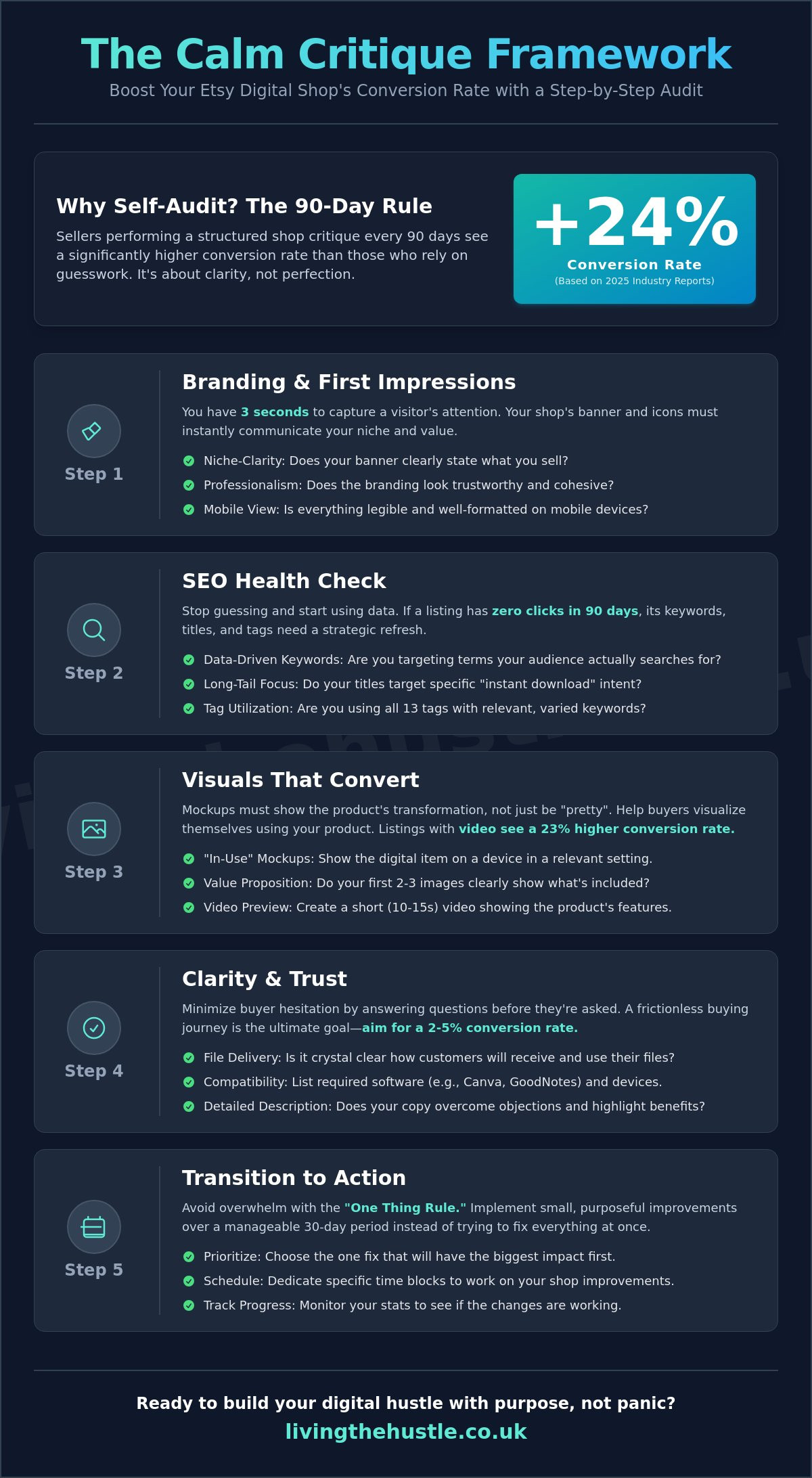
What if the reason your shop sales are stalling isn't a lack of talent, but simply because you're too close to your own work to see the gaps? Let's be honest; it's exhausting to refresh your dashboard in early 2026 only to see zero sales after spending hours on your designs. You likely feel the weight of a crowded market and the confusion of shifting algorithm trends. Conducting a calm, objective etsy shop critique for digital products is the best way to move past that feeling of being invisible. Data from 2025 industry reports shows that sellers who perform a structured self-audit every 90 days experience a 24% higher conversion rate than those who rely on guesswork alone.
I'm here to help you replace that overwhelm with a sense of quiet confidence. You'll learn exactly how to audit your shop using a gentle, step-by-step framework designed to fix low conversion rates and clarify your branding. We're going to look at your listing photos, your keyword strategy, and your shop's overall flow to identify what's working and what's holding you back. This guide provides a clear list of actionable improvements to help you build your digital hustle with purpose, not panic.
Key Takeaways
- Overcome “Founder Blindness” by learning how to view your shop through your customer’s eyes to identify exactly where they are getting stuck.
- Follow a calm, step-by-step framework to conduct an etsy shop critique for digital products that targets both SEO health and visual appeal.
- Audit your listing images and mockups to ensure they communicate value clearly and look professional on every device.
- Transition from analysis to action without the stress by using the “One Thing Rule” to implement shop improvements over a manageable 30-day period.
Why Your Digital Shop Needs a Calm, Honest Critique
Let's be honest. When you've spent hours designing a single digital planner or a set of templates, you lose your perspective. You know exactly where the “how-to” guide is and which link to click. Your customers don't. An etsy shop critique for digital products is an objective audit that looks at your shop through a fresh lens. It evaluates your SEO, your visual branding, and the overall user experience to ensure your hard work actually translates into sales.
Most sellers fall into the “Founder Blindness” trap. You're so close to your creation that you can't see the friction points stopping a buyer. Maybe your checkout instructions are confusing, or perhaps your listing photos don't clearly show what's included in the zip file. A critique clears that fog. It allows you to move away from guesswork and toward a shop that feels professional and trustworthy.
Regularly auditing your shop also prevents the dreaded “panic-pivot.” When sales dip for a few days, it's easy to feel overwhelmed and want to change everything at once. A calm critique helps you stay grounded. Instead of deleting listings in a rush, you look at the data and make small, purposeful adjustments. This approach promotes sustainable growth without the burnout of traditional hustle culture.
Critiquing a digital shop is a unique process compared to physical retail. You aren't worried about shipping times or damaged packaging. Instead, you focus on:
- File delivery clarity and ease of use.
- Listing images that represent a non-physical item effectively.
- Keywords that target “instant download” intent.
- Technical compatibility for different devices and software.
The Goal: Clarity Over Perfection
The aim of a critique isn't to build a “perfect” shop. Perfection is often just procrastination in a fancy outfit. Instead, we want a frictionless buying journey. You're looking for “leaks” in your sales funnel where potential customers might drop off. If you're getting traffic but no sales, your conversion rate optimization needs a gentle adjustment. A healthy digital shop in 2026 typically aims for a conversion rate between 2% and 5%. The Digital Feedback Loop is a strategic tool for 2026 growth that uses real-time customer behavior to refine digital product listings and minimize buyer hesitation.
When to Perform a Self-Critique
Follow the 90-day rule. You should perform an etsy shop critique for digital products every quarter to stay aligned with seasonal trends and algorithm shifts. This keeps your shop feeling fresh and relevant. If your shop views have remained stagnant for more than 30 days, or if you're seeing high traffic with zero sales, it's a clear sign you need a professional eye or a deep-dive audit.
Stay calm when you look at your own “mistakes.” They aren't failures; they're just data points showing you where to grow. Using tools like eRank for Etsy sellers can help you see the numbers clearly without the emotional weight. Remember, every successful seller started with a messy shop and refined it one step at a time.
The 5-Step Framework for a Profitable Digital Product Critique
Approaching an etsy shop critique for digital products doesn't have to feel like a high-pressure exam. It's simply a gentle way to check the pulse of your business and ensure you're building something sustainable. When you look at your shop through a fresh lens, you can spot the tiny friction points that might be keeping your customers from hitting that “buy” button. Let's walk through this five-step process together, focusing on clarity and calm over panic and perfection.
Step 1 & 2: The Foundations of Being Found
First impressions happen in a heartbeat. Research shows you have roughly 3 seconds to capture a visitor's attention before they bounce. Your shop banner and icons must communicate exactly what you sell without making the customer think too hard. If you sell digital planners for teachers, your branding shouldn't look like a generic watercolor shop. Every pixel should whisper your niche. Understanding the Fundamentals of Digital Marketing helps you realize that your shop front is your digital handshake; it needs to be firm, clear, and professional.
Once the branding is set, you need an SEO health check. Don't just guess which keywords are working. Use data to see which listings are actually pulling their weight. If a listing hasn't seen a click in 90 days, your titles and tags likely need a refresh. You can simplify this process by using tools like eRank for Etsy sellers to find low-competition keywords that resonate with your specific audience. This isn't about chasing every trend, but about being found by the people who truly need your work.
Step 3 & 4: Converting the Click
Visuals do the heavy lifting in a digital world. “Pretty” mockups often fail if they don't show the product in use. If you're selling a digital budget tracker, show it on a tablet held by someone sitting at a cozy desk. This helps the buyer visualize the transformation your product provides. Statistics from 2024 indicate that listings with video previews see a 23% higher conversion rate. A quick 10-second clip showing how to edit your template can build massive confidence in a skeptical buyer.
Your listing descriptions and policies are your final chance to build trust. In a faceless digital market, people buy from people they trust. Use your “About” section to share your story and why you created these tools. Be incredibly clear about digital delivery. Around 15% of negative reviews for digital shops come from customers who couldn't find their files. Make your download instructions idiot-proof and helpful. If you're feeling stuck on the design side, you can learn to create digital products that truly stand out to ensure your visuals match your quality.
Finally, perform a customer journey test. Buy one of your own products using a discount code. Is the “instant download” experience smooth? Does the PDF open correctly on a phone? If you find any bumps in the road, fix them immediately. If you're ready to take your shop to the next level with a supportive community, you might enjoy the Template Creators Society where we scale together with confidence.
SEO & Discoverability: Auditing Your Digital Keywords
A successful etsy shop critique for digital products begins with a deep dive into your data. In 2026, Etsy's algorithm has shifted to prioritize “Shop Quality Scores” more than ever before. This means every single listing in your shop acts like a representative for your brand. If you have “Zombie Listings,” which are products that haven't received a single sale or organic click in the last 12 months, they're likely dragging your entire shop's visibility down. Pruning these underperformers or refreshing them with new assets is a gentle way to tell the algorithm that your shop is active and relevant.
Your long-tail keyword audit is the next vital step. Many sellers feel overwhelmed because they try to rank for massive terms like “Digital Planner” or “Wall Art.” These terms often have over 500,000 competing results. Instead, look for “calm” keywords with lower competition and higher intent. For example, “undated digital budget planner for teachers” targets a specific person with a specific need. This specificity helps you bypass the noise and connect with buyers who are ready to purchase right now.
Critiquing your titles requires a shift in mindset. Move away from the robotic keyword stuffing of the past. In 2026, Etsy rewards titles that look like human-readable hooks. Start your title with the most important benefit or a descriptive phrase that catches the eye. Use commas or pipes to separate ideas, and ensure your most descriptive tags are also reflected in your attributes. Attributes now function as secondary tags, so filling out every single dropdown menu is essential for appearing in filtered search results.
Using eRank for a Data-Driven Critique
Data takes the guesswork out of your growth. You can use the “Listing Audit” tool to quickly spot missing tags, one-word tags, or broken links in your descriptions. It's helpful to analyze your “Cloud” of keywords to see if your most used terms actually match your niche. If your cloud shows generic words, you're missing an opportunity for brand consistency. To dive deeper into these tools, learn how to master eRank for Etsy sellers and start making decisions based on facts rather than feelings.
The Sibling Link Opportunity
When you conduct an etsy shop critique for digital products, you must look for “Keyword Cannibalisation.” This happens when you have multiple listings targeting the exact same primary keyword, causing them to compete against each other in search results. Instead, give each listing its own unique focus. SEO critique for seasonal digital products requires a three-month lead time to gain traction, while evergreen products need a monthly check-in to ensure their conversion rates remain steady. Diversifying your tags across “sibling” products ensures you capture a wider net of search traffic without hurting your own rankings.
Conversion Psychology: Critiquing Your Visuals and Listings
Your shop's visuals do the heavy lifting of selling while you sleep. During a thorough etsy shop critique for digital products, you need to look past the aesthetics and focus on the underlying psychology. Start with your mockup audit. Are your previews readable on a five inch phone screen? Since approximately 67% of Etsy shoppers used mobile devices to make purchases in late 2024, tiny text on a preview image is a silent conversion killer. If a customer can't read your headers without zooming, they'll likely keep scrolling.
Your images should follow a clear “Problem-Solution” arc. Don't just show a blank planner page; show a cluttered, stressful schedule being transformed into a calm, organized week. This visual storytelling helps buyers imagine their lives getting easier. Video previews have also become a non-negotiable standard in 2026. A 15 second clip showing a template being edited in real time or a printable being assembled provides the “proof of concept” customers need before hitting the buy button.
Price critiquing is the final piece of the psychological puzzle. Are you pricing for “cheapness” or for “value”? Competing solely on being the lowest price often signals low quality to discerning buyers. If your digital product saves a customer four hours of manual work, your price should reflect that massive time saving. Aim to be the best value, not just the cheapest option on the search page.
Visual Trust Signals for Digital Sellers
Digital files can feel abstract and risky to a buyer. You can bridge this gap by showing a digital “unboxing.” This involves displaying the exact folder structure or the “Thank You” PDF they receive immediately after purchase. Use bold text overlays to answer a customer's biggest objection, such as “No Canva Pro Needed” or “Print at Home in Minutes.” If your product visuals feel a bit unpolished, you can learn to create high-end aesthetics with The Art of Design to build instant authority.
The Description Audit: From Features to Benefits
The first two sentences of your description are your only chance to hook a scrolling buyer. Don't waste them on technical specs like file dimensions or DPI settings. Instead, lead with the emotional transformation. Does your product reduce overwhelm? Does it help them launch a business? Once you've hooked them, ensure your “How it Works” section is incredibly clear. This prevents the common support messages that drain your creative energy. Finally, audit your closing. Are you inviting the sale with a clear instruction, or just letting the text end? A gentle invitation like “Grab your template today and start creating” makes the next step feel easy and natural.
Moving from Analysis to Action Without the Overwhelm
Completing an etsy shop critique for digital products often leaves you with a long list of “to-dos” that can feel heavy. To keep your momentum high and your stress levels low, you must embrace the “One Thing” Rule. This means you only commit to fixing one specific category of errors at a time. If you try to overhaul your SEO, listing images, and shop policies in a single weekend, you won't know which change actually moved the needle. Focus on one area, like your listing titles, for an entire week before moving to the next task.
Create a 30 day implementation plan to stay on track. Spend the first 10 days focusing on your top 5 listings. The next 10 days can be dedicated to shop branding or customer service templates. Use the final 10 days to monitor your stats. You must wait at least 30 days to judge the success of your changes. Etsy's algorithm typically requires 14 to 21 days to re-index your listings and find the right audience for your updated keywords. Checking your stats every hour will only lead to panic; give the data room to breathe.
Prioritising Your Fixes
If your shop isn't performing, you might be tempted to dive straight into keyword research. However, SEO is actually the last thing you should fix if your visuals are poor. If your listing thumbnail doesn't look professional, shoppers won't click, no matter how high you rank in search. A click-through rate (CTR) below 1.2% is a clear sign that your images need work before you touch a single tag.
- Focus on Best Sellers: Apply your critique findings to your top 20% of products first. Improving a product that already has “social proof” yields a much higher ROI than trying to revive a listing that has never sold.
- The 80/20 Rule: Statistics show that 80% of your revenue likely comes from 20% of your digital files. Start there.
- Calm Implementation: Building a sustainable business is a marathon, so choose a gentle pace that respects your energy levels to avoid burnout.
Next Steps for Growth
Sometimes, looking at your own shop feels like trying to read a label from inside the bottle. If your conversion rate remains below 1.5% after three months of consistent tweaks, seeking an outside professional etsy shop critique for digital products can provide the clarity you need. An expert eye can spot the “invisible” friction points that are costing you sales.
Ready to move forward with a structured learning path? If you want a guided experience to help you build a profitable shop from the ground up, read our Passive Income Society Review. This resource is perfect for creators who want to skip the guesswork and follow a proven map.
Success comes from taking one small, intentional step every day. Explore our Digital Workbooks to help you build calmly and turn your shop audit into a thriving digital business.
Your Path to a Calm and Profitable Digital Shop
Taking the time to perform an etsy shop critique for digital products is the most powerful way to stop guessing and start growing. You now have a 5-step framework to audit your SEO and improve your conversion psychology without feeling overwhelmed. By looking at your shop through this lens, you move away from frantic updates and toward intentional, sustainable progress. It's about building a business that supports your life rather than draining your energy.
I started exactly where you are today. These are the same methods I used to generate over £20,000 in passive income while maintaining a calm schedule. You don't need years of tech experience or a massive marketing budget to see a difference. With step-by-step guidance designed for total beginners, you can transform your shop into a steady source of income. Success is within your reach when you focus on purposeful action instead of panic.
Ready to turn your critique into a profitable business? Join the Passive Income Society today!
You've done the hard work of analyzing your shop. Now, take that next gentle step with confidence. You've got this.
Frequently Asked Questions
How often should I critique my own Etsy shop?
You should conduct a thorough review of your shop every 90 days to stay aligned with seasonal shifts and search trends. This quarterly schedule ensures you catch four major market changes per year without feeling overwhelmed by constant micro-adjustments. Regular check-ins help you maintain a calm business rhythm while keeping your digital products relevant to what shoppers are searching for right now.
Will changing my SEO keywords during a critique hurt my current rankings?
Changing keywords only hurts your rankings if that specific listing is already converting at a rate of 2% or higher. If a listing hasn't seen a sale in 60 days, updating your SEO is a necessary step to get found. When performing an etsy shop critique for digital products, focus on underperforming items first to avoid disrupting your current winners.
What is the most common mistake digital sellers make on Etsy?
The most common mistake is using static, uninspired mockups that fail to show the product in use. Data from 2025 shop audits shows that listings with at least 3 lifestyle mockups see a 15% higher click-through rate than those using only flat files. Your customers need to see exactly how your digital planner or template will simplify their daily routine before they feel confident enough to click buy.
Can I get a free Etsy shop critique on Reddit or Facebook groups?
You can find free feedback in communities like the Etsy Sellers subreddit, which has over 200,000 members. While these peer reviews are helpful for a quick confidence boost, they often lack the data-driven depth of a professional analysis. Use these groups for initial impressions on your branding, but rely on your own Etsy Stats for making 100% of your technical SEO decisions.
How do I know if my mockups are the reason my shop isn’t selling?
If your shop has a high click-through rate but a conversion rate below 1%, your mockups or listing description are likely the culprits. A 2026 study of digital shops found that 70% of buyers decide to purchase based on the visual clarity of the first 3 images. If your mockups don't clearly display the final result, shoppers will leave your shop feeling confused rather than empowered.
Should I delete low-performing digital products after a critique?
You should deactivate listings that haven't sold in 12 months rather than deleting them entirely. Keeping the data for those products allows you to see what didn't work, which is a vital part of a successful etsy shop critique for digital products. Deactivating also preserves the URL; if you decide to revamp and relaunch the product later, you won't lose your historical SEO footprint.
How long does it take to see results after implementing critique changes?
It typically takes 30 to 60 days for Etsy's algorithm to fully index and test your new keywords and images. During this window, you might see small fluctuations in your traffic as the system finds your new audience. Be patient and give your changes at least 8 weeks of data before deciding if you need to make further adjustments to your strategy.
What is the difference between a shop critique and a shop audit?
A shop critique is a high-level look at your branding and first impressions, while an audit is a deep dive into your backend data and conversion metrics. Think of a critique as a gentle check-up on your shop's vibe and a shop audit as a 50 point inspection of your SEO and spreadsheets. Both are essential tools for building a sustainable business that grows with confidence rather than panic.