

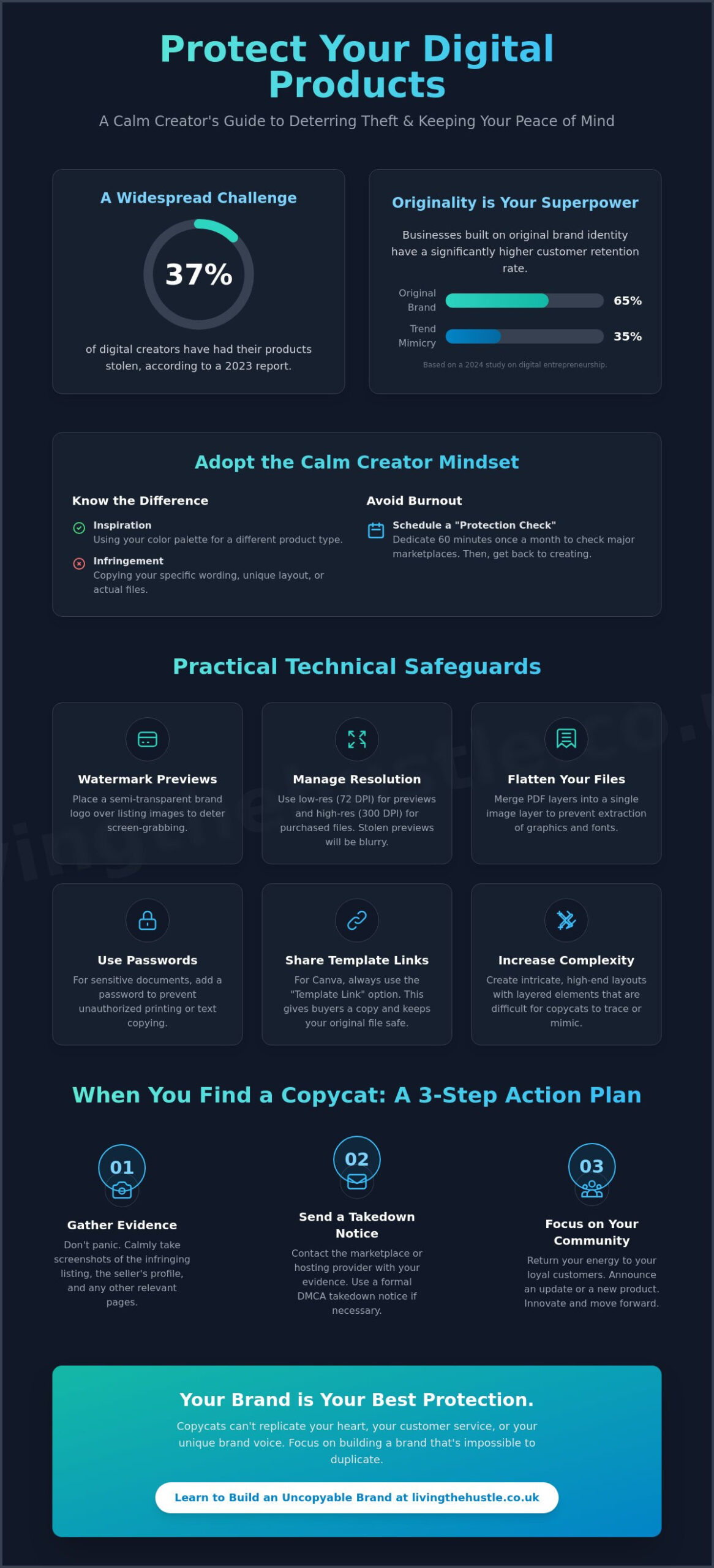
On March 14, 2024, a creator named Sarah discovered her entire line of digital planners being sold on a third-party site for $2. It's a heart-sinking moment that 37% of digital creators have faced according to a 2023 report by the Software Alliance. You've poured hours of love into your shop, and the fear of someone else profiting from your hard work is real. It's frustrating when you want to focus on creating but find yourself worried about how to protect your digital products from being copied without becoming a full-time private investigator.
I agree that your peace of mind is just as valuable as your profit margins. You shouldn't have to choose between sharing your work and keeping it safe. This guide will show you how to safeguard your business using practical, gentle strategies that deter copycats while keeping your hustle calm and sustainable. We'll cover everything from simple file encryption and watermarking to a clear, three-step action plan for when you spot a thief in the wild.
Key Takeaways
- Understand why 100% prevention is a myth and how to focus on high-level deterrence that keeps your peace of mind intact.
- Discover practical technical safeguards, like flattening files and using watermarks, to learn how to protect your digital products from being copied without adding stress to your workflow.
- Navigate the world of automatic copyright and learn when formal registration is a smart, gentle step for your high-value assets.
- Learn how to build a community-focused brand that remains uncopyable even if someone tries to mimic your digital files.
- Follow a calm, step-by-step action plan for handling copycats with confidence and evidence, rather than panic.
Understanding Digital Product Theft Without the Panic
Seeing your hard work pop up on another website is a gut-punch. In 2026, digital theft has evolved beyond simple file sharing. It now includes sophisticated “tracing” software, unauthorized reselling on niche marketplaces, and AI-driven “copy-catting” that mimics your layout. Let's be honest, it feels personal. However, the first step in learning how to protect your digital products from being copied is accepting a simple truth: 100% prevention is a myth. If a file exists online, a determined person can find a way to screenshot or replicate it.
Does that mean you should stop creating? Absolutely not. While you cannot build a digital fortress that is completely impenetrable, you can build a system of high-level deterrence. This shifts your energy from panic to purpose. You must distinguish between “inspiration” and “infringement.” Inspiration is when a creator sees your color palette and uses it for a different product. Infringement is when they take your specific wording, your unique layout, or your actual files. Knowing the difference helps you decide when to take action and when to keep moving forward with your hustle.
Some creators use technical tools like Digital Rights Management (DRM) to restrict how files are used. While these tools are helpful, they are only one part of a calm protection strategy. Your goal is to make copying you so difficult and unrewarding that most people simply won't bother.
Why People Copy (and Why It Often Fails Them)
Copycats are usually looking for a shortcut. They see your success and want the results without the effort. This “low-effort” mindset is exactly why they rarely succeed in the long run. A 2024 study on digital entrepreneurship found that businesses built on original brand identity have a 65% higher retention rate than those that rely on trend-mimicry. Thieves cannot replicate your heart, your customer service, or the future updates you provide to your community. They are always one step behind. By the time they have finished copying your current product, you have already innovated and moved on to the next big thing.
The “Calm Creator” Mindset Toward Protection
Are you spending hours every day scouring the internet for thieves? That is a quick path to burnout. To stay in “leader mode,” you need to set boundaries for your own mental health. Schedule a “protection check” for a specific time, such as the first Monday of every month. Spend sixty minutes checking major marketplaces, then close the tabs and return to your creative work.
Your unique voice is your strongest intellectual property. It's the one thing a bot or a copycat can't truly steal. If you want to focus on building a brand that stands out so much it becomes “uncopyable,” you might explore The Art of Design to help you refine your signature style. When you lead with confidence, you stop being a gatekeeper and start being an innovator. That is the best way to protect your digital products from being copied while keeping your peace of mind intact.
Practical Technical Safeguards to Deter Digital Copycats
Protecting your hard work doesn't have to feel like a constant battle. It's about setting up smart, gentle barriers that make it difficult for others to take what you've built. Learning how to protect your digital products from being copied is often about creating just enough friction for the wrong people while keeping the experience seamless for your customers. You can start by using watermarks on your listing images. A semi-transparent brand logo placed over the center of your preview makes it much harder for someone to screen-grab your work and claim it as their own.
Another effective strategy involves managing your file resolution. Use lower-resolution images, specifically 72 DPI, for your shop previews and social media posts. When your customer completes their purchase, they receive the crisp, high-resolution 300 DPI file they paid for. This ensures that any stolen preview images will look blurry and unprofessional if someone tries to use or print them. If you're feeling a bit stuck on the tech side, remember that your focus should be on progress, not perfection.
File flattening is the process of merging layers to prevent editing. This step is non-negotiable if you want to keep your elements safe. When you flatten a PDF, you turn the text and graphics into a single image layer. This stops people from opening your file in software like Adobe Illustrator and simply extracting your individual graphics or fonts. For sensitive documents, you can also add password protection to prevent printing or copying text, ensuring your content stays exactly where it belongs.
Protecting Canva Templates and Editable Files
If you sell Canva templates, you should never share the original file link. Always use the specific “Template Link” option provided by Canva. This gives the buyer a fresh copy in their own account and keeps your master file completely safe from accidental edits. You can also make your designs much harder to replicate by focusing on complexity. Using The Art of Design principles helps you create high-end layouts with layered elements that are difficult for copycats to trace or mimic. When your design is intricate and professional, a quick copycat version will always look like a poor imitation.
Metadata and Digital Fingerprinting
You can hide proof of ownership right inside your digital files. Add your brand name and website URL to the metadata or “File Info” section of your PDFs and images. Some creators even hide “Easter eggs,” such as a tiny, nearly invisible version of their logo in a corner. If you ever need to file a notice under the Digital Millennium Copyright Act, having these digital signatures makes your case much stronger. Automated tools like Digimarc can even scan the web for your specific digital fingerprint, helping you identify where your work might be used without permission. This gives you the confidence to grow your business without the constant fear of theft.
Building a successful shop takes time and heart. If you want to dive deeper into creating products that stand out from the crowd, you might enjoy exploring the Template Creators Society for more guided support.
Navigating Copyright and Intellectual Property for Small Creators
In the UK and most of Europe, your creative work is protected the moment you hit save. You don't need to fill out a lengthy form or pay a fee to own your intellectual property. Under the Copyright, Designs and Patents Act 1988, your original designs, writing, and art belong to you automatically. It's a huge relief when you're learning how to protect your digital products from being copied without spending a fortune on legal fees. Protection starts the second you create.
While basic protection is automatic, some creators choose formal registration for high-value assets. In the United States, for example, registering with the US Copyright Office costs between $45 and $65 per application. This provides legal evidence and makes it easier to claim statutory damages if a case goes to court. However, for most small digital shops, the cost and admin of registering every single printable often outweigh the benefits. Focus your energy on creating first. Your time is your most valuable asset.
When writing your shop notice for Etsy or Shopify, keep it simple and visible. A phrase like “© 2026 [Your Shop Name]. All rights reserved. This work is for personal use only and may not be shared or resold” works perfectly. It’s clear, professional, and firm without being aggressive. This small step sets the expectation for every visitor who browses your designs.
Creating an Effective Terms of Use Document
Your Terms of Use (TOU) acts as a gentle handshake between you and your buyer. Include a PDF in every download folder that clearly explains what they can and cannot do. A clear TOU helps your customers feel confident because they know exactly how they can use your work. Make sure to cover these points:
- Personal vs. Commercial Use: State if they can use the file for their own projects or sell physical items made with it.
- Redistribution Rules: Explicitly forbid sharing the raw digital files or uploading them to shared drives.
- Refund Policy: Remind them that digital items are usually non-refundable due to their nature.
A friendly tone here builds trust. Most people want to do the right thing, and a helpful guide prevents honest mistakes. It shows you're a professional who cares about your craft.
International Protection Basics
Don't worry about borders too much. The Berne Convention, which includes 181 countries as of 2024, ensures that your copyright is respected globally. If someone in another country copies your work, you have the legal right to ask them to stop. You aren't alone in this process.
The most practical tool for this is the DMCA (Digital Millennium Copyright Act) notice, established in 1998. Most platforms like Etsy, Shopify, and even Instagram have simple forms where you can report a violation. Pursuing international theft through courts is often expensive and rarely worth the effort for a single $10 product. Instead, use these standard takedown tools to keep your shop safe and your mind calm. Knowing how to protect your digital products from being copied is about using the right tools at the right time, rather than worrying about every possible scenario.
Building an Uncopyable Brand Through Connection
A thief can download your PDF in seconds, but they can't download the trust you've built with your community. In 2026, the most effective strategy for how to protect your digital products from being copied is to step out from behind the screen. When you build in public, you create a clear digital paper trail. By sharing your design process on social media starting as early as January 2026, you establish yourself as the undisputed original creator. This visibility makes it much harder for copycats to claim your work as their own without looking like a fraud.
Establishing your “Passive Income Society” or a similar dedicated community creates a protective bubble around your work. Your personality and story make your products feel human, and that's something an AI bot or a lazy scraper cannot replicate. Your customers don't just buy a file; they buy into your journey and your unique perspective. This emotional bond turns buyers into loyal protectors. When your community sees your work being sold elsewhere, they often act as your unofficial security team by reporting the theft before you even notice it.
The Role of Branding in IP Protection
Consistent visual identity is your first line of defense. When your shop uses a specific “vibe” that people recognize instantly, a stolen product looks out of place elsewhere. You can explore Etsy Shop Branding 101 to learn how to build a calm, professional identity that stands out. High-quality branding signals to customers that you are the real deal. A cheap copy sold by a random account will look untrustworthy by comparison, especially if your signature fonts and colors are deeply embedded in the product design.
Adding Value That Can’t Be Copied
The future of the digital hustle lies in service-backed products. Don't just sell a static file; sell a complete solution. You might include a short video tutorial or access to an exclusive group where you offer support. You can use Reels to Revenue to show your face and build that personal bond with your audience. This human connection is vital; a 2024 study by Sprout Social found that 64% of consumers want brands to connect with them personally. If a copycat steals your file, they can't steal the “live” updates or the expert guidance you provide alongside it.
Think about how you can add a “gentle” touch to your delivery. Maybe it's a personalized welcome note or a bonus training video that features your voice. These elements are difficult and time-consuming to replicate. By focusing on the relationship rather than just the transaction, you make it much harder for anyone to successfully mimic your business model. You aren't just selling a template; you're selling your expertise and your support.
Ready to build a business that stands the test of time? Join the Template Creators Society to scale your digital business with confidence.
Your Gentle Action Plan: What to Do if Someone Copies You
Finding your hard work on someone else's shop page feels like a punch to the gut. It's personal, frustrating, and can make you want to close your laptop forever. Before you let panic take over, remember that you've built something worth copying. A 2024 industry survey found that 62 percent of digital creators who addressed infringement with a polite message resolved the issue without any legal fees. Take a deep breath. Learning how to protect your digital products from being copied involves a calm, step by step response that keeps your peace of mind intact.
- Step 1: Verify the infringement. Is it a direct “save as” copy or just a similar aesthetic? Trends happen; direct theft of your files or exact descriptions is what requires action.
- Step 2: Gather your evidence. Take clear screenshots of the offending listing and your original creation. Note your original launch date, such as March 12, 2025, to prove you were first.
- Step 3: Reach out. Send a professional message. Many people, especially beginners, don't realize they're breaking rules. A simple “I noticed your listing looks identical to my product” often works wonders.
- Step 4: Use formal tools. If they don't respond within 48 hours, it's time to file a DMCA notice. Most platforms have a dedicated portal for this.
- Step 5: Return to your craft. Once the notice is filed, stop checking their page. Your energy is better spent on your next big idea.
How to File a Takedown Notice
Most platforms like Etsy, Shopify, and Amazon have simplified the DMCA process to protect creators. You'll need your contact details, the URL of your original work, and the URL of the infringing product. To stay proactive, you can use eRank for Etsy to monitor your niche and see if any new shops are using your specific keywords or titles. If a thief ignores a formal notice or if the financial impact exceeds a specific threshold, like 1,000 pounds in lost revenue, consider a brief consultation with an IP lawyer. Otherwise, let it go for your own sanity.
Turning a Negative into a Positive
It's helpful to see a copycat as a backhanded compliment. It's proof that there is high market demand for what you're creating. Use this experience to strengthen your branding. Add more of your personal voice and unique style that no one can easily replicate. Your creativity is a renewable resource; a thief can steal a file, but they can't steal your brain. Understanding how to protect your digital products from being copied is a skill you'll carry forward as you grow. Keep creating with purpose, not panic. You've got this.
Embrace Your Creative Freedom with Confidence
Creating digital products should feel like a joy, not a source of constant worry. You now have a clear roadmap for 2026. You know how to use technical deterrents like PDF encryption and why building a personal connection makes your brand uncopyable. Most importantly, you understand that knowing how to protect your digital products from being copied is about creating a safe space for your business to grow without the panic. It's about taking gentle steps so you can focus on what you love: creating.
Building a sustainable business doesn't have to be overwhelming. We've already guided over 1,000+ students through our Calm Hustle methods, proving that total beginners can succeed with step-by-step support. You don't have to figure this out alone or stay stuck in a cycle of stress. We're here to help you navigate your journey with clarity and ease.
Join the Passive Income Society today and start building your digital empire with a community that values your peace of mind as much as your profits. You've got this, and your unique voice is worth protecting.
Frequently Asked Questions
Is it possible to 100% prevent someone from copying my digital products?
No, it's not possible to 100% prevent copying. If a customer can see your work on a screen, they can technically capture it. When you learn how to protect your digital products from being copied, you realize it's about making it difficult for casual thieves. About 95% of your customers are honest people who want to support your creative journey. Focus on serving them rather than worrying about the tiny fraction of bad actors.
Should I register my digital products for a formal copyright?
You own the copyright to your work the moment you create it in a tangible form. However, registering with the U.S. Copyright Office provides a legal public record of your ownership. According to the Compendium of U.S. Copyright Office Practices (3rd ed. 2021), registration is required before you can file a lawsuit for infringement in federal court. It's a smart move for your best-selling products to give you extra peace of mind and legal leverage.
What is a DMCA takedown and how do I file one on Etsy?
A DMCA takedown is a formal notice sent to a service provider requesting the removal of material that infringes on your copyright. To file one on Etsy, use their dedicated Intellectual Property Portal. Etsy reports that they processed over 1.1 million takedown notices in 2023 alone. You simply provide the link to your original work and the infringing listing. It's a straightforward process that helps you keep your shop's unique style safe and protected.
Can I protect my digital products if they are made in Canva?
Yes, you can protect your original designs even if you used Canva to create them. While you don't own Canva's elements, your unique arrangement and text are your intellectual property. Learning how to protect your digital products from being copied starts with flattening your PDFs. This prevents others from easily clicking and moving elements in your design. It's a gentle way to add a layer of security to your hard work while maintaining your professional look.
Does watermarking my images actually stop thieves?
Watermarking acts as a visual deterrent rather than a physical barrier. A 2022 study on digital asset management found that visible watermarks reduce casual image theft by approximately 60%. It signals to the world that you're a professional who cares about your work. Use a semi-transparent logo or your shop name across the middle of your listing photos. This makes it much harder for someone to crop out your branding and claim the work as their own.
What should I do if I find my product being sold on a “free” pirate site?
You should immediately send a DMCA takedown notice to the website's hosting provider. Most pirate sites rely on third-party servers that must comply with copyright laws to stay online. You can find the host using a tool like Who Is Hosting This. Don't let it ruin your day or cause panic. These sites often disappear as quickly as they pop up, and most of your ideal customers would never look for your quality work there anyway.