

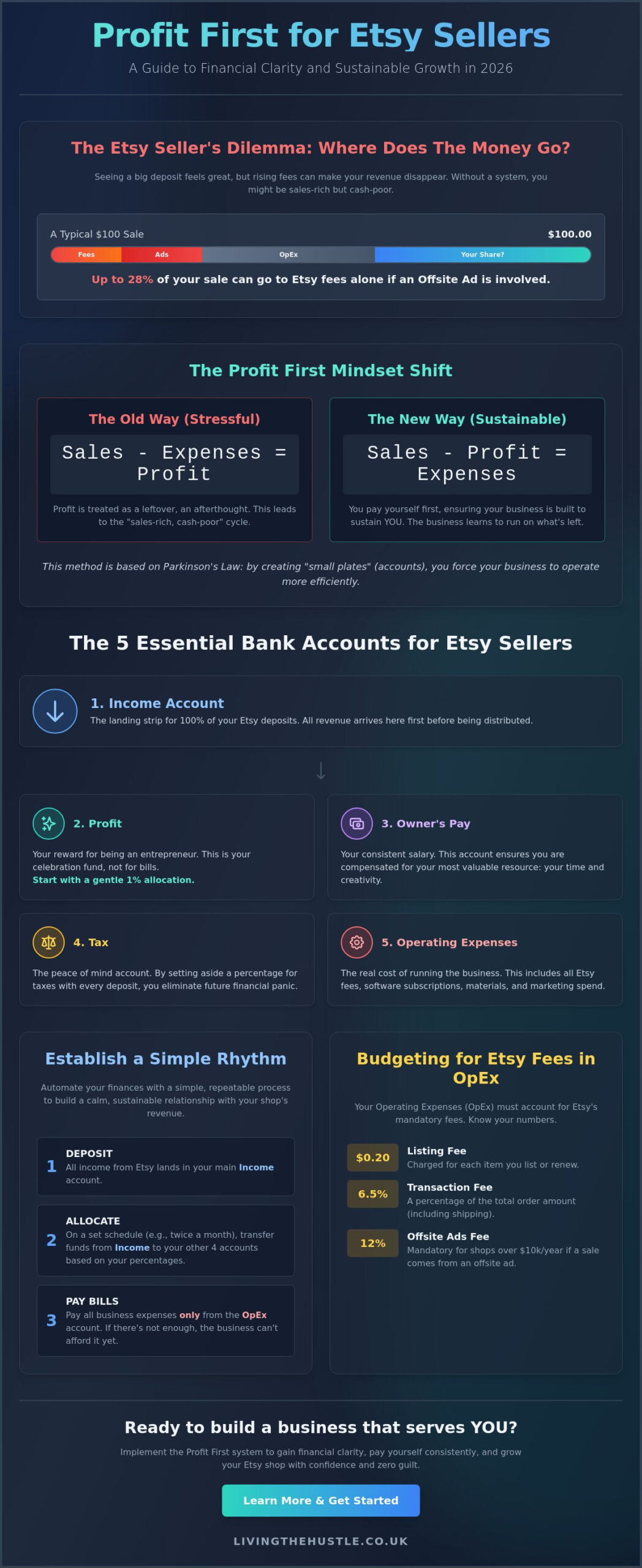
With Etsy taking approximately 10% to 13% of every sale in 2026, and up to 28% if offsite ads are involved, it's easy to feel like your revenue disappears before you even see it. You might find yourself wondering why your bank account looks so empty after a busy month of sales. Let's be honest; it's exhausting to feel like you're working for the platform instead of yourself. You deserve to feel confident that your 2026 taxes are covered and that your hard work translates into a real, consistent paycheck. Many sellers feel a sense of guilt when they try to pay themselves, but it doesn't have to be that way.
This guide to profit first for etsy sellers will show you how to transform your shop from a stressful side hustle into a sustainable business that actually serves your life. You'll learn how to implement the Profit First methodology in a way that feels gentle and manageable, even if you aren't a numbers person. We're going to walk through a clear, calm plan to ensure you get paid every single month while keeping your business bank account organized and your future secure. It's time to create a business with purpose, not panic.
Key Takeaways
- Shift your financial mindset from traditional accounting to the “Sales – Profit = Expenses” formula to ensure you always get paid first.
- Identify the five essential bank accounts every creative needs to manage income, taxes, and operating costs without the end-of-month panic.
- Learn how to implement profit first for etsy sellers by starting with a gentle 1% allocation to your new profit account.
- Establish a simple “Cap and Transfer” rhythm to automate your finances and build a calm, sustainable relationship with your shop's revenue.
- Discover how to reinvest your savings into growth tools that help you scale your business with total confidence and zero guilt.
Why Your Etsy Shop Needs the Profit First Mindset in 2026
Many sellers start their journey with a simple, beautiful dream: creating something they love and getting paid for it. But by 2026, the reality of running a shop often feels like managing a complex puzzle of rising fees and shifting trends. Traditional accounting teaches us a formula that's actually quite stressful: Sales – Expenses = Profit. This formula treats your profit as a “leftover” or an afterthought. When you implement the system created by Mike Michalowicz, author of Profit First, you flip that script entirely. By adopting profit first for etsy sellers, you prioritize your own financial health using a new formula: Sales – Profit = Expenses.
Taking your profit first isn't about being greedy; it's about building a business that lasts. When you set aside money for your paycheck and your taxes the moment a deposit hits your account, you eliminate that heavy sense of panic that usually arrives at the end of the month. This methodical, gentle approach directly supports a passive income lifestyle. It ensures your business serves your life and your bank account, rather than you serving the hustle every waking hour. With the creator economy valued at over $250 billion, there's plenty of room for you to succeed, but only if you keep what you earn.
Etsy is a high-volume world where digital downloads or small handmade items often sell for $10 to $25. These low-ticket sales can easily mask poor margins. With Etsy taking between 10% and 13% of a typical sale, or even up to 28% if an offsite ad brought the customer to your shop, your revenue numbers can be deceiving. Without a profit-first mindset, you might find yourself in the top tier of sellers by volume while still feeling broke. This system gives you the clarity to see exactly where your money is going.
Breaking the ‘Sales-Rich, Cash-Poor' Cycle
Seeing a notification for a $500 deposit feels amazing. However, the psychological trap of that “big” number often leads to overspending on new software, fonts, or clipart before realizing that half of that money is already owed to the government or Etsy. Moving from a hobbyist mindset to a confident business owner means acknowledging that revenue is vanity, but profit is sanity. You don't necessarily need “more sales” to be profitable; you need a system that captures the value of the sales you already have.
The Core Philosophy: Parkinson’s Law and Your Business
Parkinson's Law suggests that humans naturally consume whatever resource is available to them. If you have $2,000 sitting in one big business account, your “shop's appetite” will naturally find a way to spend $2,000 on “necessities.” By using “small plates” or separate accounts for profit, taxes, and owner's pay, you force your business to operate more efficiently on the smaller portion that remains for expenses. This gentle boundary protects your hard-earned money from being swallowed by unnecessary overhead. Taking your profit first ensures that your shop remains a source of joy and financial freedom rather than a source of constant overwhelm.
The 5 Essential Accounts for Every Etsy Seller
Once you've embraced the mindset of putting your profit first, it's time to build the physical structure that makes it happen. You don't need a degree in accounting to master profit first for etsy sellers; you just need five specific “buckets” for your money. These separate accounts act as a GPS for your business, showing you exactly how much you can afford to spend without touching your personal paycheck or the money you owe the government. Setting this up is a gentle first step that replaces the overwhelm of a single, messy bank balance with total clarity.
- Income: This is the landing strip for all your Etsy deposits. Every cent from your sales arrives here first before being distributed to other accounts.
- Profit: Your celebration fund. This is a small percentage of every sale that rewards your bravery for being an entrepreneur. It's not for bills; it's for you.
- Owner’s Pay: This is your salary. Your time is your most valuable resource, and this account ensures you get paid for the hours you spend designing and managing your shop.
- Tax: The peace of mind account. By setting aside a percentage for the taxman now, you'll never have to scramble when it's time to file your 2026 return.
- Operating Expenses (OpEx): This is what the business actually costs to run. If there isn't enough in here to cover a new tool, it means the business can't afford it yet.
Integrating Etsy Fees into Your OpEx
In 2026, Etsy’s fee structure is a significant part of your OpEx. You must account for the $0.20 listing fee and the 6.5% transaction fee on every order. If your shop has crossed the $10,000 threshold in the past year, you also have a mandatory 12% offsite ads fee to consider. Using Etsy SEO tools like eRank is a smart investment, but it must be budgeted within this OpEx bucket. By separating these costs, you can see if your marketing spend is actually sustainable or if it's eating into your owner's pay.
Digital Product Advantages: The OpEx Lean Factor
Digital sellers have a massive advantage because their OpEx is naturally much lower. You don't have to worry about the cost of raw materials, shipping supplies, or physical inventory storage. This lean structure allows you to allocate a much higher percentage to your Owner's Pay and Profit accounts. If you're ready to build a shop that sells while you sleep, the Passive Income Society can help you scale these high-margin products with confidence. When your expenses are low, your financial freedom grows faster. It's about working smarter, not just harder, to ensure your hustle remains calm and profitable.
Calculating Your Ideal Percentages: Digital vs. Physical Products
Once your accounts are open, you need a map to guide your money. In the world of profit first for etsy sellers, these maps are called Target Allocation Percentages (TAPs). Think of TAPs as your financial North Star. They represent where you want your business to be when it's running at peak health. If you feel overwhelmed, don't worry. You don't have to hit these numbers today. The goal is to start with a gentle approach, perhaps allocating just 1% to your Profit account, and gradually adjusting your percentages as your shop grows more efficient.
Before you set your targets, perform an “Instant Assessment.” Look at your Etsy CSV files from the last 12 months. Where did the money actually go? Most sellers find that their Operating Expenses are much higher than they realized, often swallowing 60% or 70% of their revenue. You also need to account for your local tax obligations. With 2026 federal tax brackets starting at 10% for income up to $12,400 and jumping to 12% after that, setting aside 15% for taxes is a safe, calm starting point for many US-based creators. If you have an economic nexus in states like California or Texas, you'll also need to ensure your “Tax” bucket accounts for those specific sales tax responsibilities.
The Digital Seller Blueprint (High Margin)
Digital creators enjoy a unique advantage because their overhead is remarkably low. A healthy digital shop might aim for 50% Owner's Pay, 15% Tax, 5% Profit, and 30% OpEx. Because you aren't buying wood, clay, or shipping mailers, your main risk is “shiny object syndrome.” It's tempting to subscribe to every new AI tool or graphic bundle that hits the market. To protect your margins, focus on creating premium assets that stand out. Learning the art of design allows you to justify higher price points, which keeps your Owner's Pay account full and your hustle sustainable.
The Physical Product Blueprint (Lower Margin)
If you sell physical goods, your OpEx bucket has more work to do. You might aim for 35% Owner's Pay, 15% Tax, 5% Profit, and 45% OpEx. This larger expense slice must cover your Cost of Goods Sold (COGS), including raw materials and packaging. It's vital to track these costs closely so they don't bleed into your personal salary. If you find that your margins are consistently tight, consider adding digital “add-ons” to your shop. Transitioning part of your catalog to digital downloads can significantly improve your overall profit first for etsy sellers ratios, giving you more breathing room and a calmer bank account.
Step-by-Step: Implementing Profit First Without the Overwhelm
Ready to stop the financial guesswork? Implementing profit first for etsy sellers doesn't have to be a source of stress. You can start exactly where you are today with a few gentle steps. The goal isn't perfection; it's consistency. By creating a rhythm for your money, you're telling your business that you're in charge, not the other way around. Let's walk through this manageable path together.
Step 1: Open your accounts. You don't need five different banks. Most modern online banking apps allow you to create digital “buckets” or “pots” within a single business account. Step 2: Determine your ‘Cap and Transfer' dates. Many successful sellers use the 10th and 25th of each month. This aligns well with Etsy's 2026 payout schedules and helps you avoid checking your balance every day. Step 3: Transfer your percentages. When those dates arrive, move the money from your Income account into your Profit, Tax, Owner's Pay, and OpEx accounts based on the TAPs we discussed earlier. Step 4: Pay your bills only from the OpEx account. If your Canva subscription or eRank fee is due, the money must come from this specific bucket. Step 5: Review and adjust your percentages every quarter. Every 90 days, check your progress and see if you can nudge your profit percentage up by another 1%.
Overcoming the ‘Too Many Accounts' Anxiety
It's completely normal to feel a bit of resistance when thinking about managing five separate accounts. However, you don't need a traditional brick-and-mortar bank to make this work. In fact, digital-first banks are often better suited for the profit first for etsy sellers system because they offer flexible sub-accounts. If you're still in the beginning stages, following a calm guide to Etsy shop setup can help you integrate these financial habits from day one. Keeping your structure simple allows you to focus on creating rather than calculating. It's about building a foundation that supports your creativity instead of stifling it.
Handling the ‘Dry Months' with Grace
Etsy sales naturally fluctuate. You might have a record-breaking holiday season followed by a quieter January. When sales dip, the temptation to skip your transfers is high. Don't do it. Maintaining the habit is more important than the amount. Even if you only transfer $10 into your profit account, you're reinforcing the mindset that profit comes first. If things get truly tight, you can use your Profit account as a temporary safety net, but treat it as a loan to be repaid. This approach keeps you calm and in control, even when the algorithm isn't in your favor. If you're looking for a way to organize your shop's growth alongside these new habits, the Blog, Brand & Bloom Workbook is a wonderful resource to help you build with purpose.
Scaling Your Etsy Business with a Sustainable Financial Flow
Scaling your shop often feels like a high-pressure race to the top. But when you use profit first for etsy sellers, scaling becomes a methodical, calm progression. Instead of guessing if you can afford to double your ad spend, you simply look at your OpEx account. This financial clarity gives you the confidence to invest in your business's future without the late-night worry. You're no longer just a creator with a hobby; you're a CEO building a sustainable brand with a clear vision.
As your shop grows, your Operating Expenses account becomes a powerful engine for growth. By 2026, the marketplace is more competitive than ever, making the right technology essential for staying ahead. You can use your OpEx savings to fund the best Etsy seller tools for 2026. These tools help automate your workflow, allowing you to transition from a solopreneur doing everything to a business owner who oversees a system that runs itself. This shift is how you move away from the “hustle” and toward a life of purpose and peace.
Investing in Your Future Self
Your Profit account isn't just for a rainy day. It's also your celebration and education fund. While it's important to reward yourself for your bravery, you can also use these funds to sharpen your skills and expand your reach. The Passive Income Society is a perfect example of an investment that pays dividends by helping you move away from trading your limited hours for money. Financial clarity is the ultimate form of self-care for creators. When you know your numbers, you give yourself the gift of a quiet mind and a secure future.
Your Gentle Next Step
You've already taken the hardest step by deciding to change your relationship with money. Now, it's time to start your digital hustle with confidence and grace. If you need a companion to help you refine your branding and growth strategy, the Blog, Brand & Bloom Workbook provides a clear, unhurried path forward. Implementing profit first for etsy sellers is your gentle first step toward true financial freedom. You don't have to do this alone. Join a community that values calm over chaos and sustainability over burnout. Let's build something beautiful together that serves your life for years to come.
Embrace Your Financial Freedom Today
You've taken a huge step toward a more peaceful business life today. By flipping the traditional accounting formula and setting up your five essential accounts, you're choosing a business that serves your life rather than one that consumes it. Remember that implementing profit first for etsy sellers is a journey, not a sprint. Start with that gentle 1% profit allocation. Watch your confidence grow as your bank account finally reflects your hard work. You now have the tools to handle 2026 taxes and fees without the panic that used to cloud your creativity.
Ready to build a profitable, calm Etsy business? Join the Passive Income Society today! Our program offers step-by-step guidance for total beginners and focuses on sustainable, passive income models that actually work. You'll gain access to a nurturing community of creative entrepreneurs who are all building shops with purpose. You don't have to walk this path alone. Let's build a shop that brings you genuine joy and long-term security. You've got this!
Frequently Asked Questions
Is Profit First really worth it for small Etsy shops with low sales?
Yes, starting profit first for etsy sellers is absolutely worth it even if your shop currently makes less than $500 a month. By establishing these habits early, you ensure your business remains sustainable as you scale. If you can't manage $100 effectively, managing $10,000 will feel like a nightmare. Start with just 1% for profit to build your confidence and create a calm foundation for future growth.
Do I need five separate bank accounts for Profit First?
You don't need five separate bank accounts at a traditional brick and mortar bank to make this system work. Most modern digital banks in 2026 offer “pots” or “envelopes” that allow you to segment your money within one main business account. This keeps your accounting simple and prevents you from feeling overwhelmed by paperwork. The goal is to have clear visual boundaries so you don't accidentally spend your tax money.
How do I handle Etsy's automatic fee deductions within this system?
You should treat the actual deposit Etsy sends to your bank as your income for the purposes of this system. Since Etsy automatically deducts their 6.5% transaction fee and $0.25 payment processing fee before paying you, those costs are already handled. You only need to allocate the money that actually arrives in your bank account. This simplifies the process and ensures you're working with real, available cash.
What should I do if my Operating Expenses are higher than my OpEx account balance?
If your OpEx account is empty but the bills are still coming, it's a clear signal that your business overhead is too high. This is the moment of truth where you must look at your subscriptions and material costs. Instead of pulling from your Profit or Tax accounts, look for ways to trim your expenses by at least 10%. This discipline ensures your shop remains a profitable business rather than an expensive hobby.
How often should I transfer money between my Profit First accounts?
Transferring money twice a month, typically on the 10th and 25th, is the best way to maintain a calm rhythm. This frequency allows you to see the cumulative impact of your sales without the stress of daily bookkeeping. By batching your transfers, you save time and can clearly see how your percentages are performing. Consistency is the key to making profit first for etsy sellers a permanent part of your success.
Can I use Profit First if I sell both digital and physical products on Etsy?
You can certainly use this method for a mixed model shop by creating a blended percentage for your allocations. If 70% of your sales are digital, you can afford a higher Owner's Pay percentage than a shop selling only physical goods. Perform an assessment of your total margins every quarter to ensure your targets reflect your current product mix. This flexibility allows your financial system to grow and change alongside your creative vision.
What is the best bank for Etsy sellers using the Profit First method?
The best bank is any digital first institution that allows you to create multiple sub accounts with no monthly fees. In 2026, many creative entrepreneurs prefer banks that offer automated round ups or easy to use digital buckets. Look for a bank that integrates with your accounting software to keep your workflow unhurried. The right bank should make your financial life feel lighter and more organized, not more complicated or restrictive.
How do I pay myself a consistent salary if my Etsy income fluctuates?
You can achieve a consistent salary by leaving a drip of funds in your Owner's Pay account during high income months. If you have a massive holiday season, don't take it all at once. Instead, keep the extra in your account to cover your pay during the quieter summer months. This buffer creates a reliable paycheck and eliminates the feast or famine anxiety that many Etsy sellers face throughout the year.