

What if you didn't need to be an artist to build a thriving shop on a platform famous for handmade art? You might feel like an imposter when you browse Etsy and see intricate jewelry or hand-painted canvases. It's natural to worry about wasting your time on products that won't sell simply because you can't draw a straight line. If you've been wondering how to start an etsy shop when you're not creative, you are in exactly the right place. Creativity in 2026 is less about being a master painter and more about being a smart, logical problem solver.
This guide will show you how to build a profitable business using your analytical strengths and a few clever tools. You don't need to master complex software or handle messy physical inventory to see results. We'll walk through a simple, repeatable workflow that replaces technical overwhelm with clarity. From using AI-powered research tools to selecting high-demand digital products like planners or templates, you'll gain the confidence to launch a side hustle that respects your time and your peace of mind. Success is achievable without sacrificing your well-being, and we are here to help you find that manageable path forward.
Key Takeaways
- Reframe your perspective on what it means to be “creative” by focusing on data-driven problem solving instead of traditional art.
- Identify specific types of digital products that allow you to build a successful shop without ever needing to draw or craft by hand.
- Learn exactly how to start an etsy shop when you're not creative using a simple tech stack that handles the design and market research for you.
- Follow a gentle, step-by-step method to reverse-engineer your shop setup, ensuring you choose a profitable niche from day one.
- Discover how to build a repeatable digital system that creates sustainable passive income while protecting your energy and peace of mind.
The Myth of the ‘Creative' Etsy Seller
Do you believe that Etsy is only for painters, potters, and people who spent their childhoods in craft stores? That's a common misconception that keeps many brilliant minds on the sidelines. In reality, the most successful shops in 2026 aren't always run by “starving artists.” They are run by problem solvers. If you've been wondering how to start an etsy shop when you're not creative, it's time to reframe your definition of creativity. Selling on this platform is often more about data-driven decisions than it is about artistic flair.
We are living in the year of tool-assisted entrepreneurship. You don't need to draw a single line to build a beautiful brand. Instead, you can embrace the concept of “Curated Creativity.” This means you are an assembler rather than a creator from scratch. You find high-quality elements, use smart software to arrange them, and solve a specific need for a customer. It's a peaceful, methodical process that relies on your ability to spot a gap in the market and fill it with a functional solution.
Understanding Etsy's business model helps you see that the platform thrives on variety. It's a massive search engine where millions of people look for solutions to their problems. When you view the marketplace through this lens, the pressure to be “artistic” simply melts away. You aren't building an art gallery; you're building a helpful resource for people who need specific tools to make their own lives easier.
Why Your ‘Left Brain' is Your Secret Weapon
Your logical mind is actually a massive competitive advantage. While a traditional artist might wait for “inspiration” to strike, you can rely on systems and consistency. Logical thinkers excel at the technical side of the business, such as search engine optimization and market research. You can use tools like eRank for Etsy sellers to see exactly what shoppers are searching for right now. This turns your shop into a laboratory. You aren't guessing what people want; you're testing ideas based on real data. In the world of e-commerce, a repeatable system beats a burst of inspiration every single time.
Etsy is No Longer Just for Handmade Crafts
The marketplace has seen a huge shift toward digital downloads and utility-based products. Customers often value “functional” over “pretty” in many popular niches. You don't need to knit a scarf when you can sell a budget tracker, a moving house checklist, or a set of professional email templates. These “boring” products are some of the most consistent sellers because they solve a direct pain point for the buyer. When you focus on utility, you are selling a result. That result is far more valuable to a busy customer than a hand-painted trinket, and it requires zero traditional “creative” talent to produce.
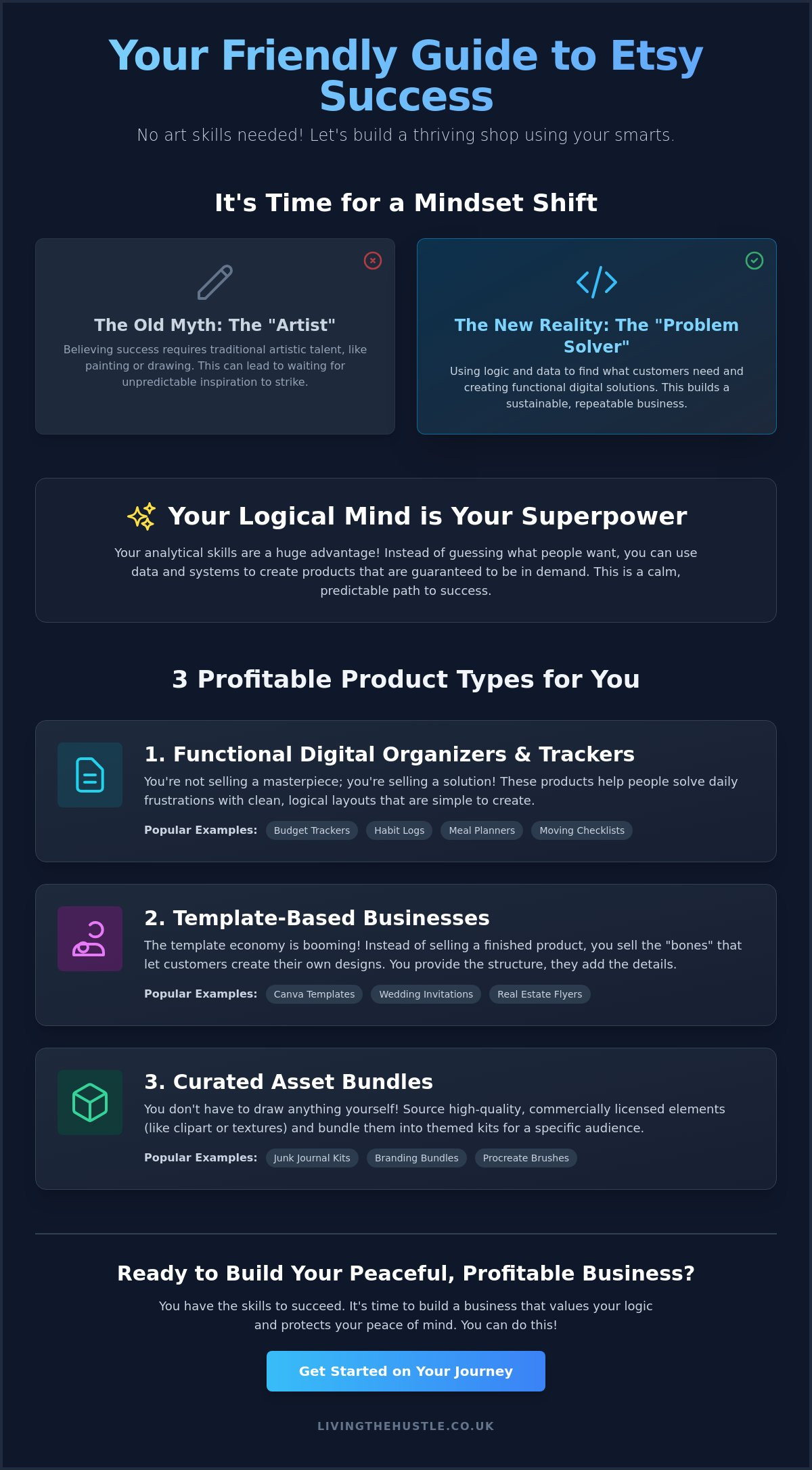
3 Profitable Product Types for Non-Creatives
If you're still feeling stuck on how to start an etsy shop when you're not creative, the secret lies in choosing the right product category. You don't need to be a master illustrator to succeed. You just need to be an organizer who arranges information in a way that helps others. While many guides tell you to follow your passion, the most sustainable shops often follow the data instead. In 2026, customers are looking for utility and ease. Here are three categories where your logical mind will shine.
You can use a step-by-step guide to setting up your shop to handle the technical logistics like banking and listings. Once the foundation is set, you can focus on creating products that solve specific problems. This approach is much more predictable than hoping someone falls in love with a piece of abstract art.
Functional Digital Organisers and Trackers
Simple is often better. Shoppers aren't always looking for a masterpiece; they're looking for a tool that works. Budget trackers, habit logs, and meal planners are incredibly popular because they solve a daily frustration. You don't need complex graphics for these. You need a clean, logical layout that makes sense to the user. A gold standard for this approach is the Calm Creators Content Planner, which prioritizes utility and ease of use over complicated design elements. Focus on the flow of the information, and the sales will follow.
Template-Based Businesses
The template economy is booming. Instead of selling a finished design, you sell the bones that allow customers to finish it themselves. Think of editable Canva templates for real estate agents or wedding invitation layouts. These products are high-value because they save the customer time. You provide the structure, and they add their own details. If you want to learn more about this model, the Template Creators Society provides excellent guidance on building and scaling a digital business without needing an art degree. It's about creating a fill-in-the-blank solution for a busy audience.
Curated Asset Bundles
You can also build a shop by curating high-quality elements you didn't draw yourself. This involves sourcing public domain assets or purchasing commercial licenses for clipart and textures. You bundle these into themed kits, such as junk journal sets or branding bundles. It’s about having a good eye for what looks cohesive together rather than creating the individual pieces. For a deeper look into this niche, Clipart Shop Profits can help you navigate the licensing and marketing aspects safely. This is a great way to start your journey toward a peaceful side hustle. If you're ready to take the next step, the Passive Income Society Course offers a clear path to making this a reality.
The Non-Designer's Tech Stack for 2026
Why struggle with complex software when you can use tools built for simplicity? Many beginners feel intimidated by professional design programs that require years of training. In 2026, the barrier to entry has vanished. Learning how to start an etsy shop when you're not creative often comes down to the quality of your toolkit. By choosing accessible, smart software, you can build a professional presence without the steep learning curve. A simple tech stack doesn't just save you time; it creates a peaceful productivity that keeps you from feeling overwhelmed.
Your workflow should feel like a supportive system, not a source of stress. Instead of staring at a blank canvas, you can use tools that provide the structure for you. This approach allows you to focus on the logical side of your business. You aren't guessing what might look good or what might sell. You are using data and pre-built frameworks to ensure every product you list has a purpose. This is the foundation of a sustainable side hustle that respects your energy.
Mastering Canva Without an Art Degree
Canva is the ultimate equaliser for anyone who feels “design-challenged.” It provides professional alignment and spacing through pre-made layouts, so you never have to worry about your product looking amateur. For non-designers, the best strategy is often the “Minimalist” hack. Less is almost always more. By using clean fonts and plenty of white space, you create products that feel modern and trustworthy. If you want to bridge the gap between being a beginner and a pro, The Art of Design is a wonderful resource to help you create products that truly stand out with ease.
Data-Driven Research with eRank
Data doesn't lie. While others are guessing what might be popular, you can use eRank to know for sure. This tool allows you to find “low competition, high demand” niches in just a few minutes. It turns the creative process into a logical search for gaps in the market. When the numbers tell you exactly what to create next, the fear of wasting your time disappears. You can follow a clear, eRank for Etsy Sellers guide to set everything up correctly. This data-driven approach ensures your shop feels like a successful laboratory rather than a high-pressure art project.
AI also plays a quiet, supportive role in 2026. Rather than just generating images, use it as a brainstorming partner. It can help you write product descriptions, generate keywords, or suggest layout ideas when you're feeling stuck. This tool-assisted entrepreneurship allows you to maintain a calm, methodical rhythm while your shop grows in the background.
Step-by-Step: Setting Up Your Shop Calmly
Setting up your storefront should be a peaceful experience, not a frantic race. Most people start by obsessing over a shop name, but that is actually one of the last steps you should take. If you want to know how to start an etsy shop when you're not creative, you need to reverse-engineer the process. You start with the problem you are solving, find the people who have that problem, and then build the shop around that solution. This methodical approach removes the pressure to “be artistic” and replaces it with a clear, logical plan. It's about being a guide for your customers, not a performer.
Choosing a Niche That Doesn't Require Drawing
Your niche is simply a specific group of people with a specific need. Instead of thinking about what you can draw, think about what you can organize. Are there hobbies or professions that involve a lot of paperwork or planning? Real estate agents need client checklists. Gardeners need seed-starting logs. You can validate these ideas using the eRank ‘Keyword Explorer' tool to see exactly how many people are searching for these terms each month. Once you've found your gap, you can follow this How to Set Up an Etsy Shop in 2026 guide for the technical logistics. It walks you through the banking and tax details without the stress.
Branding for the Non-Artist
You don't need a complex mascot or a hand-drawn illustration for your logo. In fact, a simple, text-based logo often feels more professional and trustworthy to a modern audience. Use a clean serif or sans-serif font and a palette of “calm” colors like sage green, soft terracotta, or slate blue. These tones build immediate buyer trust because they feel grounded and mature. You want your shop to look like a reliable resource. For a boost of visual inspiration, check out the Etsy Shop Branding 101 pillar to see how minimalist design can do the heavy lifting for you.
When you write your first product description, focus entirely on the benefit. Don't just list the features like “10 pages” or “PDF format.” Explain how this product will save the customer time or reduce their daily stress. Your first 30 days should be about learning and listing, not perfection. If you're looking for a complete, supportive roadmap to guide you through this journey from start to finish, the Passive Income Society Course is designed to help you grow at your own pace without the burnout. Success is a slow build, and you have plenty of time to get it right.
Scaling to Passive Income Without the Burnout
Building a successful shop isn't a sprint. It's a journey toward a peaceful and sustainable lifestyle. Once you've learned how to start an etsy shop when you're not creative, the next step is to move away from trading your time for money. You want to transition from making individual sales to creating a repeatable digital system. This is where the “Calm Hustle” philosophy comes in. It's about building slow but building strong, ensuring your business supports your life rather than consuming it. This tranquil growth allows you to enjoy the journey as much as the destination.
One of the best ways to protect your energy is through automation. You can set up clear FAQs and automated messages to handle common customer questions. This allows you to step away from your screen without worrying about your shop's reputation. When you provide clear instructions within your digital downloads, you empower your customers to help themselves. This creates a smoother experience for them and a much quieter inbox for you. By removing the need for constant manual intervention, you create a manageable side project that grows while you rest.
The Power of the Digital Product Ecosystem
Your first product is just the beginning. A single, high-utility tracker can naturally lead to a whole suite of related items. If you created a budget tracker, your customers might also need a debt payoff planner or a savings goal sheet. You can use customer feedback to “design” your next bestseller. Listen to what they are asking for, and then use your logical mind to build the solution. To see how this system has worked for others, you can read the Passive Income Society Review. It's inspiring to see how a simple, data-driven approach can turn into a flourishing ecosystem that provides consistent value.
Next Steps: Your 7-Day Action Plan
If you're feeling ready to begin, don't let perfectionism stop you. Your logical brain is your greatest asset in this process. Here is a low-stress growth plan to get you started over the next week:
- Day 1-2: Niche research. Use the tools we've discussed to find a gap in the market that needs a logical, step-by-step solution.
- Day 3-5: First product creation. Keep it simple. Use a clean, minimalist layout and focus entirely on solving a single customer problem.
- Day 6-7: Shop launch. Set up your basic branding and open your doors. Remember, done is better than perfect.
You don't have to do this alone. Joining a supportive community of like-minded sellers can provide the encouragement you need when things feel new. Your analytical skills are exactly what the marketplace needs in 2026. Trust your ability to solve problems, take it one step at a time, and enjoy the process of building something that brings you both profit and peace. You have everything you need to start this journey with confidence.
Begin Your Journey Toward Peaceful Profit
Success on Etsy doesn't require a paintbrush; it requires a plan. You now have the tools to turn your logical mind into a source of sustainable growth. By reframing creativity as data-driven problem solving and using a simple tech stack, you can build a storefront that thrives while you rest. Remember that building slow is building strong. Your analytical strengths are exactly what you need to create a manageable side project that respects your well-being. It is entirely possible to find tranquility in your productivity.
If you're ready for more support, we'd love to help you take the next step. You can join the Passive Income Society and start your calm Etsy journey today. We have taught over 1,000 students how to build successful shops with a specialist focus on digital products. Our step-by-step guidance is designed for absolute beginners who want to skip the overwhelm. Learning how to start an etsy shop when you're not creative is much easier when you have an experienced guide by your side. You have the skills, you have the tools, and now you have the path. We can't wait to see what you build.
Frequently Asked Questions
Can I really sell on Etsy if I can't draw?
Yes, you absolutely can sell on Etsy without being an artist. Many of the most successful shops focus on functional items like planners, checklists, and templates rather than hand-drawn art. Success is about identifying a customer’s pain point and providing a logical, clean solution. By focusing on utility, you are selling a result that helps someone organize their life. This approach requires zero traditional drawing talent. It's a great way to learn how to start an etsy shop when you're not creative.
What are the best digital products for beginners with no design skills?
The best products for beginners include budget trackers, habit logs, and simple checklists. These items rely on a clear layout and logical structure rather than complex graphics. You can also create text-based digital downloads like professional email templates or resumes. These high-utility products are always in demand because they solve specific problems for busy people. They remain very easy to design using basic tools and pre-made frameworks.
Do I need expensive software like Adobe Illustrator?
You don't need expensive or complicated software to build a thriving business. Canva has become the industry standard for non-designers because it provides professional layouts and alignment tools for free or a small monthly fee. It removes the steep learning curve of programs like Adobe Illustrator. This allows you to focus on your shop’s growth and your own peace of mind instead of technical frustration. Simple tools lead to a much calmer workflow.
How much does it cost to start an Etsy shop in 2026?
Starting a shop is very affordable, as it only costs $0.20 to create a new listing. When you make a sale, Etsy charges a 6.5% transaction fee on the total order amount. For US sellers, there is also a payment processing fee of 3% plus $0.25 per transaction. These low entry costs make it a gentle way to test your product ideas without a large financial risk. You can grow your presence at your own pace.
Is the digital product market on Etsy too saturated?
The market isn't too saturated for those who use data to find a specific niche. Etsy has over 92 million active shoppers looking for unique solutions to their problems. By using research tools to find low-competition keywords, you can stand out easily. Success comes from being a specialist who solves a particular need rather than a generalist trying to sell to everyone. There is always room for a shop that provides genuine value.
How do I protect my digital products from being copied?
You can protect your work by including a clear “Terms of Use” document with every purchase. It's also helpful to flatten your digital files so the individual elements cannot be easily extracted by others. While you can't prevent every copycat, building a trustworthy brand and a loyal community is your best defense. Focus on your own journey and providing consistent value to your customers to stay ahead of the competition.
How long does it take to see your first sale as a non-creative?
Many sellers see their first sale within the first 30 to 60 days, though this depends on your niche and SEO. If you use a data-driven approach to choose your products, you often see results much faster than those who guess. Treat your first month as a calm learning phase. Consistency and small, daily improvements will lead to that first notification on your phone. Patience is a key part of the process.
Can I use AI to help me start my Etsy shop?
Yes, AI is a powerful partner for brainstorming and administrative tasks. In May 2026, Etsy launched an app in ChatGPT to help shoppers find items, showing how important this tech has become for discovery. You can use AI to help you write product descriptions, generate search tags, or brainstorm new product ideas. This tool-assisted approach helps you maintain a manageable workflow. It's a smart strategy for how to start an etsy shop when you're not creative.