

What if the secret to reaching your dream customers wasn't about mastering a complex computer algorithm, but simply using the right etsy titles and tags examples to speak their language with clarity? You've likely felt the frustration of pouring your soul into a digital product only to feel invisible in a crowded marketplace. It's exhausting to watch low traffic numbers while you wonder if you're just “stuffing” keywords into a box that no one actually reads.
I want to help you replace that stress with a sense of calm and control. In this guide, I'll show you how to transform confusion into confidence with strategies designed for the 2026 marketplace. You'll learn to get your digital products found naturally, so you can spend less time stressing over data and more time doing what you love: creating. We'll explore the recent shift toward natural language, look at real-world examples for digital sellers, and break down the simple steps to help your shop bloom.
Key Takeaways
- Understand why the 2026 algorithm favors readability over keyword stuffing and how to master the most valuable real estate in your shop.
- See how real-world etsy titles and tags examples for digital products can help you bridge the gap between your creativity and your customer's needs.
- Learn the “Five Ws” of tagging to ensure you're using all 13 slots to speak directly to the right buyers.
- Discover a gentle approach to shop optimization that focuses on steady progress and manageable daily habits instead of technical overwhelm.
Why Etsy Titles and Tags are the Foundation of Your Calm Business
Think of Etsy SEO as a gentle bridge. On one side, you have your beautiful digital creations. On the other, you have a person looking for exactly what you've made. Titles and tags are the signals that help them cross that bridge. Since Etsy updated its algorithm in early 2026, the focus has shifted toward clarity and buyer intent. It's no longer about tricking a system. It's about being helpful. When your titles and tags work in harmony, they tell the search engine precisely who your product is for. This creates search relevancy, which is the heartbeat of a shop that grows while you rest.
Your shop's success depends on how well you communicate. Titles and tags aren't just technical boxes. They are the language of connection. When you use the right etsy titles and tags examples, you're telling a story to both the shopper and the search engine. This alignment builds trust before a customer even clicks your listing. It transforms your shop from a hidden gem into a visible solution for your dream buyers.
The Shift from Keyword Stuffing to Buyer Clarity
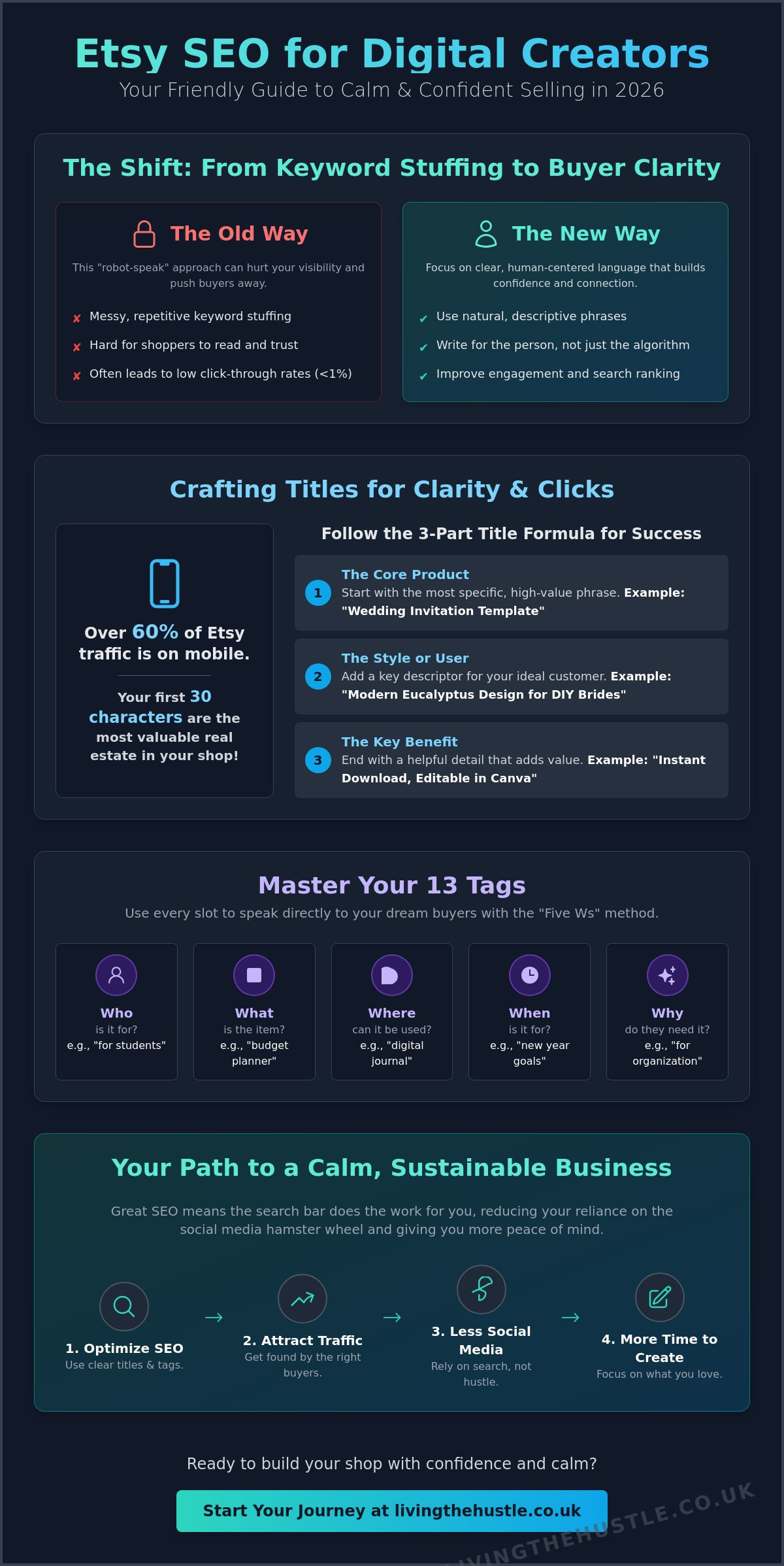
For years, sellers were told to pack their titles with every possible word. In 2026, that “robot-speak” actually hurts you. Listings with a click-through rate below 1% often struggle because their titles are messy and hard to read. Etsy's AI now understands the context of your words better than ever. It wants to see human-centered descriptions that build confidence. When a shopper sees a clear, descriptive title, they feel safe clicking. If you look at successful etsy titles and tags examples today, you'll see phrases that flow naturally. Long, repetitive strings of words are out. Clarity is the new currency for conversion. You don't need to shout to be heard; you just need to be clear.
The Passive Income Connection
Why does this matter for your peace of mind? High-quality SEO reduces your reliance on the social media hamster wheel. You don't need to post every hour when the search bar is doing the work for you. By following the Passive Income Society approach, you build a foundation that lasts. You can set your strategy and then step back to focus on your art. A well-optimized shop becomes a sustainable asset. It works in the background, attracting the right buyers while you enjoy your life. This isn't about working harder; it's about working with intention. When search relevancy is high, your shop attracts traffic consistently, allowing you to build a business that supports your lifestyle rather than draining your energy.
Crafting Etsy Titles: Formulas for Clarity and Conversion
Creating a title that works doesn't have to be a source of stress. The most effective way to approach this is through the Specifics-First formula. This means you lead with the most descriptive, high-value phrase that tells the customer exactly what they are buying. When you study high-performing etsy titles and tags examples, you'll see that successful sellers don't hide the core product at the end of a long sentence. They put it right at the beginning where it belongs. This clarity helps the shopper feel immediate confidence in your listing.
This is especially important because the first 30 characters are the most valuable real estate in your shop. Since over 60% of Etsy's traffic now comes from mobile devices, many shoppers will only see those first few words before deciding whether to click. If those words are clear and compelling, your click-through rate will rise. If they are buried under fluff or technical jargon, you might lose a sale before the customer even sees your beautiful design. Think of these first few words as a warm invitation to enter your shop.
Your goal is to balance broad seed keywords with specific long-tail phrases. A seed keyword like “planner” is often too competitive to help you stand out. A long-tail phrase like “minimalist budget planner for students” is a manageable path to success. Avoid the common mistake of repeating the same word five times in one title. Etsy's 2026 algorithm is smart enough to know what you're selling without you saying “planner” over and over. When you use these etsy titles and tags examples as a template, you can create listings that feel professional and approachable. It's also best to keep punctuation simple; stick to commas or pipes to separate your thoughts so your title looks clean and calm.
The 3-Part Title Formula for Digital Products
To make this process easy and repeatable, you can follow this simple three-part structure for your listings:
- Part 1: The Core Product. Start with the main item, such as “Wedding Invitation Template.”
- Part 2: The Style or User. Add a descriptor like “Modern Eucalyptus Design for DIY Brides.”
- Part 3: The Key Benefit. End with a helpful detail like “Instant Download and Editable in Canva.”
Why Readability is the New SEO
In the broader world of e-commerce marketing, user experience is everything. Etsy's algorithm now prioritizes buyer engagement signals like clicks and favorites. If your title is a wall of text that's hard to scan, shoppers will keep scrolling. Writing for the person behind the screen is the best way to improve your search ranking. If you feel overwhelmed by the technical side of things, you might find more peace of mind using a structured guide like the Blog, Brand & Bloom Workbook to help you organize your thoughts and build your shop with confidence.
Mastering the 13 Tags: Reaching Your Ideal Customer
Have you ever left a few tag slots empty because you weren't sure what else to say? It's a common feeling, but those 13 slots are your best chance to tell Etsy's search engine exactly who should see your work. Every tag is a unique door to your shop. You want to open as many doors as possible to welcome different types of shoppers. When you look at effective etsy titles and tags examples, you'll notice they don't just repeat the same three words. They explore different angles to catch buyers at various stages of their search journey.
To fill your slots with intention, try the “Five Ws” framework. This simple method helps you think like a buyer instead of a seller:
- Who is this for? (e.g., “busy moms” or “college students”)
- What is it? (e.g., “digital planner” or “budget tracker”)
- Where will they use it? (e.g., “Goodnotes” or “iPad air”)
- When do they need it? (e.g., “back to school” or “new year”)
- Why do they want it? (e.g., “productivity gift” or “get organized”)
Finding the right balance between broad and niche tags is much easier with the right tools. You can use eRank for Etsy to identify low-competition phrases that still have high search volume. Broad tags like “planner” help you get seen by many, while niche tags like “adhd daily organizer” help you get seen by the right people. Using both ensures you're casting a wide net while still targeting the customers most likely to buy from you.
Brainstorming Your 13 Tags Like a Pro
Synonyms are your best friends when filling out your tags. A “gift for her” is also a “birthday present” or a “best friend gift.” For digital sellers, the “Materials” field is a hidden gem. While you don't have physical fabric or wood, you can tag the software your customers use. Using terms like “Canva template” or “Procreate brush” helps shoppers find products compatible with their favorite tools. This adds another layer of relevancy to your listing without extra effort.
Tagging Mistakes That Stall Your Growth
One of the biggest mistakes is using single-word tags like “digital.” These are far too competitive for most shops to rank for effectively. Instead, always use multi-word phrases. You also don't need to repeat keywords that are already in your title. Etsy's 2026 algorithm combines your title and tags to understand your listing, so repeating words just wastes valuable space. Finally, don't worry about misspellings. The current AI handles typos automatically. You can use that space for better etsy titles and tags examples that actually describe the value of your product.
Real-World Examples: Etsy Titles and Tags for Digital Products
Seeing how these strategies look in practice can turn a complicated task into a manageable project. Many sellers feel stuck because they don't know how to translate their creative vision into search terms. By looking at specific etsy titles and tags examples, you can begin to see the patterns that lead to success. In the 2026 marketplace, the most successful listings balance clarity for the human eye with the specific phrases the search engine needs to see. If your conversion rate is above 2.5-3%, it is a strong signal that your title and tags are perfectly aligned with what your buyers want.
Example: The Digital Budget Planner
Title: Digital Budget Planner for Goodnotes | iPad Finance Tracker | Monthly Budgeting Template, Instant Download
Tags: budgeting tool, money manager, ipad planner, finance tracker, goodnotes template, digital download, financial freedom, monthly expenses, debt tracker, savings goal, canva editable, minimalist planner, adulting gift
Analysis: This title works because it leads with the core product and identifies the specific software (Goodnotes) and device (iPad) right away. This builds immediate buyer confidence. The tags use the “Five Ws” to cover different search intents, from the “What” (monthly expenses) to the “Why” (financial freedom). It avoids repeating words unnecessarily and focuses on how the customer will actually use the product.
Example: Custom Clipart for Small Businesses
If you want to build a shop that sells year-round, you can use the specialized strategies found in Clip Art Shop Profits to refine your SEO. Clipart requires a unique approach because your buyers are often other creators.
Title: Watercolor Floral Clipart Set | Pink Peony Graphics for Branding | Commercial Use Digital Flowers
Tags: floral graphics, watercolor flowers, branding kit, logo elements, pink peonies, digital clipart, commercial use, invitation design, scrapbooking art, junk journal, planner stickers, botanical art, wedding clipart
Analysis: This example targets professional users by including “Commercial Use” in the title. The tags explore various niches like “junk journal” and “wedding clipart,” which helps the product show up in specific, low-competition searches. This variety ensures the listing isn't just relying on broad terms like “flowers.”
Example: Social Media Templates and Wall Art
For social media graphics, focus on the aesthetic and the end user. A title like “Instagram Aesthetic Templates for Coaches | Neutral Social Media Post Pack” tells a buyer exactly who it's for. For printable wall art, focus on the style and the room. A title such as “Modern Abstract Wall Art Printable | Neutral Tones Gallery Wall Decor” helps a shopper visualize the product in their own home. These etsy titles and tags examples show that when you write for the person, the search engine naturally follows. If you're ready to scale your creative business with ease, consider joining the Passive Income Society Course to master these strategies and more.
Optimizing Your Shop Without the Overwhelm
Does the thought of updating your entire shop feel like a mountain you aren't ready to climb? It's a common feeling for creative entrepreneurs who want to grow without losing their peace of mind. You don't have to fix every single listing in a single weekend to see results. A calm approach to optimization is much more sustainable for long-term success. Start by performing a quick SEO audit using your shop stats to identify listings with a click-through rate (CTR) below 1%. These are the specific items that need a little extra love in their titles or thumbnails. By focusing on just a few listings at a time, you can apply the etsy titles and tags examples we've discussed without feeling drained by the process.
The ‘One Listing a Day' rule is a wonderful way to build your empire with peace and ease. If you update just one product daily, you'll have an entirely refreshed shop in a few months. This steady progress creates a solid foundation for growth and allows you to see what's working in real-time. As your traffic begins to rise, you can connect your improved SEO to your overall shop identity. When your search terms match your visual style, you create a seamless experience that turns casual browsers into loyal customers. If you're feeling stuck on how to align your message with your look, the Blog, Brand & Bloom Workbook provides a manageable path to clarity and branding confidence.
Sustainable Growth vs. Burnout
Tracking your results is the best way to quiet the “what if” thoughts in your head. When you change a title, give it at least 30 days to gather data before making more tweaks. This patience is key to a peaceful strategy; it prevents you from making reactive changes based on short-term dips. You can stay organized and keep your creative energy high by using the Calm Creators Content Planner. It helps you map out your shop updates so you always know your next step. You're building a sustainable business, not a temporary project. There's no need to rush the process when you're moving in the right direction with intention.
The Path Forward to Financial Freedom
Transitioning from a hobby shop to a professional passive income business is a journey of small, intentional choices. You've already taken a huge step by learning how to use etsy titles and tags examples to improve your visibility in a crowded marketplace. This newfound traffic is the first spark of consistent revenue that allows you to spend more time creating. If you're looking for a deeper dive into scaling your digital product shop with a supportive community, I invite you to join the Passive Income Society. We provide the training and steps you need to turn your passion into a thriving reality. You have everything you need to succeed, and I'm so excited to see your shop bloom.
Your Path to a Peaceful and Profitable Shop
You now have a clear path to make your digital products shine in 2026. We've explored how clarity and buyer intent have replaced the old habits of keyword stuffing. By following the etsy titles and tags examples shared in this guide, you can build a shop that feels professional and approachable. Remember that success doesn't require a weekend of total exhaustion. It's built through small, daily choices that respect your time and your creativity.
Mastering your SEO is the first step toward a business that truly works for you. You've learned how to lead with specifics in your titles and how to fill all 13 tags using the “Five Ws” framework. This foundation allows you to step away from the screen with confidence. If you want step-by-step guidance for beginners and proven strategies for digital products, I'd love to help you grow with ease.
Ready to build your passive income empire? Join the Passive Income Society today!
You have the talent and the tools to create something beautiful. Take it one listing at a time and watch your shop bloom with peace and purpose.
Frequently Asked Questions
How many tags should I use on my Etsy listing?
You should use all 13 tags every single time to give your shop the best chance of being discovered. Etsy provides these slots as a way for you to describe your product from many different angles. Leaving even one slot empty is like closing a door to a potential customer. Using every tag helps you reach a wider variety of shoppers who might be searching for your creative work in different ways.
Can I use the same keywords in my title and my tags?
Yes, you can repeat your most important keywords, but you don't need to match them exactly word-for-word. Etsy’s algorithm is smart enough to combine the information from your title and your tags to understand what you're selling. It's often better to use your tags for synonyms or specific use cases that you didn't have room for in your title. This variety helps you show up in more diverse search results.
What is the best length for an Etsy title in 2026?
The best length for a title is one that stays under the 140-character limit while putting your most important descriptors in the first 30 characters. Since most shoppers are browsing on mobile devices, they often only see the beginning of your title. You want to make sure the core of your product is visible immediately. A title that is clear and easy to read will always perform better than one that feels cluttered.
Do I need to use commas or pipes in my Etsy titles?
You aren't required to use punctuation for the algorithm, but it's a wonderful way to help your human shoppers. Using pipes (|) or commas creates a visual break that makes your title much easier to scan. This small step can improve your click-through rate because it builds immediate confidence. When a buyer can quickly understand what you're offering, they're much more likely to click on your listing and explore your shop.
How often should I update my Etsy titles and tags?
You should wait at least 30 days before making new changes to a listing's SEO. It takes time for the search engine to gather data on how buyers are interacting with your updated words. If you change things too frequently, you might prevent your product from ever finding its rhythm in the search results. Patience is a key part of a calm business strategy. It allows you to make decisions based on real data rather than stress.
Does Etsy search look at my product descriptions for keywords?
Yes, Etsy's search engine considers the keywords you use within your product descriptions. While your titles and tags are still the most powerful factors, a well-written description adds helpful context for the algorithm. It's also a great place to speak directly to your customer's needs. Use natural, encouraging language in your description to explain the benefits of your digital product and how it will help the buyer in their own life.
Should I use plural or singular versions of my keywords in tags?
You only need to use one version because Etsy's search system automatically accounts for both singular and plural forms. If you use the tag “template,” your listing will still appear when someone searches for “templates.” This is great news because it saves you valuable space. You can use that extra room in your 13 tags to add entirely different descriptive phrases that help more people find your shop.
How do I find high-ranking keywords for my digital products?
You can find effective keywords by using the Etsy search bar's auto-suggest feature or by looking at successful etsy titles and tags examples in your specific niche. Pay attention to the phrases that describe the “Who, What, Where, When, and Why” of your product. Finding specific long-tail keywords that have a healthy amount of interest but less competition is a manageable way to grow. This approach helps you stand out without feeling overwhelmed by the technical side of SEO.