

What if the legal side of your creative business felt like a gentle breeze instead of a looming storm? You've likely spent hours perfecting your designs, only to feel paralyzed by the thought of HMRC letters or the technicalities of an etsy shop setup for digital products. It's completely normal to feel overwhelmed by legal jargon when you're just starting out. You want to build a sustainable side project, not a mountain of paperwork.
The good news is that staying compliant doesn't have to be stressful. This guide will give you total peace of mind by breaking down exactly what you need to do to protect your business in 2026. You deserve to feel confident that your shop is legally sound so you can focus on the joy of creating. We're here to simplify the process and remove the fear of the unknown.
We'll walk through the £1,000 trading allowance, explain the latest Etsy fee updates, and simplify the 2026 UK consumer protection laws. This article provides a clear, step-by-step roadmap to launch your shop with confidence and start your passive income journey on solid ground.
Key Takeaways
- Identify exactly when you need to register with HMRC by understanding the specific £1,000 trading allowance rules for the 2026 tax year.
- Choose between a sole trader or limited company structure with confidence, knowing which path supports your long-term peace of mind.
- Simplify your etsy shop setup for digital products by discovering how the platform manages VAT on your behalf to keep your workload light.
- Ensure your business is fully compliant with the latest UK consumer rights and data protection laws to protect both you and your customers.
- Follow a practical checklist to handle the final details, from checking UK trademarks to opening a dedicated business bank account for total financial clarity.
Hobby or Business? Understanding Your Legal Status with HMRC
Starting your creative journey often begins with a single spark of inspiration. Maybe you've designed a beautiful planner or a set of digital stickers. Now, you're wondering if this is just a fun weekend project or the start of something bigger. In the UK, the line between a hobby and a business isn't just about how much you love what you do. It's about your intent to make a profit. Getting your etsy shop setup for digital products feels much lighter when you understand these rules from the start.
Before diving into the technical details, it's helpful to look at an Etsy platform overview to see how millions of others have turned their passions into sustainable income. Thinking like a business owner early on doesn't mean adding more stress. It actually creates a foundation of peace. You aren't guessing; you're building with clarity. When you approach your shop with the intent to profit, you're giving your creativity the space it needs to flourish.
The £1,000 Trading Allowance Explained
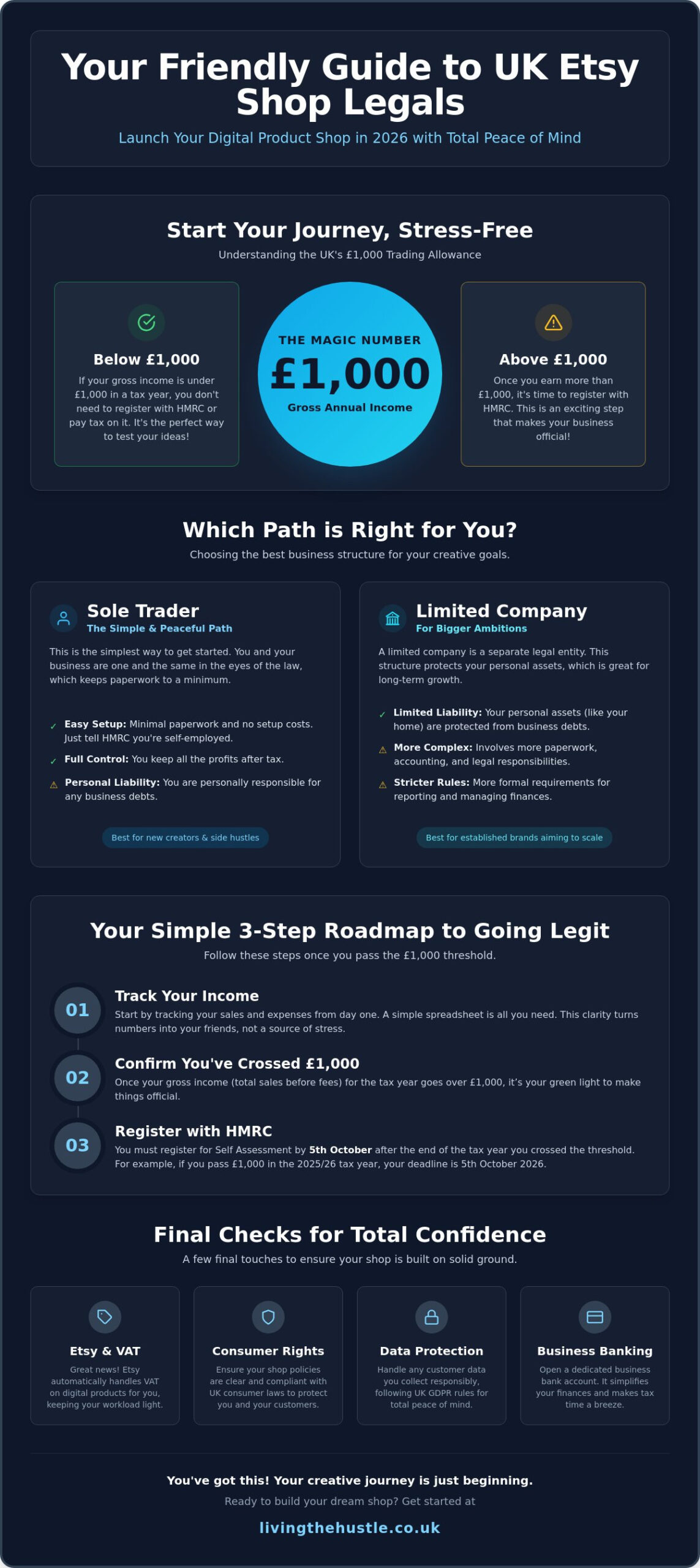
The UK government offers a wonderful safety net called the Trading Allowance. For the 2026/27 tax year, this allowance is £1,000. This means you can earn up to £1,000 in gross income without needing to register with HMRC or pay tax on that money. Gross income refers to your total sales before you subtract any fees or expenses. It's a perfect way to test the waters for casual sellers and side-hustlers. Think of it as a low-risk trial period for your ideas.
Do you plan to grow beyond that? If your gross income exceeds £1,000 in a single tax year, you must notify HMRC. The best way to keep this process low-stress is to track your sales and expenses from day one. Use a simple spreadsheet or a dedicated notebook. When you have clear records, the numbers become your friends rather than a source of confusion. Simple record-keeping is the antidote to tax-season overwhelm.
Registering as a Sole Trader
Once you cross that £1,000 threshold, most creators choose to register as a Sole Trader. It is the simplest business structure in the UK. You and your business are legally seen as the same entity. This makes your initial etsy shop setup for digital products much more manageable than jumping straight into a limited company. It's a popular choice for a reason. It's approachable, easy to maintain, and keeps your focus on your art.
The deadline to register for Self Assessment is 5th October following the end of the tax year where you earned over the allowance. For example, if you pass the threshold in the 2025/26 tax year, your deadline is 5th October 2026. Registering is an invitation to take your work seriously while keeping your operations simple. It gives you the legal freedom to grow your passive income at your own pace. If you are still in the creative phase, learning the art of design will help you build a collection that truly resonates with your future customers.
Choosing the Right Business Structure for Your Etsy Shop
Deciding how to structure your business is a big step toward making your dream feel real. It's the moment you move from “just trying things out” to building a professional foundation. Your choice will influence your taxes, your legal responsibilities, and how you handle your etsy shop setup for digital products. Most importantly, it should align with your personal goals for 2026. Do you want a simple side project that grows at its own pace, or are you aiming to build a large-scale brand from day one?
Your business structure also dictates how you verify your identity on the Etsy platform. For a smooth start, you'll need to match your Etsy Payments details exactly with your legal registration. This clarity prevents delays in receiving your hard-earned funds. Whether you choose the path of a sole trader or a limited company, remember that both options are valid ways to achieve success. There is no “wrong” choice, only the one that best supports your peace of mind right now.
The Simplicity of the Sole Trader Path
For many new creators, starting as a sole trader is the most peaceful route. It involves very little paperwork and carries no setup costs. You simply tell HMRC that you're self-employed. You can find all the necessary steps in the official government guide for sole traders to ensure you're following the 2026 requirements correctly. Under this structure, you keep all your shop's profits after paying Income Tax and National Insurance.
Most students in our community begin here because it allows them to focus on creativity rather than complex administration. You are the heart of the business. While this means you're personally responsible for any business debts, the risks are often very low when selling digital items. If you're ready to turn your ideas into a scalable brand, joining the Template Creators Society can help you build with confidence while keeping your operations manageable.
When to Consider a Limited Company
A limited company is a separate legal entity from you as an individual. This provides “limited liability,” which means your personal assets, like your home or savings, are generally protected if the business faces financial trouble. It offers a professional sheen that some sellers find empowering as they scale. However, this protection comes with more administrative weight. You'll need to file annual accounts with Companies House and manage corporation tax returns.
This structure might be right for you if you plan to earn significantly more than the £50,000 threshold, where Making Tax Digital (MTD) rules become more detailed in 2026. It's a choice for the future-focused creator who is ready to handle a bit more paperwork in exchange for extra legal security. Whatever you decide, your etsy shop setup for digital products will be the gateway to a sustainable and joyful income stream.
Navigating UK Taxes and VAT for Digital Products
The word “taxes” often brings a sense of heavy weight, but it doesn't have to be that way. When you're in the middle of your etsy shop setup for digital products, understanding your obligations early on is the secret to a peaceful mind. In the UK, the tax system is designed to be manageable for small creators. You don't need to be an expert to get it right; you just need a clear map to follow.
One of the most common questions for new sellers is about VAT. For the 2026/27 tax year, the UK VAT registration threshold is £90,000. This means you only have to register for VAT if your taxable turnover exceeds this amount in a rolling 12-month period. Most beginners can breathe a sigh of relief here. You can focus on growing your shop without the immediate pressure of complex VAT returns. It's also helpful to remember the difference between VAT on your sales and VAT on your expenses. If you aren't registered, you don't charge VAT on your products, and you cannot claim back the VAT you pay on business expenses like design software or marketing tools.
VAT on Digital Downloads: The Basics
Digital products are unique because they are delivered instantly without physical shipping. Because of this, they follow specific “place of supply” rules. The wonderful news for your etsy shop setup for digital products is that Etsy acts as the “marketplace facilitator.” This means Etsy automatically calculates, collects, and remits the Digital VAT from your customers based on their location. Whether your buyer is in London, Paris, or Berlin, Etsy handles the heavy lifting for you. Your only real responsibility is to ensure your product is correctly categorized as a digital download during the listing process.
Simplified Bookkeeping for Creative Hustlers
Keeping your books calm is all about consistency. You don't need expensive software to start. A simple spreadsheet to track your Etsy fees, software subscriptions, and marketing spend is plenty. Remember that Etsy's fees, such as the £0.15 listing fee and the 6.5% transaction fee, are business expenses you can deduct from your taxable income. Organising your business life becomes much easier with a tool like the Calm Creators Content Planner. The deadline to register for Self Assessment for the 2025/26 tax year is 5th October 2026. By tracking your numbers monthly, you'll find that tax season becomes just another quiet, manageable task in your creative journey.
Consumer Rights and GDPR: Protecting Your Business
Protecting your business isn't just about keeping the tax man happy. It's about creating a safe space for your customers to shop with confidence. When you approach your etsy shop setup for digital products with a clear understanding of consumer law, you're building a foundation of trust. In the UK, the Consumer Rights Act 2015 is your friend. It ensures that the digital goods you sell meet three simple standards: they must be of satisfactory quality, fit for purpose, and exactly as you described them in your listing.
If a customer buys a digital planner that won't open or contains broken links, they have a legal right to a repair or a replacement. Because digital files can't really be “returned” in the traditional sense, being honest and detailed in your product descriptions is the best way to prevent issues. Professionalism is the antidote to customer disputes. By setting clear expectations, you create a peaceful experience for both yourself and your buyers.
Digital Products and the Right to Cancel
Do you worry about customers asking for refunds after they've already downloaded your hard work? Under UK distance selling regulations, buyers usually have a 14-day “cooling-off” period to cancel an order. However, digital content is different. You can legally waive this right to cancel if the customer starts the download process, provided you've followed two steps. First, they must give express consent to begin the download immediately. Second, they must acknowledge that they will lose their right to cancel once the download starts.
Etsy includes language in its checkout process to help with this, but it's vital to mirror this in your own shop policies. Clearly state that due to the nature of digital downloads, refunds aren't typically available once the file has been accessed. This transparency protects your income and keeps your business relationship with your customers honest and clear.
UK GDPR for Etsy Sellers
Data protection might sound technical, but it's really just about respecting your customers' privacy. As an Etsy seller, you handle personal data like names and email addresses. Under UK GDPR, you have a responsibility to process this information lawfully and securely. You cannot, for example, take a customer's email from an order and add them to your marketing newsletter without their explicit “opt-in” consent. It's also important to note that under updated 2026 regulations, you must acknowledge any data complaints within 30 days.
Creating a simple, clear Privacy Policy is a requirement for a professional shop. It tells your buyers what data you collect, why you need it, and how you keep it safe. If you're feeling stuck on the wording, you can use the Blog, Brand & Bloom Workbook to help you define your brand values and set up your essential legal pages with ease. Taking these small steps now ensures your etsy shop setup for digital products is fully compliant and ready for long-term growth.
Your Calm Legal Setup Checklist for 2026
You've navigated the technicalities, and now it's time to bring everything together into a peaceful plan of action. Completing your etsy shop setup for digital products is a milestone worth celebrating. It marks the moment your creative vision becomes a tangible reality. By following a methodical checklist, you can move from the planning phase to your first sale without the weight of “what ifs” hanging over your head.
Before you open your virtual doors, take a quiet moment to ensure these foundational pieces are in place:
- Verify your shop name: Is your chosen name truly yours? Perform a quick search for UK trademarks to ensure you aren't accidentally using a protected brand. It's a simple step that prevents big headaches later.
- Open a dedicated business bank account: Mixing personal and business finances is a recipe for stress. Even a simple, separate account helps you track your digital profits with total clarity.
- Register with HMRC: If you've passed the £1,000 trading allowance, follow the steps we discussed to register for Self Assessment. It's a clear signal to yourself that you're taking your future seriously.
- Draft your shop policies: Use the guidance of a mentor to ensure your wording protects your work while being fair to your customers. Clear policies are the backbone of a professional shop.
This methodical approach to your etsy shop setup for digital products ensures you aren't just building a store, but a legacy. You can launch with the total confidence of someone who has joined the Passive Income Society, knowing every legal corner is tucked in and secure.
Final Steps Before You Hit Publish
As you prepare to go live, Etsy Payments UK will ask you to verify your identity. Have a valid form of ID ready to upload. This is a standard security step that protects the entire marketplace. Don't forget to fill out your “About” page too. In 2026, UK buyers value transparency and connection. Sharing your story helps you meet trader requirements while building a bridge of trust with your audience. Once your legal foundation is set, you can focus on visibility by exploring Etsy SEO in 2026 to ensure your hard work gets the attention it deserves.
Scaling Your Hustle Calmly
A solid legal setup is the first real step toward true financial freedom. It removes the fear that often holds creators back from scaling. When you know your business is compliant, you're free to dream bigger and work more peacefully. You can transition from a quiet side hustle to a full-time business at your own pace, supported by systems that work for you. If you're ready for a deep-dive into building a sustainable creative empire, we invite you to join the Passive Income Society for the training and community you need to thrive.
Your Journey to a Peaceful and Profitable Shop
You've taken the first brave steps toward creating a life of freedom and creativity. Understanding your HMRC status and choosing the right business structure isn't just about compliance; it's about giving your dreams a stable foundation. By mastering the 2026 VAT rules and consumer rights, you've turned a confusing process into a clear path forward. Your etsy shop setup for digital products is now more than just an idea. It's a legally sound reality that allows you to grow without the weight of worry.
Building a business should feel like a joyful expansion, not a source of stress. We've helped over 1,000 students navigate this exact journey with our step-by-step guidance tailored for UK-based creators. If you're ready to build your dream shop without the overwhelm, join the Passive Income Society today. We focus on calm, sustainable growth that respects your time and your well-being. You have everything you need to succeed. It's time to let your creativity shine and start your passive income journey with total confidence.
Frequently Asked Questions
Do I need to register a business to sell on Etsy UK in 2026?
You must register with HMRC as soon as your gross income from selling exceeds £1,000 in a tax year. While you don't need a specific business license to open your shop, the UK government considers you a trader if you're making or buying items to sell at a profit. Most creators find that registering as a sole trader is the simplest way to start their journey.
How much can I sell on Etsy before I have to pay tax in the UK?
You can earn up to £12,570 in total income before you owe any income tax for the 2026/27 tax year. However, don't confuse the tax-free personal allowance with the registration threshold. You still need to register for Self Assessment if your gross trading income is over £1,000, even if your total earnings for the year are below the personal allowance limit.
Do I need business insurance for an Etsy shop selling digital products?
Business insurance isn't a legal requirement for selling digital files in the UK. Since you aren't shipping physical goods or hosting customers in a studio, your risks are naturally much lower. Some sellers eventually choose professional indemnity insurance as they scale. This can provide extra peace of mind against potential copyright claims, but it's not something you need on day one.
What is the UK Trading Allowance, and how does it apply to Etsy?
The UK Trading Allowance is a £1,000 tax-free threshold designed for casual sellers and small side hustles. If your total sales are less than £1,000 in a tax year, you don't need to report this income to HMRC. It's a gentle way to test your etsy shop setup for digital products without the pressure of immediate tax filings or complex administrative tasks.
Can I sell on Etsy UK as a Sole Trader or do I need a Limited Company?
You can absolutely sell as a sole trader, and it's the path most beginners choose for its simplicity. You don't need a limited company to have a successful shop. While a limited company offers more legal protection for your personal assets, it also comes with higher costs and more paperwork. Being a sole trader keeps your focus on creating rather than managing accounts.
Do I need to register for VAT if I only sell digital products on Etsy?
You only need to register for VAT if your taxable turnover exceeds £90,000 in a rolling 12-month period. One of the best parts of an etsy shop setup for digital products is that Etsy handles the “Digital VAT” for you. They automatically collect the correct tax from your buyers based on their location and send it to the relevant authorities, saving you hours of work.
How do I legally handle returns for digital products in the UK?
You aren't legally required to offer a 14-day cooling-off period for digital downloads once the customer has started the download. To stay protected, you must clearly state in your shop policies that returns aren't accepted for digital items. You should also ensure your customers acknowledge that they lose their right to cancel as soon as they access the files you've created.
What information must a UK Etsy seller legally display in their shop?
You must legally display your name, business address, and contact details to comply with UK distance selling regulations. This information is usually placed in your “Seller Details” section. Providing these clear details builds trust with your buyers and ensures you're meeting the transparency standards required for professional traders. It's a small step that makes your shop feel much more established and trustworthy.