

What if the “perfect” price for your digital download isn't a number you copy from a competitor, but one that actually honors your creative energy? Knowing how to price digital products on etsy often feels like a stressful balancing act. You want to be accessible to the 86.6 million active buyers on the platform, but you also need to see a real return for your hard work. It's completely normal to feel stuck between the fear of charging too much and the worry of devaluing your art.
You probably already know that guessing isn't a sustainable strategy for a peaceful business. With the 6.5% transaction fee and the $0.20 listing fee, the math needs to be clear so your peace of mind stays intact. This guide is here to replace that pricing anxiety with quiet confidence. You'll learn how to value your time properly and set profitable prices that attract your dream customers without the overwhelm. We're going to walk through the 2026 fee structure and a simple, repeatable formula you can use for every single listing in your shop.
Key Takeaways
- Discover how to view your price as a gentle signal of quality that attracts your dream customers.
- Master the 2026 fee structure to learn exactly how to price digital products on etsy for a “worst-case” scenario so you always stay profitable.
- Learn how to find your “Price Tribe” using simple research tools without getting lost in the noise of your competitors.
- Implement a simple four-step formula to calculate a floor price that covers your costs and honors your creative time.
- See how consistent, branded pricing builds a foundation of trust that turns one-time buyers into a sustainable community.
Finding Your Pricing Sweet Spot Without the Stress
Pricing is often the biggest hurdle for new sellers. It's where imposter syndrome likes to hide. You might wonder if your work is “good enough” to charge more than a few dollars. But choosing a price is actually a form of self-care for your business. When you learn how to price digital products on etsy with a calm mindset, you're looking for a balance between making your work accessible and ensuring your creative well-being is protected. You deserve to be paid for the energy you pour into your designs.
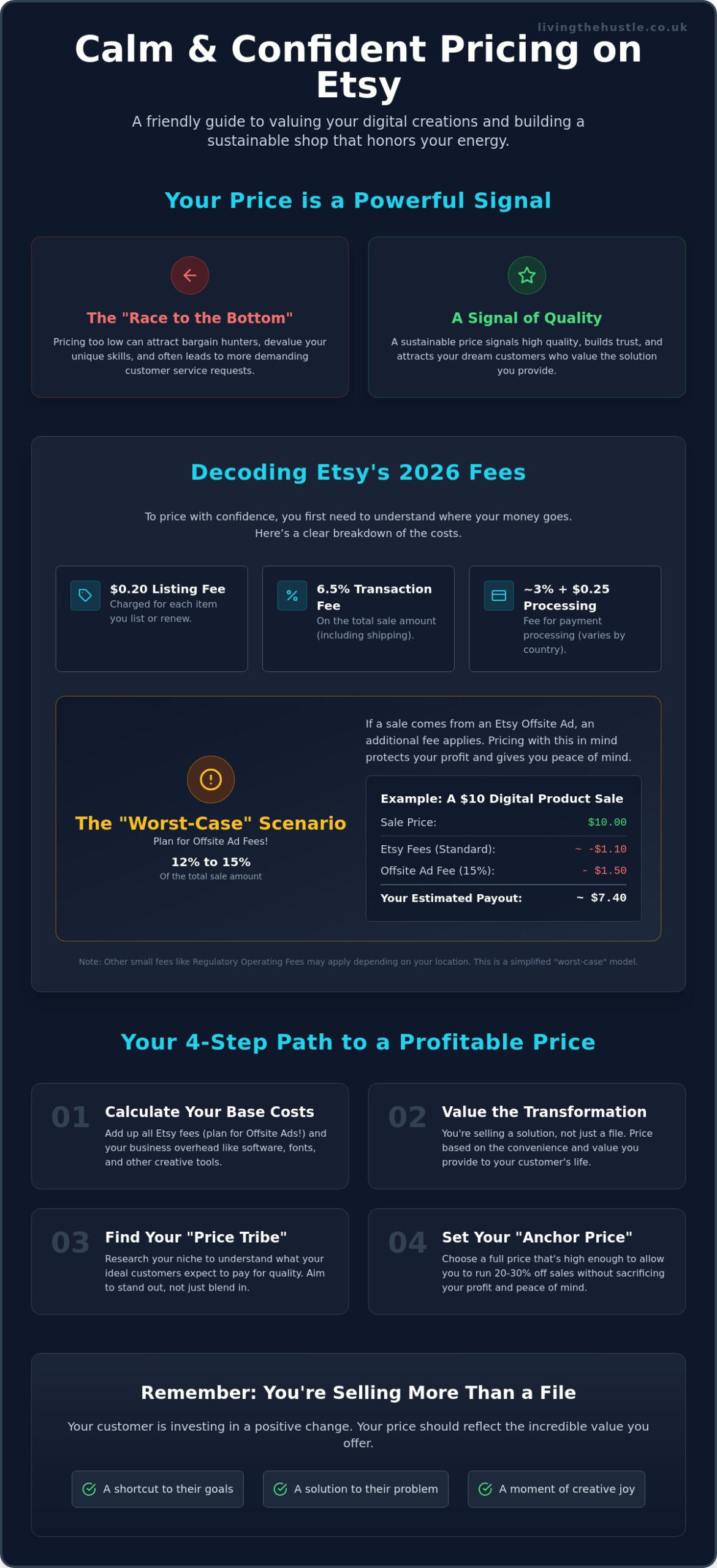
Think of your price as a signal. It tells potential buyers what to expect from your shop. If you price everything at $0.99, you might attract a high volume of sales, but you're also inviting a “race to the bottom” that devalues your unique skills. Low prices often attract customers who are more demanding or likely to leave negative reviews over small details. By choosing a sustainable price, you signal that your product is a high-quality solution worth their investment. It helps you stand out as a professional rather than a bargain bin.
Researching different pricing strategies can help you see that profit isn't a dirty word. It's the fuel that keeps your shop running while you sleep. If you don't see a healthy return for your effort, your motivation will eventually fade. A calm business is one that supports your life, not one that leaves you feeling exhausted and underpaid. Setting the right price from the start ensures you can keep creating for years to come.
The Psychology of Pricing Digital Downloads
Since digital products can't be touched, buyers rely on visual cues and price to determine value. A slightly higher price point often attracts “low-maintenance” customers. These individuals value their time and are looking for a quick, professional solution. They are usually happier to pay for quality and less likely to need constant technical support. This means fewer customer service headaches for you and more time to focus on the art of design for your next collection. Higher prices create a sense of trust and authority in your niche.
Valuing Your Creative Energy
It's easy to fall into the trap of pricing based on how long it took you to make a file. However, your buyer isn't paying for your hours; they are paying for the transformation your product provides. Whether it's an ADHD-friendly planner or a social media template, you're selling a shortcut to their goals. Remember that digital products are inherently passive. Once the work is done, it can sell hundreds of times. Value-based pricing means setting your price based on the total benefit and time-saving convenience your customer receives rather than the minutes you spent clicking “save.”
Understanding Etsy Fees and Hidden Costs in 2026
To build a sustainable shop, you need to look past the surface of your sales numbers. Many creators feel a pinch when they realize Etsy’s cut is more than just a single percentage. In 2026, the fee structure includes a $0.20 listing fee, a 6.5% transaction fee, and a payment processing fee that usually sits at 3% plus $0.25 for US sellers. If you are learning how to price digital products on etsy, these numbers are your starting point. You also need to account for Offsite Ads. If Etsy’s marketing brings you a buyer, they take an additional 15% for shops earning under $10,000 annually or 12% for those over $10,000.
Planning for the “worst-case” scenario is a core part of Finding The Right Price. If an offsite ad leads to a sale, your total fees could jump to 22% or even 28% of the total price. This is why pricing too low can be dangerous. You want a profit buffer that protects your peace of mind even when Etsy’s marketing engine is working hard for you. Depending on your location, you might also see a Regulatory Operating Fee between 0.4% and 1.1% if you're selling in countries like the UK or Spain.
The True Cost of a Digital Sale
Your net profit is what remains after every fee and tool cost is paid. Don't forget your overhead. Canva Pro subscriptions, professional font licenses, and specialized file hosting are all part of your business ecosystem. For low-ticket items, like a $2.00 printable, that $0.20 listing fee and the $0.25 processing base fee eat up a massive chunk of your margin. Consider bundling smaller items to make the math work in your favor. If you want to see how your niche rivals are handling these costs, using erank for etsy sellers can provide the clarity you need to stay competitive.
Planning for Discounts and Sales
Everyone loves a bargain. Etsy’s search algorithm often favors shops running promotions. To stay profitable, you should set an “Anchor Price.” This is a base price high enough to allow for a 20% or 30% discount without dipping into your necessary profit. If your goal is a specific profit amount, but you want to run frequent sales, your starting price might need to be 40% higher than your floor price. This strategy keeps your income steady while giving shoppers the excitement of a deal. Once your pricing is solid, you can focus on visibility by following this Etsy SEO guide to ensure your dream customers can actually find your listings.
Researching the Market: How to Compare Without Overwhelm
Do you find yourself scrolling through Etsy, feeling smaller with every listing you see? It is easy to look at a shop with 50,000 sales and think you have to match their low prices to survive. This is a common trap that leads to burnout. Instead of looking at everyone, you need to find your “Price Tribe.” These are the shops that share your aesthetic, your level of detail, and your target audience. If you are designing high-end, nature-inspired digital art for the 2026 “Cozy Minimalism” trend, don't compare yourself to a shop selling basic clip art from five years ago.
Analyzing “Best Sellers” gives you a snapshot of what worked yesterday. However, looking at “New Arrivals” tells you where the market is moving today. When you are figuring out how to price digital products on etsy, remember that being the “new and better” solution allows you to step away from the bargain bin. You should never compare your “Day 1” price to a competitor’s “Year 5” price. Established shops can afford lower margins because they have massive volume. You are building a foundation, and that requires a price that respects your current growth.
Using eRank for Smart Pricing Data
Data takes the guesswork out of your business and replaces it with quiet confidence. You can use specialized tools to find the average price range for your primary keywords. Look for gaps where “Premium” options are missing. If every digital planner in your niche is priced under $10 but lacks depth, there is an opening for a high-value, $25 “ecosystem” bundle. For a step-by-step walkthrough on gathering this data, check out this guide on eRank for Etsy Sellers to find your competitive edge.
Differentiating Your Product to Justify Your Price
If you want to charge more than the average, you must deliver more than the average. This doesn't mean working harder; it means working smarter. You can justify a 20% to 30% price increase simply by adding “bonus” value like a quick-start video tutorial or a printable checklist. High-quality mockups also play a huge role in how buyers perceive your work. When your product looks professional and solves a specific problem, shoppers don't mind paying a little extra. To ensure your work truly shines, explore the art of design to create products that naturally command a higher price point.
A Simple 4-Step Formula to Price Your Digital Products
Ready to move from guessing to knowing? Finding the right number doesn't have to be a headache. When you are deciding how to price digital products on etsy, a repeatable formula creates a sense of order. It moves you away from emotional guessing and toward a sustainable business model that honors your energy. Follow these four steps to find your number.
- Step 1: Calculate your Floor Price. Start with the absolute minimum. Add your $0.20 listing fee, the 6.5% transaction fee, and your payment processing costs. Include a small portion of your software costs and at least a $1.00 minimum profit. This is your “break-even” point.
- Step 2: Add your Value Markup. Think back to the problem your product solves. A simple checklist might have a small markup, while a complex wedding planner that saves a bride 20 hours of work deserves a much higher value-based addition.
- Step 3: Adjust for Market Reality. Look at your “Price Tribe” data from earlier. If your calculated price is $30 but the highest-quality similar items are $22, you may need to add more “bonus” value or slightly lower your markup to stay competitive.
- Step 4: Finalize the Marketing Buffer. Add 20% to 30% to your price to create a buffer. This allows you to run sales and participate in Etsy’s site-wide promotions without ever dipping below your Floor Price.
If you want to build a shop that grows with you, consider joining the Template Creators Society to learn how to scale your digital business with confidence.
The Tiered Pricing Framework
A balanced shop offers something for everyone. You can use a tiered approach to guide your customers through their journey. Entry-level “Lead Magnets” priced between $3 and $7 are perfect for quick wins and getting your shop noticed. Standard products usually fall between $12 and $25. These are your core offerings that provide comprehensive solutions. For high-impact results, Premium Bundles priced at $47 or more offer a “business-in-a-box” experience that delivers massive value and higher profit margins.
Testing and Tweaking Your Prices
Patience is your best friend when it comes to data. Follow the “30-Day Rule” and avoid changing your prices more than once a month. This gives the Etsy algorithm and your customers time to respond. You can use Etsy’s “Sales and Coupons” tool to test price elasticity by running a short promotion and seeing if the lower price point significantly increases your volume. Monitor your conversion rate by checking the “Orders per Visit” ratio in your shop stats for at least four weeks after any price adjustment.
Scaling Your Calm and Profitable Etsy Business
Success on Etsy is a marathon, not a sprint. Once you feel confident with your first few listings, you can begin to look at the bigger picture. Moving from a single product to a cohesive, branded shop is where the real magic happens. When you know how to price digital products on etsy across an entire collection, you create a professional environment that shoppers trust. They aren't just buying a file; they are buying into your unique style and perspective.
Consistency is your quiet ally in building that trust. If your pricing feels random, it can create friction for your buyers. Imagine a customer who finds a beautiful planner for $12, only to see a similar one in your shop for $28 without a clear reason for the jump. This confusion often leads to them leaving without a purchase. By keeping your pricing tiers logical and steady, you encourage repeat business. You want your dream customers to know exactly what to expect every time you release a new design.
As your sales grow, use your profit to buy back your time. Reinvesting in tools like high-end design software, automation, or advanced research platforms makes your business even more passive. This is how you move from “pricing per item” to “building a lifetime customer.” A customer who trusts your value today is much more likely to buy your premium bundles tomorrow. Your goal is to create a sustainable stream of income that supports your life without demanding every hour of your day.
Beyond the Price Tag: Building a Brand
Branding is what allows you to step out of price wars entirely. When people connect with your specific aesthetic or your unique way of solving their problems, they stop comparing your prices to everyone else. You become the only person who does what you do. To lay a solid foundation for your shop's identity, it helps to build your blog brand without the overwhelm. Remember that you don't have to navigate this path alone. Joining a supportive community of creators can provide the encouragement you need to keep growing during the quiet months.
Your Next Steps to Passive Income
It's okay to start small. You don't need a hundred listings to be successful. You just need a few that are priced with intention and care. Adjust your strategy as you learn more about your customers and as the marketplace evolves. Your peace of mind is the ultimate profit in this journey. If your business feels heavy, it's time to simplify and return to the basics. Ready to scale your reach and build a life of freedom? Join the Passive Income Society for our full roadmap on turning your creativity into a thriving, low-stress business.
Step Into Your Profitable Future
You now have a clear path to replace pricing anxiety with a sense of purpose. By understanding the 2026 fee structure and choosing to value your creative energy, you've already taken the hardest step. Remember that your price is more than just a number; it's a signal of quality to your customers. Mastering how to price digital products on etsy using a repeatable formula allows you to cover your costs while building a shop that feels sustainable and calm.
You don't have to navigate this journey alone. If you're ready to move beyond the basics and build a shop that supports your lifestyle, we're here to help. We have mentored over 1,000 students through a step-by-step roadmap designed for beginners who crave low-stress, sustainable growth. Join the Passive Income Society: Build your dream shop with our expert guidance. Your creative journey is just beginning, and the world is ready for what you have to offer.
Frequently Asked Questions
Is $0.99 too low to price a digital product on Etsy?
Yes, $0.99 is generally too low for a sustainable business model. When you subtract the $0.20 listing fee and the $0.25 payment processing base fee, you've already lost nearly half your revenue before the transaction percentages are even applied. This price point often attracts high-maintenance buyers and leaves you with very little profit to reinvest in your growth.
How often should I change my prices to see what works?
You should wait at least 30 days before making another adjustment to your prices. The Etsy search algorithm needs a consistent window of time to observe how shoppers interact with your listing at a specific price point. Changing your numbers too frequently creates noisy data, making it difficult to tell if a price shift actually caused a change in your conversion rates.
Do I need to include my creation time in my digital product price?
You shouldn't strictly base your price on the hours you spent creating the file. When learning how to price digital products on etsy, it's better to focus on the value and transformation you provide to the buyer. Since a digital download can sell thousands of times, your initial labor becomes a smaller part of the math over time. Focus on the time and stress you save your customer instead.
What is the average profit margin for Etsy digital products in 2026?
Most digital sellers enjoy profit margins between 70% and 90% in 2026. Because you don't have shipping costs or physical materials, your main expenses are Etsy's fees and your design tools. Even after accounting for the typical 10% to 13% cut Etsy takes from a standard sale without advertising, your margins remain significantly higher than those for physical handmade goods.
Should I charge more for commercial use licenses on my digital downloads?
Yes, charging a premium for commercial use licenses is a smart way to increase your revenue. Buyers who plan to use your designs to make their own profit expect to pay more for that right. This creates a high-value tier in your shop that respects your intellectual property while helping other small businesses grow. It's a professional way to offer more value to those who need it.
How do I price a bundle of digital products vs. individual items?
A bundle should typically offer a 30% to 50% discount compared to buying each item separately. This “ecosystem” approach encourages buyers to spend more in a single transaction, which increases your average order value. Higher order values are great for you because they help offset fixed costs like the $0.20 listing fee and the $0.25 processing base fee that apply to every sale.
Does a higher price help or hurt my Etsy SEO rankings?
A higher price can actually help your rankings if it leads to higher overall revenue for the platform. Etsy's algorithm often looks at how much money a listing generates per visit rather than just the number of sales. If you are confident in how to price digital products on etsy, a premium price paired with high-quality mockups can signal authority and boost your visibility in search results.