

What if you could stop guessing what shoppers want and start creating with total confidence? Let's be honest; it's incredibly draining to spend 6 hours perfecting a digital download only to see it buried under thousands of search results. You might feel like the market is already too crowded for a new shop to thrive. I've been there, and I know that heavy feeling of wondering if your hard work will ever be noticed. The truth is that mastering etsy keyword research doesn't have to be a technical nightmare that leaves you feeling burnt out or confused.
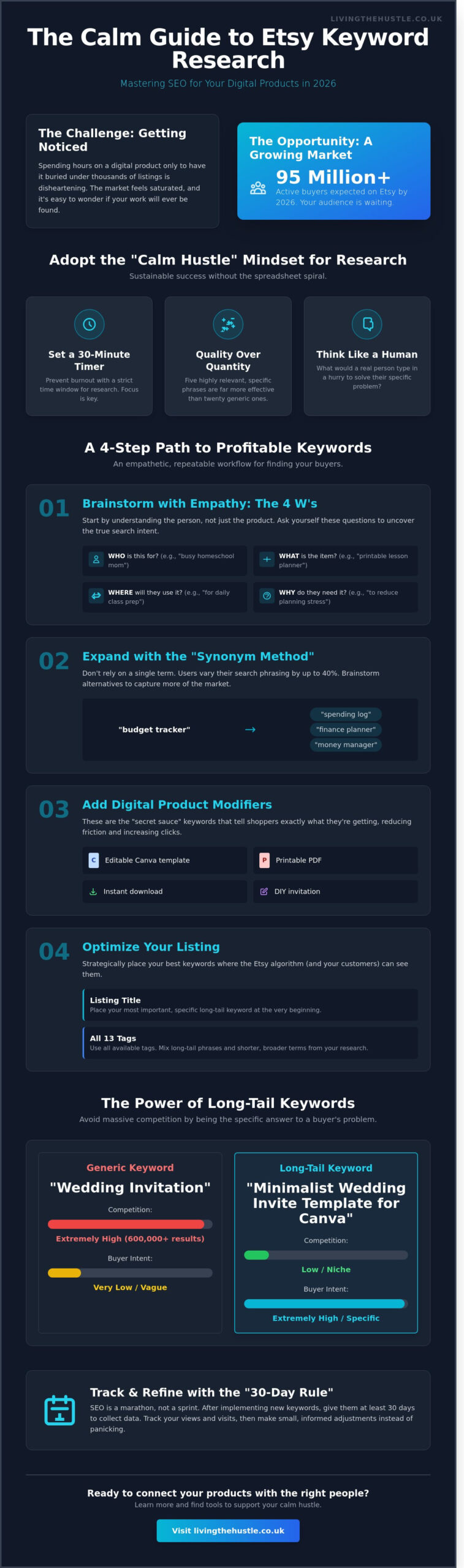
With over 95 million active buyers expected to browse the platform by the start of 2026, the opportunity is larger than ever if you know how to be seen. I promise to show you a calm, step-by-step method to find profitable niches without the usual stress. You'll learn how to build a repeatable workflow that connects your digital products with the right people. We're going to walk through a simple strategy for choosing tags that actually work, ensuring your shop feels like a peaceful success rather than a frantic race.
Key Takeaways
- Learn how to bridge the gap between your creative digital products and your ideal customers with a calm, purpose-driven approach.
- Discover how to brainstorm high-impact “seed” keywords by focusing on the specific problems your product solves for your buyers.
- Master the art of etsy keyword research to strategically place your listings in front of the right audience using titles and all 13 tags.
- Explore simple, free tools that validate your ideas and take the guesswork out of finding profitable niches.
- Understand the “30-Day Rule” for tracking your progress, allowing you to refine your strategy with confidence instead of panic.
Understanding the Basics of Etsy Keyword Research
Have you ever spent hours creating a beautiful digital planner only to see it sit on a virtual shelf? It is a common frustration for many creative entrepreneurs. To fix this, we need to understand What is keyword research? in the context of your shop. Think of it as the bridge between your creativity and a customer’s specific need. In 2026, etsy keyword research is no longer just about stuffing boxes with random tags. It is about being the direct answer to a buyer's problem.
Organic growth on Etsy relies on how well you speak the buyer's language. Search intent is the “why” behind the search. For digital product buyers, they aren't just looking for “art.” They might be looking for a “minimalist wedding invite template for Canva.” One is a vague idea; the other is a specific solution. By 2026, the algorithm has become even more sophisticated at identifying these nuances, making your choice of words the most important factor for getting found without paying for ads.
What is Etsy SEO and Why Does it Matter?
The Etsy algorithm acts like a helpful librarian. It scans your titles and tags to match your listing with exactly what a buyer types into the search bar. This process is the core of Etsy SEO in 2026, ensuring your work gets found by the right people. Long-tail keywords are phrases with three or more words that signal specific buyer intent. Using these helps you avoid competing with 600,000 generic results and instead connects you with the specific group looking for your unique style.
The “Calm Hustle” Mindset for Research
Research doesn't have to lead to a “spreadsheet spiral.” You don't need to spend eight hours a day analyzing data to find success. To keep things manageable, follow these steps:
- Set a 30-minute timer: Give yourself a strict window for etsy keyword research to prevent burnout.
- Focus on quality: Choosing five highly relevant phrases is more effective than picking twenty mediocre ones.
- Think like a human: Ask yourself what a real person would type if they were in a hurry.
By focusing on “Quality over Quantity,” you create content with purpose rather than panic. This human-centered approach ensures your business remains sustainable and gentle. Remember, you're building a shop to support your life, not to take it over. When you think like your customer, the right keywords usually reveal themselves naturally.
Step 1: Brainstorming Your Seed Keywords with Empathy
Effective etsy keyword research doesn't start with a spreadsheet; it starts with a person. Think about the last time you bought a digital product. You likely weren't looking for an “SEO optimized PDF.” You were looking for a way to feel more organized or a way to celebrate a friend's baby shower without the stress. Start your journey by identifying the core problem your product solves. Is it “time-saving,” “stress reduction,” or “creative expression”? Focusing on the emotion behind the search helps you connect with your buyer before they even see your listing.
To build a solid foundation, ask yourself the four W's. Who is this for? What is the specific item? Where will they use it? Why do they need it right now? For example, a “Who” might be a “busy homeschool mom,” while the “Why” is “lesson planning made easy.” This empathetic approach helps you uncover the heart of what your customers are actually typing into that search bar. For a broader look at how these principles apply to online selling, you can explore this practical guide to ecommerce keyword research which highlights how intent drives sales across various platforms.
Don't stop at the first word that comes to mind. Use the “Synonym Method” to expand your list. If you're selling a “budget tracker,” your customers might also search for “spending log,” “finance planner,” or “money manager.” According to 2023 search data, users often vary their phrasing by up to 40 percent when looking for the same solution. Diversifying your terms ensures you don't miss out on these quiet, profitable corners of the market.
Thinking Like Your Ideal Customer
Create a simple buyer persona to guide your choices. Give them a name and a daily routine. Do they use professional terms, or do they use “mom-slang”? Understanding their vocabulary is the secret to low-stress etsy keyword research. You should also categorize your ideas into seasonal and evergreen buckets. A “Christmas scavenger hunt” is a seasonal win, while a “daily gratitude journal” provides steady sales all year. To keep these ideas organized without the panic, you can use the Calm Creators Content Planner to map out your production schedule months in advance.
The Power of Digital Product Modifiers
Modifiers are the secret sauce that reduces customer friction. They tell the shopper exactly what they're getting before they even click. Common modifiers include:
- Editable Canva template: For those who want to customize the design easily.
- Printable PDF: For the pen-and-paper lovers who want something tactile.
- Instant download: For the last-minute shoppers who need a solution right now.
- DIY invitation: For the budget-conscious crafter who enjoys the process.
Choosing the right modifier depends on the software your customer feels comfortable using. If your audience isn't tech-savvy, “printable PDF” is much more inviting than “layered SVG file.” By being specific about the format, you build trust and ensure the right people find your shop, leading to higher conversion rates and happier customers.
Step 2: Validating Your Ideas with Simple Tools
Once you have a list of potential niches, it's time to see which ones have real legs. This part of etsy keyword research doesn't need to be a math-heavy chore. We're simply looking for evidence that buyers are ready to spend. Let's look at how to find that proof without the stress.
The Etsy Search Bar Hack
The easiest way to start is by using the tool right in front of you. Etsy's search bar is a goldmine for real-time data. When you start typing, the “Autosuggest” feature shows you exactly what other shoppers are looking for right now. To do this properly, you must open a private or “Incognito” window in your browser. This ensures Etsy doesn't show you results based on your own past shopping habits, giving you 100% unbiased data.
Follow these simple steps to find hidden gems:
- Type your “seed” word, like “planner,” into the search bar.
- Wait for the dropdown menu to appear. Don't hit enter.
- Look for phrases with the “Popular Now” badge. This signal indicates a high volume of recent searches, often representing the top 1% of trending phrases on the platform today.
- Write down the specific long-tail phrases, such as “digital budget planner for moms,” that Etsy suggests.
Using eRank for Deeper Insights
If the search bar is your compass, eRank is your detailed map. It's a supportive partner that takes the guesswork out of your growth. I recommend checking out this eRank for Etsy guide for a gentle walkthrough of the setup. One of the best features for beginners is the “Traffic Light” system. It uses simple colors to show you the health of a keyword. Green means the data looks promising, while red suggests you might face a steep uphill climb.
When you're analyzing data, you're looking for the “Sweet Spot.” This is the magic middle ground where search volume is high but competition remains manageable. For example, a keyword with over 1,000 monthly searches and fewer than 50,000 competing listings is often a fantastic entry point for a new shop. A good keyword has high engagement but manageable competition, allowing your products to actually be seen by the 96 million active buyers on the platform.
Don't be afraid to peek at what successful shops are doing. Scroll to the bottom of a top-selling listing to see the “Related Searches” section. These are often the actual tags the seller used. It isn't about copying their hard work. It's about understanding the language your customers use so you can serve them better. If five different top-tier shops all use the phrase “boho nursery decor,” it's a clear sign that this specific etsy keyword research term is worth your attention.
Step 3: Implementing Keywords into Your Etsy Shop
You have gathered your list of high-potential phrases. Now it's time to place them strategically so the Etsy algorithm can connect your products with the right shoppers. Successful etsy keyword research isn't just about finding words; it's about implementation without the stress. By following a methodical approach, you ensure your shop stays visible while maintaining a professional look that appeals to real people.
Writing Titles That Convert
Etsy allows for 140 characters in your title, but the first 30 to 40 characters are the most vital. This is known as “front-loading.” Since 67% of Etsy traffic came from mobile devices in late 2023, shoppers often only see the start of your title before they decide to click. Put your most descriptive, high-search volume phrase right at the beginning.
While you want to satisfy the search engine, you must also write for humans. Avoid long strings of repetitive words that look like spam. Instead, use commas or pipes to separate phrases. This creates a readable flow that tells the shopper exactly what they are buying. A clear, concise title builds trust and encourages the click, which eventually improves your search ranking through a higher conversion rate.
The 13 Tags Strategy
Every listing gives you 13 tag slots. You should never leave a single one blank. Each tag is a new opportunity for a shopper to find you. Use multi-word phrases, also known as long-tail keywords, to fill the 20-character limit for each tag. Instead of just “planner,” use “digital daily planner” to capture a more specific and ready-to-buy audience.
- The No-Repeat Rule: You don't need to repeat words across your tags. If you have “blue wedding invite” as one tag, you don't need “wedding” in another. Use that extra space to add “bridal shower decor” or “minimalist stationery” to widen your reach.
- Attribute Synergy: Etsy uses your category and attributes as “hidden” keywords. If you've already selected “blue” in the color attribute, you don't necessarily need “blue” in your tags. This frees up space for more descriptive phrases.
- Query Matching: Think about how people actually type. Use phrases like “gift for new mom” or “office wall art” to match common search patterns.
Your description also plays a role in “off-Etsy” SEO. While Etsy's internal search focuses heavily on titles and tags, Google looks at your first 160 characters of the description. Weave your primary keywords naturally into the first few sentences. This helps your shop appear in external search results without making the text feel forced or robotic. Keep your tone gentle and inviting to ensure the reader feels supported throughout their journey.
Refining Your Strategy: The Path to Passive Income
Building a shop that generates sales while you sleep isn't about chasing every fleeting trend. It's about refining what works and letting your data tell the story. Once you've implemented your initial etsy keyword research, the most important thing you can do is wait. I call this the 30-Day Rule. Etsy's algorithm needs time to test your listing and find the right audience. If you change your SEO too frequently, you reset that learning phase and confuse the system.
Instead of constantly tweaking, focus on scaling your success through keyword clusters. This means creating a family of related products that target similar search terms. For example, if a 2026 digital budget planner starts selling, don't just stop there. Create a cluster with a debt payoff tracker, a sinking funds worksheet, and a monthly expense log. This strategy builds your authority in a specific niche and makes it easier for customers to find multiple items they love in one place.
Analysing Your Results Without the Panic
Data doesn't have to be scary. When you check your Etsy Stats, focus on the metrics that actually drive your business forward. For digital sellers, a healthy conversion rate typically sits between 2% and 3.5%. If your views are high but your sales are low, your keywords are working, but your listing photos or description might need a gentle touch-up. Here is how to find your focus:
- Identify Hidden Gems: Look at your search terms report for phrases you didn't intentionally target but are bringing traffic. These are golden opportunities to create new, specific listings that meet that exact demand.
- The 60-Day Refresh: If a listing has received zero views after 60 days, it's time to revisit your tags. Use fresh data from 2026 trends to give it a second life.
- Traffic Sources: Notice if your traffic is coming from Etsy search or external sources. This helps you decide where to spend your energy to get the best return.
Taking the Next Step in Your Hustle
You've laid the groundwork for a successful shop, but you don't have to navigate the journey alone. Building a business should serve your life, not consume it. If you're looking for a structured roadmap to scale your digital product shop, the Passive Income Society offers a supportive community and expert guidance to help you grow with confidence.
For those ready to think beyond Etsy and build a long-term presence, the Blog, Brand & Bloom Workbook is your guide to creating a cohesive brand identity without the stress. Remember, success in etsy keyword research is a marathon, not a sprint. Take it one step at a time, stay consistent, and celebrate every small win along the way. You've got this.
Your Gentle Path to Etsy Growth in 2026
Building a shop that thrives doesn't have to feel like a frantic race. By focusing on etsy keyword research with empathy and clear validation, you've already taken the most important step toward a sustainable business. You've mastered how to brainstorm with heart, use simple tools to check your ideas, and place those keywords exactly where they belong. These 3 manageable steps are the foundation of a shop that works for you, even when you're busy living your life. It's about creating with purpose rather than panic.
Success with digital products comes from consistency and a calm approach rather than chasing overnight miracles. We've focused on strategies that prioritize your well-being while building a reliable stream of passive income. You don't need to be a tech expert to master these methods. You just need the right roadmap to guide you through the noise of the online world. It's about making progress without the burnout.
Ready to turn your research into results? Explore the Passive Income Society and start your digital hustle today. We provide step-by-step guidance for total beginners and proven strategies for digital products. It's time to build your dream with confidence and clarity. You're more than ready for this next chapter!
Frequently Asked Questions
How many keywords should I use on my Etsy listing?
You should use all 13 tags provided by Etsy for every single listing to maximize your visibility. It's also vital to use your most important phrases in your title, which has a 140 character limit. This simple strategy ensures you're taking advantage of every opportunity the algorithm gives you without any extra stress.
Can I use the same keywords for all of my digital products?
You shouldn't use identical keywords for every product because it causes your own listings to compete against each other. Try to vary at least 5 of your 13 tags for every new item you post. When 80% of your keywords overlap across multiple listings, you risk keyword cannibalization, which can lower your overall shop ranking.
Does Etsy keyword research change for different countries?
Yes, keyword research varies by region because shoppers use different terminology for the same digital products. For example, a shopper in the US searches for a “planner” while a UK buyer might type “organiser” into the search bar. Since 27% of Etsy's active buyers live outside the United States, targeting these regional variations can help you grow your shop with confidence.
How often should I update my Etsy tags and titles?
You should review and update your tags and titles every 90 days to stay aligned with current trends. It takes Etsy approximately 30 days to fully index your changes and collect enough data to show your true rank. This quarterly schedule gives you a clear, calm rhythm for maintenance without the need to constantly tinker with your shop.
What is the best free tool for Etsy keyword research in 2026?
The most reliable free tool for your etsy keyword research in 2026 is the Etsy search bar itself through its auto-suggest feature. This gives you direct access to the exact phrases shoppers are typing right now. You can also use Google Trends to see which 2026 design styles are gaining popularity to ensure your digital products stay relevant and profitable.
Is it better to target high-volume keywords or low-competition ones?
It's much better to target low-competition, long-tail keywords that have fewer than 1,000 search results. High-volume terms often have over 100,000 competing listings, making it very difficult for a small shop to reach the first page. By focusing on specific 3 or 4 word phrases, you can find a gentle path to the top of the search results.
Do I need to put keywords in my Etsy shop announcement?
You don't need to put keywords in your shop announcement because Etsy's search engine prioritizes your Shop Title and individual listing tags instead. Your Shop Title gives you 55 characters to describe your niche for SEO purposes. Use your announcement for a 1 or 2 sentence friendly greeting to welcome your customers and build a personal connection.