

Does your beautiful Etsy shop feel like a secret? You pour your heart into creating amazing products, hit ‘publish,’ and then… crickets. You’ve heard about “SEO,” but the very word brings on a wave of tech-panic, and the thought of spending hours on tags that don't bring sales is completely draining.
Let’s take a deep breath. What if you could master the Etsy algorithm without the stress? This is your calm guide to etsy seo for beginners. We believe in purpose, not panic. This is your gentle first step toward getting your products seen by the people who are actively searching for them, turning your passion into a visible, thriving hustle.
Forget the confusing jargon. In this guide, we’ll walk you through a simple, step-by-step approach to keyword research and listing optimization. You’ll leave with a clear, manageable SEO routine that builds consistent organic traffic and, most importantly, the confidence that your shop is finally getting the visibility it deserves.
Key Takeaways
- Learn to think like Etsy's algorithm by treating your SEO as a matchmaking service between your product and the perfect shopper.
- Discover why specific, ‘long-tail' keywords are your secret weapon for getting seen, especially when you're just starting out.
- Master the simple anatomy of a perfect Etsy listing, from front-loading your title to using all 13 tags without repeating keywords.
- Understand the ‘wait and see' rule that makes Etsy SEO for beginners a calm and sustainable practice, not a weekly panic.
What is Etsy SEO and Why Does it Matter for Beginners?
Let’s be honest-the term ‘SEO’ can sound intimidating. But what if we thought of it differently? Instead of a complex code to crack, think of Etsy SEO as a friendly matchmaking service. Its only job is to connect your amazing digital products with the exact shoppers who are looking for them. This is the heart of the ‘Calm Hustle’ approach: you set up your SEO once, and it works for you passively, bringing in the right customers while you focus on creating.
Before we dive into the specifics of Etsy, it helps to understand the basics. If you're wondering, What is Search Engine Optimization (SEO)?, it's simply the practice of helping search engines understand what you're selling so they can show it to the right people. Unlike Google, where users search for information, Etsy shoppers are there with one goal: to buy. This is great news for you. And don't worry about the platform being ‘too saturated.’ There is always room for your unique voice and creativity, especially in the world of digital products.
How the Etsy Algorithm Works
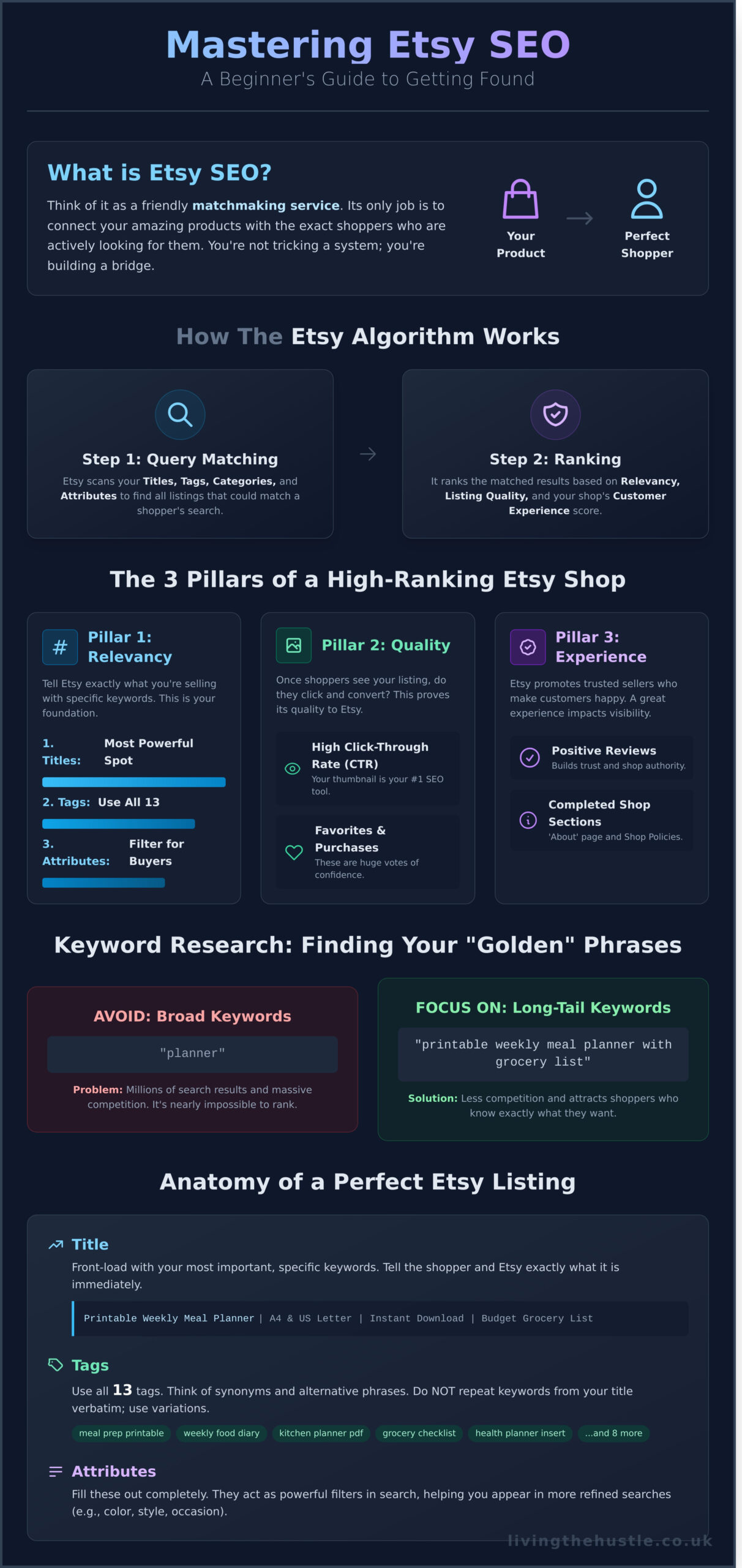
The Etsy algorithm is your partner, not your enemy. It uses a two-step process to connect buyers with your listings. Understanding this is the first gentle step in mastering Etsy SEO for beginners.
- Query Matching: First, the algorithm scans your titles, tags, categories, and attributes to find every listing that could be a potential match for a shopper's search term.
- Ranking: Next, it ranks those results based on factors like relevancy (how well you match the search), listing quality (good photos and high conversion rates), and your shop's overall customer experience score.
SEO as a Bridge, Not a Barrier
The best way to approach SEO is to shift your mindset from ‘tricking the system’ to ‘helping the customer.’ Your goal is to build a clear bridge between what a shopper wants and what you offer. As a new seller, Etsy even gives you a small, temporary boost in search to gather data on your listings-use it! Start with a sense of purpose, not panic. By focusing on clear, helpful descriptions and keywords, you’re not just optimizing for a robot; you’re creating a better experience for a real person.
The 3 Pillars of a High-Ranking Etsy Shop
Let's be honest, SEO can feel overwhelming. But when it comes to etsy seo for beginners, it helps to think of it not as a complex code, but as three simple pillars. Etsy’s goal is to connect a happy buyer with a great product. Your job is to prove your shop is the perfect match by mastering Relevancy, Quality, and Experience.
Pillar 1: Keywords and Relevancy
This is your chance to tell Etsy exactly what you're selling. Think of it as a clear conversation-the more specific you are, the better Etsy can match you with the right shoppers. Your keywords have a clear hierarchy:
- Titles: The most powerful spot. Place your most important, specific phrase here, like “Printable Weekly Meal Planner.”
- Tags: Use all 13! Think of synonyms and alternative phrases your customer might type into the search bar.
- Attributes: These are the filters (color, style, etc.). Filling them out completely helps you appear in more refined searches.
Even in 2026, using an exact-match phrase that a buyer would actually search for still gives you a powerful edge.
Pillar 2: Conversion and Quality
Once a shopper sees your listing, do they click? This is your Listing Quality Score in action. Etsy watches how users interact with your products to judge their quality and appeal.
Your thumbnail image is your most important SEO tool here. A high click-through rate (CTR) tells Etsy your listing is a great match for the search. For digital sellers, creating mockups that earn clicks is crucial. If you need a little help, The Art of Design is your gentle guide to creating visuals that stand out. When someone favorites or buys your item, it’s a huge vote of confidence that tells the algorithm your SEO is working.
Beyond static images, incorporating video into your listings is becoming a powerful way to boost conversion. A short clip showing your product in use can dramatically increase buyer confidence. For those looking to elevate their brand with professional creative content, exploring the work of a full-service agency like AHS Digital can provide inspiration on how to present your products in the best possible light.
Similarly, studying how successful independent brands present their handcrafted items can be incredibly inspiring. For a masterclass in product photography and building a premium feel that drives conversions, you can check out KaMila Fine Jewellery.
For sellers specializing in art prints or photography, studying how established galleries present their work is also incredibly valuable. As a source of inspiration for high-end curation and product presentation, you can check out Galerie Prints.
Pillar 3: Shop & Customer Experience
This final pillar is about trust. Do you provide a great experience from start to finish? Positive reviews, a completed ‘About' section, and clear shop policies all contribute to your shop’s authority. Etsy wants to promote sellers who make their customers happy, a core principle you can see reflected throughout Etsy's Ultimate Guide to Marketing. A great customer experience directly impacts your visibility.
Digital product sellers have a secret weapon here: instant delivery! This often leads to quicker, happier reviews, giving your shop an effortless boost in this crucial pillar.
Keyword Research: Finding Your ‘Golden' Search Phrases
If you feel like your products are a needle in a digital haystack, you're not alone. The secret to getting seen isn't shouting louder; it's learning to speak your customer's language. That language is built on keywords, and finding the right ones is the most important part of etsy seo for beginners.
Let's start with a common mistake. A new seller might try to rank for a broad keyword like “planner.” This term has millions of search results, making it nearly impossible to compete. Instead, we focus on long-tail keywords-longer, more specific phrases like “printable weekly meal planner with grocery list.” These phrases have less competition and attract shoppers who know exactly what they want.
A simple way to start is with Etsy's own search bar. Type in a broad idea like “budget spreadsheet” and let the auto-suggest feature show you what real customers are searching for. This is your first clue to what's in demand!
Using eRank to Find Low-Competition Gems
When you're ready to dig deeper with real data, eRank becomes your best friend. This tool is designed to take the guesswork out of your research. We have a full guide on using eRank for Etsy Sellers, but the goal is to find keywords with ‘green' metrics-meaning high search volume and low competition. It also helps you spot the difference between a seasonal trend (like a “Christmas gift tracker”) and an evergreen product that sells all year.
The ‘Customer Conversation' Method
Tools are great, but your greatest insights come from empathy. Imagine a conversation with your ideal customer. What problem are they trying to solve? They might not search for a “daily planner”; they might search for a solution like “adhd organization” or “how to manage a chaotic schedule.” Thinking this way helps you find powerful, solution-based keywords.
Your gentle first step: Try writing a single sentence that defines your niche using three long-tail keywords you've discovered. This simple exercise builds confidence and brings clarity to your shop's purpose.
Step-by-Step: Optimizing Your Etsy Listing for Maximum Visibility
Ready to take a calm, deep breath? This is where your keyword research meets action. Optimizing an individual listing is the most hands-on part of etsy seo for beginners, but we're going to approach it with purpose, not panic. By focusing on four key areas-your title, tags, attributes, and description-you can give your product the best possible chance of getting found.
Writing Titles That Both Humans and Robots Love
Your title is your digital handshake, so make it a good one. Always “front-load” your most important, specific search term. Instead of a ‘panic' title stuffed with jumbled words like Mug Gift Coffee Cup Funny, create a ‘purpose' title that tells a story: Funny Work Mug for Coworker | "My Brain Has Too Many Tabs Open" Sarcastic Coffee Cup. It’s welcoming for shoppers and perfectly clear for the Etsy algorithm. Use separators like pipes (|) or dashes (-) to keep it organized.
Mastering the 13 Tags and Your Attributes
Think of your 13 tags as 13 more chances to connect with a buyer. The key is to use multi-word phrases that mimic how real people search. For example, “work from home gift” is much stronger than using three separate tags for “work,” “home,” and “gift.” Diversify your tags with synonyms and use-cases, like “office secret santa,” “funny colleague gift,” or “sarcastic desk decor.” Don't forget your Attributes! These dropdowns for color, style, and occasion are powerful search filters and a form of ‘hidden' SEO that many sellers overlook. Fill out every relevant option.
Optimizing Descriptions for Conversion
While Etsy search prioritizes titles and tags, your description is crucial for converting browsers into buyers and getting seen on Google. The first 160 characters often become your Google search snippet, so weave your main keyword phrase into the first sentence naturally.
- Reduce overwhelm: Use bullet points to list key details like dimensions, materials, and care instructions. This makes your information scannable and easy to digest.
- Add a gentle nudge: End with a clear, simple call to action. Something like, “Explore more quirky and fun gifts in my shop!” encourages shoppers to stick around.
Tackling your listings one by one with this framework builds incredible confidence and momentum. For more gentle strategies to grow your creative business, explore the resources at livingthehustle.co.uk.
The ‘Calm' SEO Routine: How to Maintain and Scale
You’ve done the hard work of researching and applying your keywords. Now comes the most challenging part: waiting. It’s tempting to dive back in and change everything if sales don't appear overnight, but effective SEO requires patience. The ‘wait and see' rule is a core part of mastering etsy seo for beginners. Give the Etsy algorithm at least 30-60 days to “settle” and learn where your listing fits before making major changes. Constant tweaking can confuse the algorithm and reset your progress.
Reviewing Your Progress Without the Panic
Instead of obsessively refreshing your stats, schedule a gentle, monthly check-in. Head to your Etsy Stats > How shoppers found you. The ‘Search terms' report here is pure gold-it shows the exact phrases customers used to find your listings.
- Identify Your Wins: See a keyword driving consistent visits? That's a winner. Don't touch it! This is clear data showing what your audience is searching for.
- Scale Your Success: Use that winning keyword as inspiration. If “boho digital planner” is a hit, create variations like “earthy weekly planner” or “neutral goodnotes planner” for new products to attract a similar audience.
- When to Refresh: If a listing has been live for 2-3 months with good keywords but has seen a significant drop in views and sales, it might be time for a gentle refresh. Update the main photo, tweak the title slightly, or swap out a few underperforming tags based on your new research.
Building a Sustainable Business Beyond Search
Think of SEO as the friendly signpost that guides your ideal customers to your digital storefront. It’s a crucial piece of the puzzle, but your incredible products are what build a lasting business. As you gain confidence, you'll naturally start looking at the bigger picture. Taking the next step from first sale to full-time income is an exciting journey that involves building a brand and creating a true passive income stream.
As your shop grows and you're ready to scale beyond DIY efforts, you can discover Social Magic, an agency that specializes in taking creative brands to the next level. They can handle everything from advanced SEO to broader online advertising campaigns, allowing you to focus on your creative work.
Remember, you already have the creative talent. SEO is just the skill that helps the right people discover it. You’ve learned the fundamentals, and now you have a clear, calm path to follow. Keep creating, stay patient, and trust the process. You've got this.
Your Calm Path to Etsy Success
See? Mastering etsy seo for beginners isn't about complex, overwhelming tactics. It's about a gentle, consistent process built on two core ideas: finding the right keywords your customers are using, and weaving them thoughtfully into your titles, tags, and descriptions. This simple, repeatable routine is the true key to getting your beautiful products found without the panic or the burnout. You've learned the fundamentals, and that's a huge, confident first step.
If this calm, methodical approach to building your shop resonates, and you’re ready for more than just visibility, I’m here to guide you. The Passive Income Society is your next step, offering the step-by-step guidance total beginners need. We focus on proven strategies for digital product success and sustainable, ‘calm' business growth. It’s about building a business that serves you, not the other way around. Ready to turn your creativity into a calm, profitable business? Join the Passive Income Society today.
You have the power to build this. You're already on your way.
Frequently Asked Questions
How long does it take for Etsy SEO to start working?
Let's be honest, we all want instant results! But Etsy SEO is a gentle, gradual process. You might see small changes in a few weeks, but it can take 30 to 60 days for Etsy's algorithm to fully recognize and rank your updated listings. The key is to stay consistent and patient. Focus on making steady improvements rather than expecting an overnight jump in traffic. This is a marathon, not a sprint, for your calm hustle.
Do I need to put my keywords in my Etsy shop description?
This is a common point of overwhelm, but the answer is simple: no! Your shop description is for your human customers, not the Etsy search algorithm. Use this space to tell your story, build trust, and connect with shoppers who have already found you. Focus your keyword efforts on your listing titles, tags, attributes, and categories, where they will have a real impact on your visibility. This keeps your SEO strategy clear and manageable.
Should I repeat my title in my tags?
Absolutely! Think of your title and tags as working together to tell Etsy what your item is. If your title is “Minimalist Gold Bar Necklace,” you should use tags like “gold bar necklace” and “minimalist necklace.” You don't need to use the exact full title as one tag. Breaking up your strong title keywords into individual tags gives you more chances to be found in different searches, boosting your visibility without the extra stress.
Is it better to have short or long titles on Etsy?
Longer, descriptive titles are almost always better. Don't be afraid to use all 140 characters available! A title like “Printable Weekly Planner” is good, but “Printable Weekly Planner, Undated A4/Letter, Minimalist To-Do List, Digital Download” is much better. It gives shoppers more information and includes more keywords for Etsy to match with searches. A clear, long title helps both your customers and your SEO, making it a confident choice for your shop.
Can I use the same keywords for all my listings?
It’s tempting to copy and paste, but it’s best to use unique keywords for each listing unless the products are nearly identical. Your goal is to be as specific as possible. For example, a “blue floral mug” and a “red striped mug” should have different keywords. Using specific keywords helps the right shoppers find the exact item they’re looking for. This targeted approach is a key part of building a successful, sustainable shop on Etsy.
How often should I update my Etsy SEO?
You don't need to panic and update your SEO every week! A gentle, consistent approach works best. A good practice for Etsy SEO for beginners is to review your stats every few months. If a listing's views are dropping, it might be time for a keyword refresh. Also, consider updating seasonally for items like holiday decor. The goal is to make purposeful changes based on data, not to constantly chase the algorithm.
Does free shipping help my Etsy SEO ranking?
Yes, it definitely does! Etsy has confirmed that listings with free shipping (or a free shipping guarantee for US orders over $35) are prioritized in US search results. While it's a business decision you need to make for your own shop, offering it can give your listings a significant boost in visibility. It’s one of the clearest signals you can send to both Etsy and your customers that you offer a great shopping experience.