

What if the choice between Etsy and your own website isn't about which platform is “better,” but about which one honors your peace of mind right now? When you're weighing etsy vs own website digital products, it's easy to feel stuck between two stressful extremes. You might worry about Etsy's 6.5% transaction fees eating your small margins, or perhaps you feel a sense of technical overwhelm at the thought of building a site from scratch. It's a heavy weight to carry when you just want to share your creativity with the world.
We understand that you want a business that feels sustainable and calm. You've likely felt the fear of being hidden by an algorithm or the frustration of paying $0.20 just to list a single item. Think of Etsy as your training ground and your own website as your eventual empire. This guide is here to help you discover the most profitable and peaceful path forward. We'll compare the built-in audience of 92 million Etsy shoppers against the total freedom of your own digital storefront.
By the end of this article, you'll have a clear, low-stress plan to start selling with confidence. We'll break down the real costs and the technical hurdles so you can build your business without the headache. Let's find the solution that fits your life and your goals perfectly.
Key Takeaways
- Learn the essential differences between a shared marketplace and a personal website so you can choose the path that feels most manageable for you.
- See how Etsy acts as a low-stress training ground, allowing you to reach over 92 million active shoppers without a complex marketing plan.
- Compare the long-term profit potential of etsy vs own website digital products to find the balance between ease of use and financial freedom.
- Discover a peaceful two-phase plan to validate your digital products first and then build a permanent brand you truly own.
- Identify the simple steps to transition from a marketplace seller to a confident business owner with the help of the Blog, Brand & Bloom Workbook.
The Digital Product Dilemma: Why Platform Choice Matters
Have you ever felt like you're building your dream on borrowed ground? When you're deciding between etsy vs own website digital products, it's about much more than just where to upload your files. It's about how you want your daily life to feel. You likely started this journey to find more freedom, perhaps chasing that passive income dream where your shop works for you while you're resting or spending time with family. Digital products like printables, planners, and templates are the perfect vehicle for this because they remove the stress of physical inventory and shipping.
The platform you choose acts as the foundation for this peaceful lifestyle. If the foundation is shaky or too restrictive, your business can quickly start to feel like another high-pressure job. By understanding the core differences now, you can build a sustainable path that honors your energy and your time. It is about finding that sweet spot where productivity meets tranquility.
Marketplace vs. Independent Storefront
Think of Etsy as a booth in a massive, bustling shopping mall. The mall provides the lights, the security, and, most importantly, the shoppers. Etsy's business model is designed to bring people together, which is why it's such a popular entry point for new creators. However, you don't own the mall. If the mall owners change the rules or decide to close your shop, you lose your connection to those customers overnight. It's a common fear that can keep many creators feeling stuck.
Your own website is more like a charming boutique on a quiet high street. You own the building, you choose the decor, and you keep the keys. While you have to do more work to invite people inside, you have total control over the experience. In the 2026 economy, this ownership is vital. It allows you to build a direct relationship with your audience using tools like the Blog, Brand & Bloom Workbook to define your unique voice away from the marketplace noise.
The 2026 Digital Product Landscape
The way people shop for digital goods has shifted significantly. With the creator economy valued at over $250 billion in 2024, shoppers are no longer just looking for the cheapest option in a crowded marketplace. They are looking for niche authority and creators they can trust. When weighing etsy vs own website digital products in 2026, remember that shoppers are moving toward specialized solutions.
Right now, instant gratification is your greatest asset. Whether it's a Notion template or a junk journal printable, customers want immediate access to solutions that make their lives easier. By positioning yourself as a trusted guide in a specific niche, you move away from the “general” feel of a marketplace and toward a brand that people actively seek out for its unique value and heart.
Selling on Etsy: The Low-Stress Entry Point for Beginners
Starting a new business often feels like a mountain to climb. Etsy flattens that mountain for you. It's a gentle, low-stress entry point because it solves the two biggest problems beginners face: finding customers and handling the technology. You don't need a massive marketing budget or a degree in web design to get your first sale. For many, this is the most manageable way to start a side project without feeling overwhelmed by technical details.
With over 92 million active shoppers, the audience is already waiting for you. These people visit the site with their wallets out, ready to buy. When weighing the choice of etsy vs own website digital products, this built-in trust is a massive shortcut. Shoppers feel safe knowing their payment information is secure and they'll receive their files instantly. You can start your shop for just $0.20 per listing, which is a very low barrier to entry for anyone testing a new creative idea.
Why Etsy Loves Digital Products
Etsy is perfectly set up for the “instant gratification” that digital buyers crave. When someone buys your printable planner or template, the platform handles the secure delivery of PDFs, JPEGs, and ZIP files automatically. You don't have to be at your computer to fulfill orders. To help you get found, the site uses its own search engine. You can use erank for etsy sellers to find low-competition digital niches. This helps you get your products in front of the right eyes without having to build a social media following first.
The Trade-offs: Fees and Competition
Every convenience comes with a cost. While Etsy is easy to use, the fees can add up as you grow. As discussed in this look at Shopify Vs. Etsy, you're paying for the access to their audience. You'll face a $0.20 listing fee, a 6.5% transaction fee, and payment processing fees. These are manageable when you're starting, but they're important to track to keep your business sustainable. When comparing etsy vs own website digital products, these fees are the price of a simpler setup.
The marketplace can also feel like a “sea of sameness.” Because you're listed right next to your competitors, it's easy to feel pressured to lower your prices. You're essentially renting space on their platform. You don't own the customer list, which makes it harder to build long-term brand loyalty. If you want to move beyond these limits, you might eventually explore the Passive Income Society Course to learn how to scale your reach. For now, enjoy the ease that a marketplace provides while you validate your beautiful ideas.
Your Own Website: Building a Permanent Home for Your Brand
While Etsy is a lovely place to start, there comes a time when you might want a space that's truly yours. The biggest shift in the etsy vs own website digital products debate is moving from being a “seller” to being a “brand owner.” When you own your website, you have the ultimate peace of mind. No one can shut down your shop overnight because of a sudden policy change or an algorithm glitch. You own the domain, you own the customer data, and you own the future of your business.
Financial freedom feels a lot closer when you aren't paying a 6.5% transaction fee on every sale. On your own site, you generally only pay your platform subscription and standard payment processing fees. This means your profit margins stay healthy even as you scale. You also have the freedom to integrate an email list directly into your checkout process. This is the secret to turning a one-time buyer into a loyal friend who comes back whenever you release a new planner or template.
Modern Platforms for Digital Sellers
You don't need to be a coding expert to build a beautiful digital storefront. Shopify is often considered the gold standard for scalability because it has incredible apps specifically for digital file delivery. If you're mostly selling through social media, Stan Store offers a simple “link in bio” solution that makes buying your products incredibly easy for your followers. For those who want absolute control and a place to write long-form blog posts, WordPress with WooCommerce provides a flexible, permanent home that can grow with you for decades.
The Marketing Responsibility
It's important to be honest about the effort involved. If you build it, they won't necessarily come. This is often called the “Ghost Town” risk. Unlike Etsy, your own website doesn't come with a built-in audience. You'll need to invite people in through SEO, Pinterest, or social media marketing. This is where your creativity truly shines. To make sure your products are high-quality enough to drive that traffic and keep people talking, you might explore the art of design. Creating something beautiful is the first step to building a brand that people actively seek out. It takes more work to get the doors swinging, but the rewards of ownership are well worth the initial push.
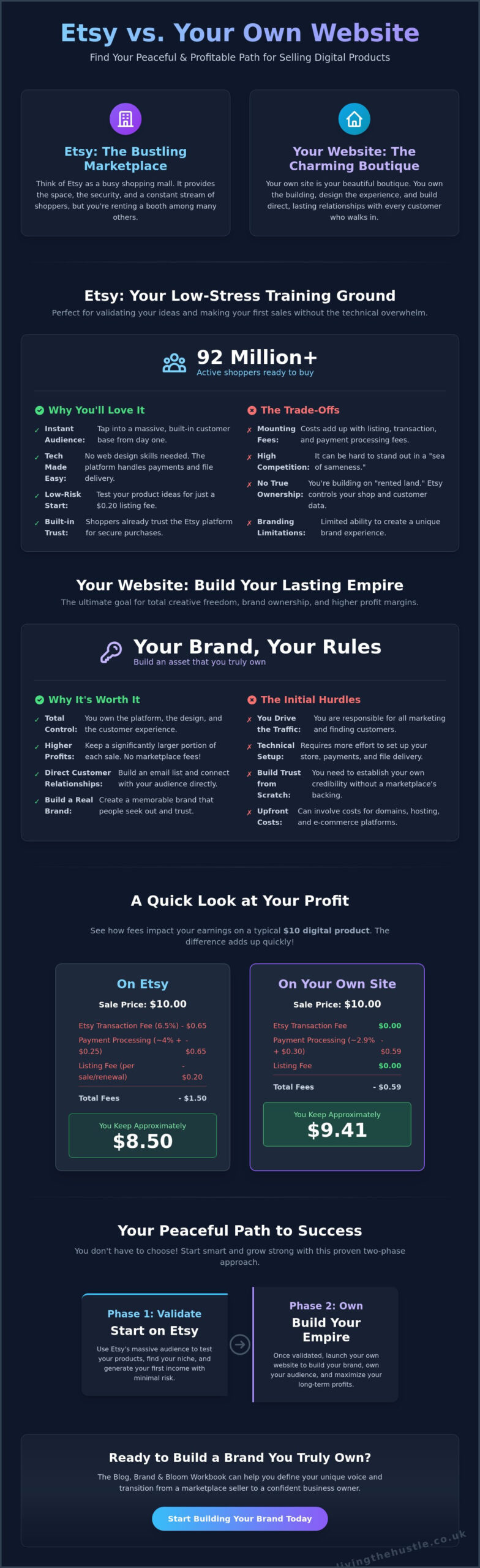
Etsy vs. Website: A Side-by-Side Comparison for 2026
Choosing between etsy vs own website digital products often comes down to your current season of life. Do you have more time or more money right now? Etsy is the clear winner for speed and simplicity. You can open a shop and list your first printable in a single afternoon. Building your own website is a much slower, more intentional process. It usually takes days or even weeks to get the design and tech exactly right. If you're feeling a bit stuck, starting small on a marketplace can give you the momentum you need to keep moving forward.
The technical skill required varies significantly between the two. Etsy handles the security, the hosting, and the automatic file delivery. It's a low-stress environment for beginners. A website requires a moderate level of skill to maintain. You'll be responsible for updates, backups, and ensuring your site stays fast. While this sounds daunting, it's the price of total freedom. On Etsy, you are essentially renting your customers. On your own site, you own the relationship from day one. You can speak directly to your audience without a middleman standing in the way.
Fee Comparison Breakdown
Let's look at the numbers with a calm mind. Etsy charges a 6.5% transaction fee plus a $0.20 listing fee. This is a great deal for low-volume sellers because you only pay when you make a sale. However, as your business grows, these percentages start to sting. Once you're making consistent sales, a monthly subscription for a website platform, which typically ranges from $20 to $50, often becomes the more profitable choice.
Marketing Effort vs. Organic Reach
Etsy provides organic reach through its internal search engine. Millions of people are already there looking for “digital planners” or “Notion templates.” You just need to show up where they're already looking. Google SEO for your own website is a much longer game. It takes time and patience for your site to build authority and show up in search results.
Pinterest is the secret weapon for both platforms. It acts as a visual search engine that can drive traffic to an Etsy shop or a personal blog with equal power. To understand the full landscape of marketplace traffic, you can read our guide on how to sell digital products on etsy. If you're ready to build a business that supports your lifestyle without the constant hustle, explore the Passive Income Society Course for a clear, manageable roadmap to success.
The Calm Growth Strategy: How to Have the Best of Both Worlds
The debate over etsy vs own website digital products often feels like you must choose one side or the other. But why limit yourself? You can build a business that evolves as you grow, moving from a marketplace beginner to a brand owner at your own pace. This is what we call a calm growth strategy. It allows you to leverage the strengths of both platforms while keeping your stress levels low and your creative energy high.
Think of this as a four-phase journey toward a sustainable lifestyle business:
- Phase 1: Validate on Etsy. Use the built-in audience of 92 million shoppers to test your ideas. This is the time to see which planners or templates people actually want to buy before you invest in a complex website.
- Phase 2: Build Your Brand. Once you have a few consistent sales, it's time to define your unique voice. Use the Blog, Brand & Bloom Workbook to create a cohesive aesthetic that stands out from the marketplace noise.
- Phase 3: Diversify. Launch your own website as your permanent home. Keep your Etsy shop open as a “lead generator” to introduce new people to your work, then invite them back to your own site for exclusive offers.
Transitioning Without the Overwhelm
How do you know when it's the right time to move? A good milestone is when your Etsy transaction and listing fees start to exceed the monthly cost of a website subscription, which is typically between $20 and $50. If you're consistently paying more than that in fees, moving to your own storefront is a smart financial step. You can also use Etsy to grow your email list by including a link to a freebie in your “Message to Buyers.” This helps you build a community you own legally and calmly. Managing this transition is much easier when you have a clear plan, like the one found in our Calm Creators Content Planner.
Your Next Steps to Passive Income
The most important thing you can do today is simply start. Whether you choose the low-stress entry point of Etsy or the total freedom of your own website, you are taking a step toward a more purposeful life. You don't have to navigate this journey alone. Structured learning and a supportive community can make the process feel much more manageable. If you're ready to build a digital product business that supports your well-being, we invite you to join the Passive Income Society. Let's find your most profitable and peaceful path together.
Your Path to a Peaceful Digital Business
You've explored the strengths of massive marketplaces and the freedom of independent storefronts. Remember that Etsy is a wonderful training ground while your own website is your eventual empire. Validating your ideas first allows you to grow without the heavy weight of technical overwhelm. By transitioning slowly as your sales increase, you keep your profit margins healthy and your creative heart happy. Balancing etsy vs own website digital products is really about matching the platform to your current energy and goals.
We've helped over 1,000 students navigate this exact journey with step-by-step guidance designed specifically for tech-phobes. You don't need to be a coding expert to find success. If you're ready for sustainable, low-stress growth that honors your time, Join the Passive Income Society and build your digital empire calmly. Your dream of a manageable, passion-driven endeavor is well within reach. Take that first small, confident step today and watch your beautiful business bloom.
Frequently Asked Questions
Is it better to start on Etsy or my own website for digital products?
Starting on Etsy is generally the best choice for beginners because it provides a built-in audience of over 92 million active shoppers. This allows you to test your designs and see what people actually want to buy without needing an initial marketing budget. It's a low-stress way to gain confidence. Once you have a proven product and a small following, you can think about moving to your own site.
Can I sell the same digital products on both Etsy and my own website?
You can absolutely sell the same digital items on both platforms simultaneously to diversify your income. This is a smart strategy to reach different types of shoppers while building your own brand in the background. Just ensure your branding and customer service stay consistent across both storefronts. Many successful creators use Etsy to find new customers and then offer exclusive rewards or bundles on their personal website.
Which platform is cheaper for a total beginner?
Etsy is the most budget-friendly option for beginners because you only pay $0.20 to list an item. A dedicated website builder usually costs between $20 and $50 every month, regardless of whether you make a sale. When comparing etsy vs own website digital products, the marketplace is much safer for those testing the waters. You only face significant fees, like the 6.5% transaction charge, after you've actually earned money.
Do I need a business license to sell digital products on Etsy vs. my own site?
Your need for a business license depends on your local government and country regulations rather than the platform you choose. Most sites don't require a license to open a shop, but you should check your local city or state requirements for home-based business permits. It's a good idea to consult a local professional or a government website to ensure you're operating legally. Doing this early provides real peace of mind.
How do I handle VAT and taxes for digital downloads on my own website?
Etsy handles the collection and remittance of VAT on digital items automatically, but on your own website, you are responsible for this. Most modern e-commerce platforms offer simple plugins or built-in tools to calculate these taxes based on where your buyer lives. Using automated tax software can help you manage this without a technical headache. It keeps your business growth manageable and compliant while you focus on your creative work.
Does Etsy SEO work differently than Google SEO for digital items?
Etsy SEO focuses on helping shoppers find your items within their specific marketplace using tags and titles. Google SEO is broader and requires you to build site authority through quality content and links from other websites. When weighing etsy vs own website digital products, remember that Etsy gives you faster visibility to people already looking to buy. Google takes more patience but eventually provides a permanent stream of traffic you don't pay for.
What is the best website builder for digital products in 2026?
Shopify remains the gold standard in 2026 for its reliability and excellent apps that handle digital file delivery securely. If you want a simpler solution for social media, Stan Store is a fantastic “link in bio” option that makes buying very easy for followers. Both platforms handle the instant gratification buyers expect today. Choose the one that feels most manageable for your current skill level so you can avoid technical frustration.
How do I protect my digital products from being stolen on my own website?
You can deter theft by using watermarks on your preview images and including clear licensing terms with every purchase. Most modern delivery apps also use secure, expiring links to prevent people from sharing your files widely. While no method is 100% foolproof, most customers are honest and happy to support creators. Focus on building a trustworthy brand, as this naturally encourages people to respect your hard work and creative energy.