

What if your bank account could grow while you're actually sleeping, without you needing to be a math genius or a tech wizard? Let's be honest; setting financial goals for etsy shop growth often feels more like a math test you didn't study for than a creative adventure. You might feel overwhelmed by the 6.5% transaction fees or the 12% offsite ad costs, wondering if there's actually any profit left for you. It's easy to feel stuck when the numbers don't seem to add up and the tech feels like a barrier.
I know exactly how it feels to stare at a spreadsheet and want to close your laptop forever. It's completely normal to feel a little bit of panic when you think about investing your hard earned money into a business that hasn't quite taken off yet. The good news is that building a digital product business doesn't have to be stressful or complicated. In this guide, I'll show you how to set gentle, realistic milestones that lead to true financial independence through passive income. We'll walk through a clear plan to track your profits and price your products with total confidence. You'll learn how to move past the fear of Etsy fees and start making your money work for you, so you can focus on creating instead of worrying.
Key Takeaways
- Define calm milestones that protect your energy and prevent burnout while your business grows.
- Identify the difference between fixed and variable costs to gain total clarity on your true profit margins.
- Follow a gentle month-by-month roadmap for setting financial goals for etsy shop growth during your first year.
- Master the transition to true passive income by focusing on evergreen digital products and seasonal trends.
- Learn how a structured framework can remove the financial guesswork and help you build your shop with quiet confidence.
Setting Financial Goals for Your Etsy Shop Without the Overwhelm
Most business advice starts with a scary spreadsheet and a lot of complicated math. If that makes you want to close your laptop and hide, you aren't alone. Traditional hustle culture tells us that more is always better and that we should be aiming for “six figures” from day one. This high-pressure approach usually leads straight to burnout. When you set financial goals for etsy shop success, you're choosing a different path. You're choosing to value your mental well-being as much as your bank balance. A “Calm Financial Goal” is simply a target that respects your time and energy while moving you toward profit.
Understanding the platform is the first step toward building confidence. Over the years, Etsy's business model has evolved to support millions of creative entrepreneurs, making it a perfect home for digital product sellers. Within this space, it helps to distinguish between survival goals and freedom goals. A survival goal is your baseline. It covers your basic costs, like the $0.20 listing fee and your design software subscriptions. A freedom goal is much more exciting. This is the amount that allows you to pay for a family holiday or eventually replace your main income. A financial goal for your Etsy shop is a gentle roadmap that transforms your creative passion into a sustainable path toward personal and financial freedom.
The “Purpose Over Panic” Mindset
Before you look at “how much” you want to earn, you must identify your “why.” Are you looking for extra grocery money, or are you building a full-time legacy? Identifying this purpose prevents the panic that comes when you compare your start to someone else's middle. In 2026, the most successful shops are embracing intentional, slow-growth models. By auditing your numbers with a gentle, step-by-step approach, you can replace fear with clarity. If you're feeling stuck, resources like the Blog, Brand & Bloom Workbook can help you align your vision with your business plan.
SMART Goals vs. Sustainable Goals
We've all heard of SMART goals, but creative sellers need something more flexible. A sustainable goal accounts for the ebb and flow of life. Try setting “Low, Mid, and High” targets for each month to reduce performance anxiety. Your “Low” target might just cover your basic fees, while your “High” target is a reach goal for busy seasons. This tiered approach keeps you motivated even during naturally slower sales months. It reminds you that progress isn't always a straight line, and that is perfectly okay.
The Anatomy of an Etsy Budget: Tracking Costs and Profits Calmly
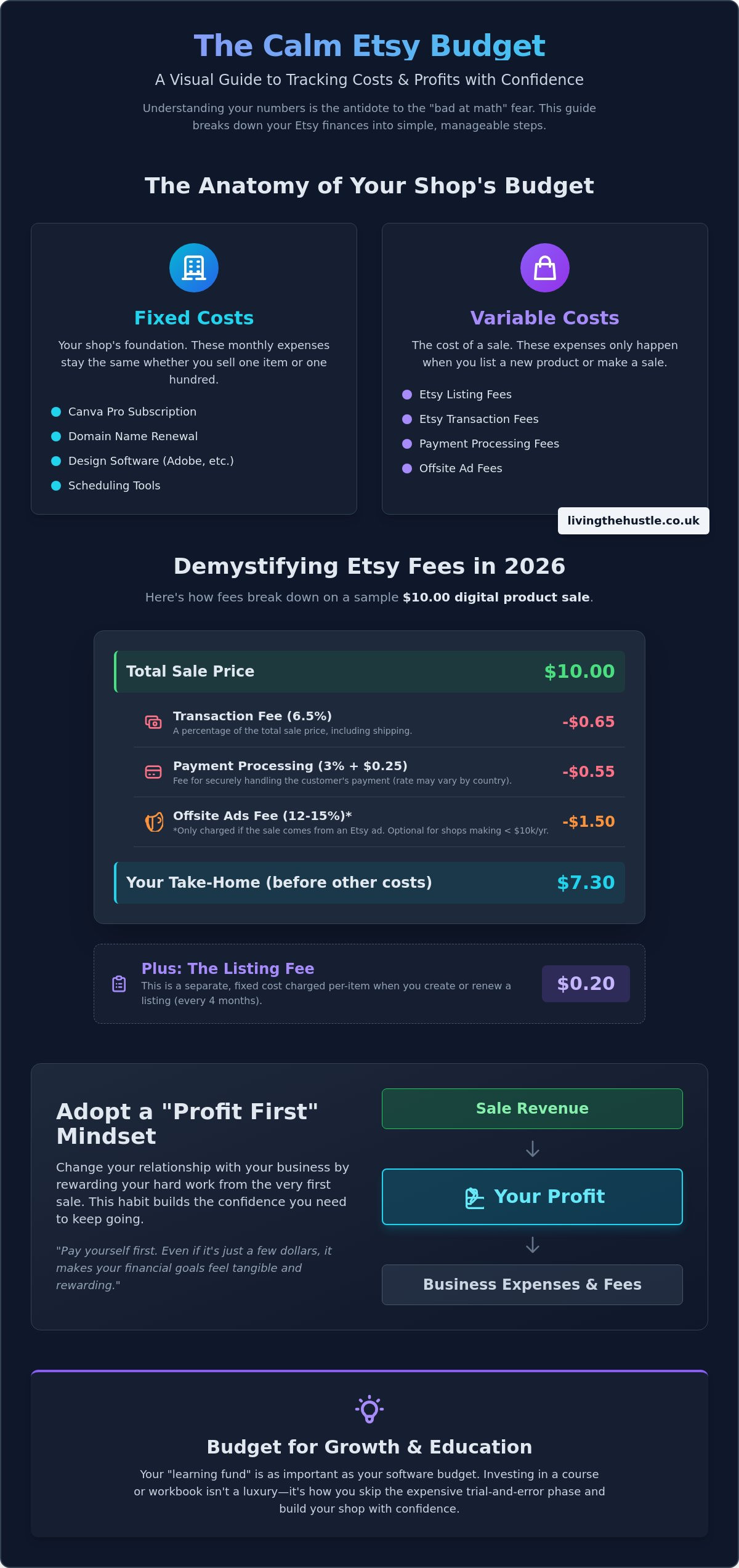
Understanding your numbers is the antidote to the “bad at math” fear that stops so many creative people in their tracks. You don't need to be a spreadsheet expert to track your budget effectively. Instead, think of your budget as a tool for clarity. When you set financial goals for etsy shop growth, you're creating a safe space for your creativity to thrive. It helps to separate your costs into two simple piles. First, you have fixed costs. These are the monthly expenses that keep your shop running, like your Canva Pro subscription or your domain name. They stay the same whether you sell one item or one hundred.
Then, you have variable costs. These only happen when you make a move or a sale. For example, every time you list a product, Etsy charges $0.20. When you make a sale, they take a 6.5% transaction fee plus a payment processing fee of 3% plus $0.25. If you're using offsite ads, that might be another 12% or 15% depending on your shop's volume. This can feel like a lot, but it's just part of the journey. Looking at financial projections for your business helps you see that these fees are simply investments in a platform that brings 93 million active buyers to your door.
One of the best things you can do for your mindset is to adopt a “Profit First” approach. This means you set aside a small percentage for yourself from the very first sale. Even if it's just a few pounds, it changes your relationship with your business. You aren't just paying fees; you're rewarding your own hard work. This habit makes reaching your financial goals for etsy shop sustainability feel much more tangible and rewarding. Pay yourself first. It builds the confidence you need to keep going.
Demystifying Etsy Fees in 2026
Etsy's fee structure can feel like a puzzle, but it's manageable once you break it down. In 2026, the standard 6.5% transaction fee applies to the total sale price, including shipping. If an offsite ad brings in a buyer, Etsy takes an additional cut. For most of us making under $10,000 a year, this is an optional 15% fee. Read our guide on eRank for Etsy sellers to learn how to use data to offset these costs and keep your margins healthy.
Budgeting for Growth and Education
Your “learning fund” is just as important as your software budget. Investing in a course or a structured workbook isn't a luxury; it's a way to skip the expensive trial-and-error phase. If you're feeling overwhelmed by the technical side of things, the Blog, Brand & Bloom Workbook is a gentle way to invest in your future success. Ask yourself if a new tool will save you time or just add to the noise before you hit buy.
Realistic Milestones: What Financial Success Looks Like in Year One
Starting a new business is a marathon, not a sprint. During your first twelve months, your financial goals for etsy shop growth should be focused on learning and building a solid foundation. It's easy to get caught up in “six-figure” success stories, but true, sustainable growth happens in stages. In the first year, success isn't just about the balance in your bank account. It's about the systems you build and the confidence you gain as a creative business owner.
Months one to three are what I call the Foundation Phase. Your primary goal here is simply to get your shop open and secure your first ten sales. Setting realistic goals during this initial window keeps the overwhelm at bay. You're learning the platform, testing your product ideas, and getting comfortable with the tech. This period is less about high profit and more about proving that your ideas have a place in the market. The Digital Product Advantage means you have near-zero cost of goods sold, so even these small early wins are almost entirely profit.
From months four to nine, you enter the Momentum Phase. This is where you focus on SEO and expanding your product line to see what truly resonates with your audience. By the time you reach the end of your first year, reaching the “break-even” point is a massive accomplishment. This means your shop's revenue fully covers your listing fees, software subscriptions, and any initial education costs. Once you hit this milestone, every sale after that is pure growth.
The First Sale Milestone
That first “cha-ching” notification on your phone is magic. It's the ultimate proof of concept. While the profit from one sale might be small, the boost it gives your creative energy is huge. Celebrate every single win, no matter how tiny it seems. If you're still waiting for that first notification, follow our guide on How to Set Up an Etsy Shop in 2026 to ensure your foundation is rock solid.
Scaling to Your First £1,000 Month
Reaching a four-figure month is a dream for many, and with digital products, the math is surprisingly simple. If you sell a digital planner for £10, you only need 100 sales in a month to hit that £1,000 target. You don't need thousands of listings to get there; often, 30 to 50 high-quality, high-demand items are enough. You can learn more about the earning potential of different niches in our article on How Much Money Can You Make Selling Digital Products?. Focus on quality over quantity, and the numbers will follow.
Scaling Your Income: From Side Hustle to Sustainable Passive Income
Scaling a digital business feels very different from scaling a shop that sells physical goods. You don't need to buy more inventory or find a bigger warehouse. Instead, scaling means shifting your focus from active creation to managing passive wealth. Once you've set your initial financial goals for etsy shop stability, you can start looking at evergreen products. These are items that solve a problem or provide value all year long, like budget trackers or resume templates. They require work once and can sell thousands of times over. It builds confidence.
While evergreen products provide a steady floor for your income, seasonal trends provide the ceiling. Planning for “income spikes” around events like Christmas, Mother's Day, or the wedding season allows you to boost your earnings without constant hustle. By strategically adding seasonal items to your shop, you can hit your higher financial targets with much less effort. As your shop grows, you might realize that Etsy is just the beginning. You can build your blog brand without the overwhelm to create a platform you own entirely. This diversification is the secret to long-term security.
Reinvesting Profits for Passive Growth
There comes a point where your time becomes more valuable than your money. When you reach this stage, reinvesting your profits is the next logical step. You might hire a virtual assistant to handle Pinterest management or use Etsy ads to keep your bestsellers at the top of search results. This “buy back your time” strategy creates a compound interest effect. The more you automate and outsource, the more space you have to dream up your next big project. If you're ready to master this transition, our Passive Income Society Course provides the exact framework you need to scale with confidence.
Protecting Your Financial Future
Relying solely on one platform is a risk, no matter how successful your shop becomes. Changes to algorithms or fee structures can happen at any time. Building your own platform alongside your Etsy shop is the best way to protect your hard work. You can learn more about crafting a unique identity in our guide on the art of design. I also recommend creating a “Calm Buffer.” This is an emergency fund specifically for your business that covers at least three to six months of your fixed costs. Having this safety net allows you to make decisions from a place of peace rather than panic. It ensures that your financial goals for etsy shop longevity are always within reach.
Turning Your Financial Vision into Reality with Living the Hustle
Setting your vision is a beautiful first step. You've looked at the math; you've identified your milestones; you've started to see how financial goals for etsy shop growth can actually feel peaceful. But let's be honest. Even with a clear plan, the “how” can still feel a bit daunting. This is exactly why I created Living the Hustle. I want to help you remove the guesswork and the tech-induced panic that often comes with building an online business. You don't have to figure it all out by yourself through endless trial and error. Instead, you can follow a path that has already been paved with care and experience.
Our structured resources are designed to meet you exactly where you are. Whether you're just starting to think about your first digital product or you're ready to scale toward that four-figure month, there's a gentle way forward. We focus on building a high-margin shop that works for you, rather than you working for it. By focusing on digital products, you're already ahead of the curve. You've eliminated the stress of shipping, inventory, and physical production costs. Now, it's just about refining your strategy and showing up with quiet confidence.
The Passive Income Society Advantage
If you're looking for a complete roadmap, the Passive Income Society is our signature framework. It's designed specifically for the creative entrepreneur who wants to build a sustainable business without the burnout. We dive deep into the strategies that help you reach your financial goals for etsy shop success while keeping your well-being at the center. You can read a full Passive Income Society Review to see how this approach has helped others find their footing. It's the ultimate antidote to traditional business stress because it prioritizes a “Calm Creator” mindset from day one.
Start Your Journey Today
Taking the first step doesn't have to be a leap of faith into the unknown. It can be a gentle move toward the life you want to lead. If you're still in the planning phase, the Blog, Brand & Bloom Workbook is a perfect starting point. For those ready for a deeper dive, our premium training offers a structured environment where you can grow alongside a community of like-minded entrepreneurs. Having a supportive group around you is one of the best investments you can make. It reminds you that you aren't alone in your struggles or your wins. Trust yourself. You have the skills and the vision; now you just need the right tools to bring it all to life. Take that first step today without the panic.
Your Path to Calm Financial Freedom
You now have a gentle roadmap to transform your creative shop into a source of steady, passive wealth. We've walked through how to define milestones that protect your energy and how to track those pesky Etsy fees without losing your peace of mind. By focusing on evergreen digital products and the specific trends of 2026, you're building a business that works for you. Reaching your financial goals for etsy shop growth doesn't require a high-stress hustle; it requires a simple, sustainable plan. It's about moving from panic to purpose with every sale you make.
If you're ready to skip the trial and error, our most popular course for beginners offers exactly what you need. You'll get step-by-step guidance to avoid overwhelm while mastering the latest digital product strategies. You don't have to navigate this journey alone. Join the Passive Income Society and build your dream shop calmly. Your future self will thank you for taking this gentle first step today. You've got this, and I'm so excited to see what you create. Believe in your vision and start building.
Frequently Asked Questions
What is a realistic profit margin for an Etsy shop selling digital products?
Realistic profit margins for digital shops are usually between 70% and 85%. Since you don't have physical materials or shipping costs, your biggest expenses are the 6.5% transaction fee and the $0.20 listing fee. If you opt into offsite ads, your margin might dip toward 60%, but this is still incredibly high compared to physical goods. It's a great way to reach your financial goals for etsy shop sustainability.
How much should I set aside for taxes on my Etsy earnings in 2026?
You should generally set aside 25% to 30% of your net profit for taxes. In 2026, the federal reporting threshold for Form 1099-K is $20,000 and 200 transactions. Even if you don't hit that, you must report all income. If your net earnings are $400 or more, you'll also need to pay self-employment tax. Keeping this “tax pot” separate prevents any end-of-year panic.
Can I start an Etsy shop with zero budget?
You can't start for absolutely zero, but you can start for less than the price of a nice dinner. New shops in 2026 pay a one-time setup fee between $15 and $29. After that, your only mandatory cost is $0.20 per listing. You can use free versions of design tools like Canva to create your first products. It's a very gentle way to test your business ideas.
How often should I review my Etsy financial goals?
Reviewing your goals once every three months is a healthy rhythm. Checking your numbers every single day can lead to unnecessary stress and “refresh button” anxiety. A quarterly check-in gives you enough data to see real trends in your sales. You can then adjust your financial goals for etsy shop growth based on what's actually working in your specific niche.
Is it worth paying for Etsy Ads when I’m just starting out?
It's often better to wait until you have a proven seller before turning on Etsy Ads. When you're just starting, focus on your organic SEO and product quality. Once you see a specific item getting regular sales, ads can help amplify that success. Think of ads as a tool to scale your momentum rather than a way to create it from scratch.
What are the most common financial mistakes new Etsy sellers make?
The most common mistake is failing to account for the “hidden” flat fees. Beyond the 6.5% transaction fee, there's a 3% plus $0.25 payment processing fee for US sellers. If you price an item too low, these flat fees can eat a large chunk of your profit. Always run your numbers through a simple calculator before you hit publish to ensure you're actually making money.
How do I price my digital products to ensure I actually make a profit?
Start with value-based pricing rather than just looking at your costs. Research what similar high-quality digital products are selling for in your niche. Ensure your price covers the standard 10% to 13% in Etsy fees while leaving plenty of room for your own profit. Pricing a little higher often builds more customer confidence in the quality of your creative work.
What tools do I need to track my Etsy shop expenses effectively?
You don't need a degree in accounting or expensive software to track your shop. A simple, clean spreadsheet is often the best tool for beginners. You can track your monthly revenue, listing renewals, and subscription costs like Canva or domain names. Focus on clarity over complexity. This methodical approach keeps you organized and helps you feel in control of your business journey.