

What if looking at your Etsy rivals didn't have to feel like a comparison trap that leaves you feeling behind? It's completely natural to feel a bit overwhelmed when you see shops with thousands of sales and seemingly perfect branding. You might even worry that by looking too closely, you'll accidentally lose your own creative spark or end up copying someone else's hard work. I know that feeling of being stuck before you even begin, but learning how to analyze your etsy competition can actually be the very thing that sets you free to create something truly unique.
In this guide, you'll discover how to study your Etsy rivals to find your specific niche without the stress or overwhelm. We'll strip away the noise so you can find the data that actually matters for your growth, such as identifying keywords that are working right now and understanding current price points for digital products. We're going to walk through a simple, step by step strategy to help you find a gap in the market and fill it with your own signature style. It's time to build a shop that feels both profitable and authentically yours.
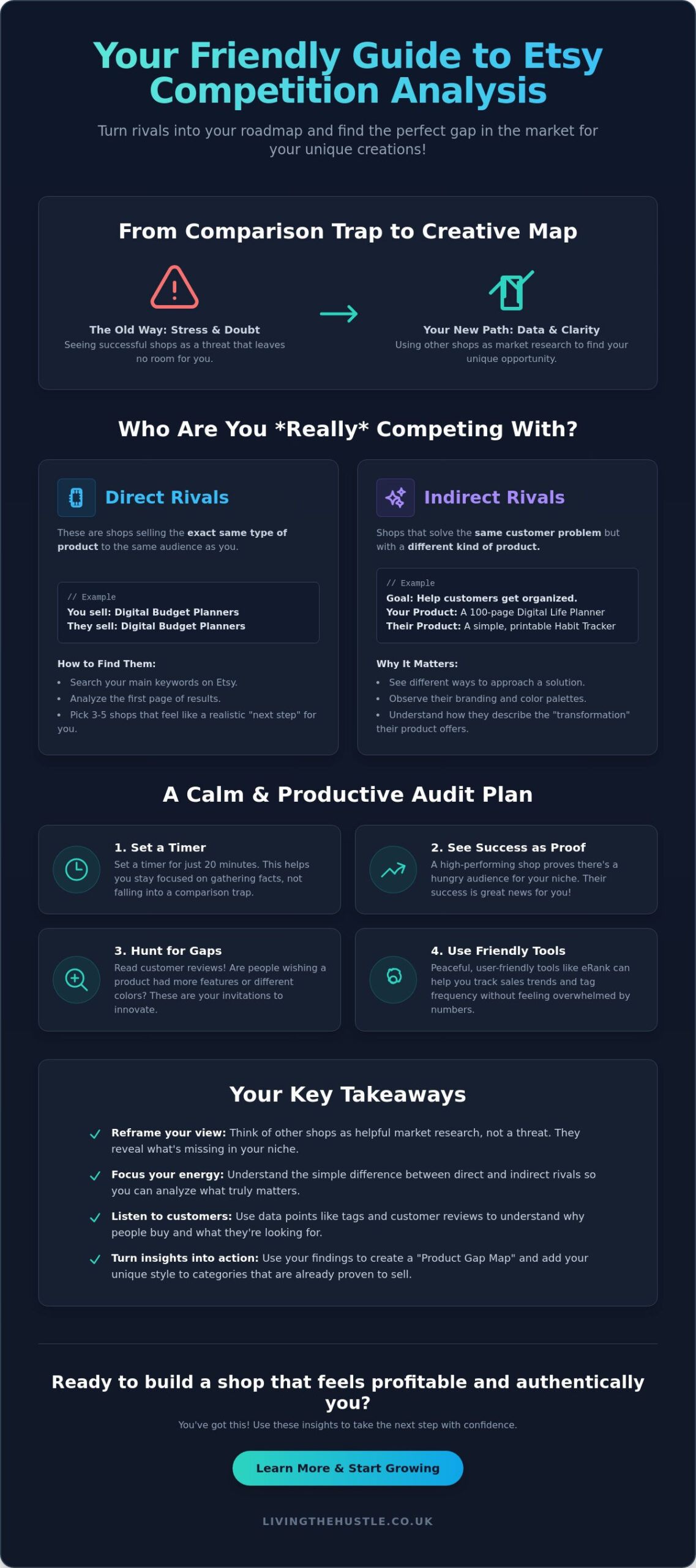
Key Takeaways
- Reframe your view of other shops as helpful market research that reveals exactly what is missing in your specific niche.
- Learn the simple difference between direct and indirect rivals so you can focus your energy on the shops that truly impact your reach.
- Discover how to analyze your etsy competition using straightforward data points like tags and customer reviews to understand why people buy.
- Explore peaceful, user friendly tools like eRank and RankHero to track sales trends and tag frequency without feeling overwhelmed by numbers.
- Turn your market insights into a clear Product Gap Map that helps you add your unique signature style to categories that are already proven to sell.
Why Competition Analysis is a Creative’s Best Friend (Not a Stressor)
Do you ever find yourself scrolling through successful Etsy shops and feeling a sudden weight in your chest? It’s a common feeling. We see hundreds of sales and glowing reviews, and our brains immediately tell us that there isn't any room left for us. But what if we changed the name of that feeling? Instead of seeing a threat, we can choose to see a map. Learning how to analyze your etsy competition is simply about gathering the information you need to make confident choices for your own creative business.
In the professional world, Competitor analysis is a standard practice used to understand market trends and customer needs. On Etsy, it serves the same purpose. It helps you distinguish between fleeting trends and sustainable product ideas. When you understand how to analyze your etsy competition without the stress, you stop being a follower and start being a leader in your niche. By looking at what others are doing, you aren't looking for things to copy. You are looking for the quiet spaces they’ve missed. This prevents you from chasing every new fad and keeps you focused on your own unique path.
The Goal: Finding Your Unique Gap
When you look at a rival shop, don't just look at what they sell. Look at what their customers are asking for in the reviews. Are people wishing a digital planner had more space for notes? Do they mention that the colors are a bit too bright? These small complaints are actually invitations for you to step in and provide a better solution. Competition analysis is a tool for clarity, not comparison. You can take these weaknesses and turn them into your shop’s greatest strengths, serving the customers who currently feel ignored and underserved.
Mindset Shifts for a Peaceful Audit
A calm audit starts with boundaries. It's easy to fall into a comparison trap where you spend hours feeling inadequate. Try setting a timer for just twenty minutes. During this time, view high performing shops as a proof of concept. If they are selling well, it means there is a hungry audience for that niche. That’s great news for you! It confirms that your idea has potential. You might even find learning to use eRank helps you stay grounded in facts rather than feelings. Remember, their success doesn't take away from your future sales. It simply proves that the market is alive and waiting for your voice.
Identifying Your True Etsy Competitors: Direct vs. Indirect
Not every shop on Etsy is your rival. That's a huge relief, isn't it? When you're learning how to analyze your etsy competition, the biggest mistake is trying to look at everyone at once. Instead, we want to find your specific “neighborhood” on the platform. This is a core part of market research and competitive analysis. By identifying just a handful of shops that share your space, you can gather insights without the heavy weight of overwhelm. Let's break down the two types of shops you should keep an eye on.
Finding Your Direct Rivals
Direct rivals are the creators selling the exact same type of digital product as you. If you sell digital budget trackers, these are your fellow spreadsheet enthusiasts. To find them, simply type your main “seed keywords” into the Etsy search bar. Look at the first page of results. Who is ranking consistently? It's tempting to only look at the “mega-shops” with tens of thousands of sales. While they are great for seeing high-level trends, don't ignore the smaller shops that have a similar aesthetic or target audience to yours. These smaller, successful shops often show you what is working for new sellers right now. Aim to pick three to five shops that feel like a realistic “next step” for your own business growth.
Spotting Indirect Competitors
Indirect competitors are shops that solve the same problem you do, but with a different tool. Imagine you sell a 100-page digital life planner. An indirect competitor might be a shop selling simple, printable habit tracker sheets. Both products aim to help a customer get organized. Analyzing these shops helps you see different ways to approach a solution. You can observe their branding, color palettes, and how they describe the “transformation” their product offers. This broader view helps you understand the different ways customers like to consume information. If you want to dive deeper into creating products that truly stand out from both direct and indirect rivals, you might enjoy exploring The Art of Design to help you refine your signature style.
By keeping your list of competitors short, you stay focused on your own progress. You aren't trying to beat everyone on the internet. You're just looking for the best way to serve your specific customers. This simple shift in perspective makes the entire process feel much more like a manageable side project rather than a high-pressure race. Once you have your 3-5 shops identified, you're ready to look at the specific data points that will help you grow.
The 4 Pillars of a Stress-Free Etsy Shop Audit
Now that you've chosen your small group of competitors, it's time to look under the hood. Understanding how to analyze your etsy competition doesn't mean you need to be a data scientist. It just means you're looking for patterns. We can break this down into four simple pillars that will give you all the information you need to move forward with confidence. These pillars focus specifically on digital products, where the value often lies in the ease of use and the emotional solution you provide.
By focusing on these four areas, you'll gain a clear picture of the market without feeling like you're drowning in numbers. It's about finding the balance between what's already working and where you can add your own special touch. Let's walk through each step together, keeping things simple and manageable.
Keywords and Tag Discovery
What phrases are your rivals using to get found? Start by looking at their listing titles. You'll likely see recurring words that appear in almost every high-ranking shop. Don't stop there. Scroll to the very bottom of an Etsy search page to find the “Related Searches” section. This is a goldmine of information provided by Etsy itself. It shows you exactly what buyers are typing into the search bar. You can often find long-tail keywords here that larger shops might be overlooking. These specific, three or four-word phrases are often less competitive and easier for a new shop to rank for.
Mining Reviews for Hidden Gems
Reviews are more than just stars. They are a direct line into the customer's mind. While many tools show you sales numbers, they don't always explain the “why” behind the purchase. Read through the 3 and 4-star reviews of your competitors. These are often the most honest. Look for phrases like “I wish this had…” or “It would be better if…”. This is where you find your competitive edge. If customers are praising a competitor's design but complaining about the instructions, you can make “easy-to-follow guides” a hallmark of your shop. Using the exact language customers use in their praise or complaints will help you write descriptions that truly resonate.
Pricing and Visual Branding
Pricing digital goods is a unique challenge. You aren't paying for materials, so you're really pricing the value and time you save the customer. Look for the “sweet spot” in your niche. Is there a gap for a budget-friendly starter kit? Or perhaps people are looking for a premium, all-in-one bundle? Your visual branding should match this price point. Look at the listing photos that make you want to click. Do they use clear mockups? Are the fonts easy to read on a mobile screen? If you want to refine your own aesthetic, The Art of Design can help you create digital products that look as professional as they feel. A peaceful, cohesive shop “feel” builds trust with your buyers before they even read your description.
Best Tools for Analyzing Etsy Competition Without the Overwhelm
Choosing the right tools is like picking a comfortable pair of shoes for a long walk. You want something that supports you without causing blisters. When you're ready to learn how to analyze your etsy competition, you don't need a dozen different tabs open. You just need a few reliable resources that give you clarity. Let's look at the most helpful tools that keep the process peaceful and productive.
eRank is a favorite for many digital sellers because it turns messy data into clear visuals. You can use it to track daily sales trends for specific shops, which helps you see if a niche is truly active. It also lets you compare your listings directly against others to see where your SEO might need a little boost. If you want a deep dive into this specific tool, check out this guide on eRank for Etsy Sellers. It simplifies the technical side so you can focus on being creative.
RankHero is another wonderful option for quick shop audits and revenue estimates. It's perfect for when you want a “big picture” view without getting lost in the weeds. Don't forget the power of a simple “Incognito” search. By browsing Etsy in a private window, you see what a brand new customer sees. This gives you an unbiased view of the search results, free from your own browsing history. You might even peek at Pinterest to see which digital products are being saved and shared. This helps you spot visual trends before they even hit the Etsy bestseller lists.
Mastering eRank for Competitor Tracking
Inside eRank, you can set up a “Competitor List” to monitor up to 50 shops. For a calm approach, I suggest starting with just five. Use the “Compare Listings” feature to spot SEO gaps. Perhaps your rivals are all using the same broad tags, leaving a specific long-tail keyword wide open for you to claim. It's about working smarter, not harder. You can see their most frequent tags and how often those tags actually lead to sales. This takes the guesswork out of your own listing strategy.
Free vs. Paid Analysis Methods
Manual research is a great way to start learning how to analyze your etsy competition without any financial commitment. You can absolutely audit a shop manually by looking at listing dates and review frequency. It takes a little more time, but it's a great way to build your research muscles. As your shop grows, investing in a paid tool can save you hours of work. The “Calm Creator” approach is to pick ONE tool that feels intuitive and stick to it. Don't feel pressured to subscribe to everything at once. If you feel ready to turn these insights into a sustainable business, the Passive Income Society Course offers a supportive path to building your shop with confidence.
From Analysis to Action: Building Your Unique Digital Product
You have done the hard work of research. You have looked at the tags, the reviews, and the pricing. Now comes the most exciting part: turning all that information into something beautiful and profitable. Knowing how to analyze your etsy competition is only the first half of the journey. The second half is using that clarity to create a product that feels like a breath of fresh air for your customers. We do this by building a “Product Gap Map” where we plot what is already available and look for the quiet, empty spaces where your creativity can shine.
A Product Gap Map is simply a visual way to see where the market is crowded and where it is quiet. You might list your top five competitors and note their main features. Then, look for a feature that none of them offer. Is it a specific color palette? Is it a focus on a particular niche, like planners for teachers or budget sheets for students? This is your gap. When you fill it, you aren't just another shop in a sea of options. You are the specific solution a customer has been looking for. This approach takes the pressure off because you already know there is a demand for what you are making.
Creating Your Stand-Out Offer
How can you make your product truly special? Sometimes the best ideas come from combining two successful concepts into one unique offer. For example, if you see that minimalist planners are popular, but habit tracking stickers are also trending, you might create a minimalist planner with built in habit tracking elements. Your product description should speak directly to the pains you discovered during your review mining. If you want a supportive community to help you through this process, the Passive Income Society is a wonderful place to learn how to grow your digital business with confidence.
- Address specific customer complaints in your product features.
- Use high quality mockups that reflect your unique branding.
- Offer a “soft launch” to a small group to gather early feedback.
Next Steps for Your Shop
Now that your product is ready, it's time to put those high performing tags to work. Update your SEO using the specific phrases you found when learning how to analyze your etsy competition. Refine your shop branding to appeal to that underserved customer you identified earlier. Instead of a high pressure launch, try a gentle, soft launch approach. Share your process on social media and invite people to see what you've been working on. This methodical, unhurried way of building a shop ensures that you stay true to your creative vision while still meeting the needs of the market. You've done the work, and now it's time to bloom.
Your Path to a Peaceful and Profitable Shop
You now have the clarity and the tools to look at the marketplace with a sense of calm. Remember, other sellers aren't your rivals; they are your guides. By focusing on direct competitors and mining their reviews for “hidden gems,” you can build something that truly serves your customers. This methodical approach keeps the overwhelm away and lets your creativity take the lead. Learning how to analyze your etsy competition isn't about winning a race. It's about finding the quiet spaces where your voice is exactly what buyers are looking for.
If you're ready to turn these insights into a thriving business without the stress, I'd love to support you. I've taught over 1,000 students how to embrace a “Calm Hustle” through peaceful growth and expert strategy. Whether you need deep dives into Etsy SEO or help with digital product design, there's a place for you here. Join the Passive Income Society and build your shop with confidence. You have everything you need to create a shop that feels both productive and purposeful. I'm so excited to see your unique ideas bloom.
Frequently Asked Questions
Is it ethical to look at my Etsy competitors?
Yes, it is completely ethical and is a standard business practice known as market research. The goal isn't to copy their hard work, but to understand what customers in your niche are looking for. By observing successful shops, you can find gaps in the market that you can fill with your own unique style. This helps you build a shop that is both authentic and helpful to your buyers.
How often should I analyze my Etsy competition?
Checking in once every three months is usually enough to stay informed without feeling overwhelmed. You might also do a quick audit before launching a brand new product line to see how trends have shifted. Constant monitoring can lead to unnecessary stress and comparison. A quarterly “calm audit” keeps your strategy fresh while allowing you to focus on your own creative journey for the rest of the year.
Can I see exactly how many sales another Etsy shop makes?
You cannot see the exact daily sale numbers directly on Etsy, but tools like eRank and RankHero provide very close estimates based on shop data. These tools help you see which shops are growing and which products are their bestsellers. Seeing these trends is a great way to learn how to analyze your etsy competition effectively. It gives you a realistic view of what is possible in your chosen niche and helps you set manageable goals.
What is the best free tool for Etsy competition analysis?
The most powerful free tool is actually the Etsy search bar itself. By using the auto-complete feature and looking at the “Related Searches” at the bottom of the page, you can see exactly what buyers are searching for. You can also manually look at a competitor's reviews to see what their customers love or wish was different. This simple, manual approach is a wonderful way to gather deep insights without spending any money on subscriptions.
What should I do if a competitor has much lower prices than me?
Don't feel pressured to lower your prices just because someone else is cheaper. Instead, focus on adding more value or a unique “signature style” that justifies your price point. Perhaps your digital products include better instructions or more file types. Customers are often willing to pay a little more for a product that feels premium and saves them time. Your goal is to find the customers who value quality over the lowest price.
How do I find out what tags my competitors are using?
You can find a listing's tags by scrolling to the very bottom of the page under the “Explore related searches” section. These words are often the tags the seller has chosen to get found in search. For a faster approach, tools like eRank can pull all thirteen tags for you in a single view. This makes it much easier to see which keywords are helping them rank and which ones you might want to use too.
Does analyzing competition help with Etsy SEO?
Yes, it is one of the most effective ways to improve your search ranking. When you learn how to analyze your etsy competition, you discover the specific keywords and long-tail phrases that are already driving traffic to successful shops. You can then use these insights to refine your own titles and tags. This ensures your products are showing up in front of the right buyers who are ready to make a purchase, helping your shop grow sustainably.
What if I find out my niche is too crowded?
A crowded niche is actually a good sign because it proves there is high demand for those products. If it feels too busy, try narrowing your focus to a specific “micro-niche.” For example, instead of just selling generic digital planners, you could create planners specifically for night shift nurses. Finding these specific pockets allows you to stand out easily. It's much better to be the perfect solution for a small group than a generic choice for everyone.