

What if your most profitable hour in 2026 isn't spent chasing a client, but instead watching a digital file you created once sell for the fiftieth time? It's a beautiful shift in perspective that replaces panic with purpose. Let's be honest; the “time-for-money” trap is a quick path to burnout. You likely want to monetize your creative skills, but a 2024 industry report found that 72% of independent creators feel overwhelmed by the technical hurdles of starting an online shop. You want to share your gifts, but the tech-phobia and endless options often feel like a wall.
It's time for a gentler approach. In this guide, you'll learn how to turn your passions into a sustainable, low-stress income stream by focusing on scalable digital assets. We'll strip away the complexity to give you a clear roadmap to your very first sales. You'll discover how to build a business that provides passive income and finally honors your true creative value. We're starting with the basics of shop setup and moving toward a sustainable strategy that keeps your schedule free and your heart full.
Key Takeaways
- Learn why traditional “hustle culture” often leads to burnout and how to adopt a gentler, more sustainable business model that honors your creative spirit.
- Discover the simple math behind digital products and how to monetize your creative skills by creating assets once and selling them indefinitely.
- Identify which monetization pillar-services, products, or teaching-aligns best with your unique personality and long-term energy.
- Follow a clear, 5-step roadmap to research your market and launch a “Minimum Viable Product” without the usual tech-induced panic.
- Master the art of “gentle scaling” to grow your income by adding value and products rather than adding more hours to your workday.
Beyond the Burnout: A Gentler Way to Monetize Your Creative Skills
Do you feel like you are running on a treadmill that only goes faster? Let's be honest, the traditional advice for creators is often to grind harder. But for those of us with a creative spirit, that is a one way ticket to burnout. You don't need to work 80 hours a week to succeed. Instead, you can adopt a Calm Hustle. This approach focuses on purpose rather than panic. It's about building a business that supports your life, not one that consumes it.
If you want to monetize your creative skills, the goal should be sustainability. A 2023 study by MBO Partners revealed that 64 percent of independent workers prioritize flexibility over making the most money possible. Yet, many feel pressured to produce more content. Research from the 2022 Tilt Creator Economy Report showed that creators who spent more than 40 hours a week on their business weren't always the highest earners. In fact, many creators earning over $50,000 annually worked fewer hours than those stuck in the starving artist cycle. As a vital part of the creator economy, you have access to tools that automate the boring stuff, allowing you to focus on value rather than volume.
Making the shift from Artist to Creative Entrepreneur doesn't mean losing your soul. It means respecting your talent enough to put a price on it. It means understanding that your work has value to someone else. You aren't just making things; you are solving problems for your customers. By 2026, the demand for specialized digital services is projected to increase by 12 percent, making it the perfect time to refine your offerings. This transition is about gaining confidence in your worth.
Why ‘More' is a Recipe for Creative Exhaustion
The myth of the starving artist has been replaced by the reality of the burnt-out freelancer. In 2024, 45 percent of freelancers reported feeling high levels of stress daily. To avoid this, you must set “enough” goals before you even open your laptop. This means deciding on a specific monthly income or a set number of projects that satisfies your needs. You don't have to say yes to every client. The Calm Hustle is a sustainable business model that prioritizes mental well being and intentional growth over the relentless pursuit of “more” at any cost.
Identifying Your High-Value Creative Assets
Start by listing everything you can do. Can you design a logo in 20 minutes? Do you have a knack for organizing messy digital files? These are your assets. In 2026, demand for niche digital products is expected to grow by 15 percent according to market analysts. Finding your spot involves a simple inventory:
- Inventory your skills: List everything from graphic design and writing to technical organization.
- The Venn Diagram: Identify the overlap between what you love doing and what people are actually searching for on platforms like Etsy or Shopify.
- Embrace the wacky: Your odd hobbies often lead to the most profitable niches because they have less competition from the general crowd.
By choosing to monetize your creative skills with intention, you stop competing on price and start competing on uniqueness. Let's find that sweet spot together. When you focus on what makes your perspective different, you create content with purpose, not panic. This is your gentle first step toward a business that actually lasts.
From Trading Time to Trading Value: Why Digital Products are a Creative's Secret Weapon
Have you ever felt like there aren't enough hours in the day to finish your client work? When you rely on custom commissions, your income hits a natural ceiling because you only have so much energy to give. Shifting your focus to digital products allows you to monetize your creative skills without the constant pressure of a ticking clock. It is the difference between being a service provider and being a business owner who owns their time.
Let's look at the math of scalability. If you spend 10 hours on a custom illustration for $200, you've earned $20 per hour. That is a solid wage, but you can't repeat it without spending another 10 hours. Now, imagine you spend those same 10 hours creating a high-quality digital template. If you sell that template to 500 people for $15 each, you've earned $7,500 for the same initial effort. In a 2024 study of independent creators, 64% reported that digital products provided a more stable income floor than freelance gigs alone. This shift doesn't just increase your bank balance; it changes your relationship with your craft.
You don't need a degree in software development to start this journey. Most creators already own the tools they need. Whether it's Canva for layouts or Procreate for brushes, the barrier to entry is lower than it has ever been. If you want to ensure your creations don't just sit on a digital shelf, The Art of Design can help you learn to create products that truly resonate with your audience. The goal is to move away from “panic mode” and into a space of purposeful creation.
The psychological freedom of making money while you sleep is hard to overstate. There's a specific kind of calm that comes from waking up to sales notifications that happened while you were resting. It removes the “feast or famine” anxiety that many creatives face. When you monetize your creative skills through assets rather than hours, you give yourself the grace to take a day off without losing your income for the week.
Packaging Your Skill into a Scalable Asset
Your existing skills are more versatile than you might realize. A graphic designer can easily turn a single branding project into a series of social media templates. If you are an organized person, the habit tracker or budget sheet you use personally can be polished into a digital planner. For those who love drawing, visual assets are in high demand. You can explore ClipArt Shop Profits to see how visual artists are building successful businesses by selling small, reusable pieces of their art to other creators.
Overcoming the ‘It's Too Simple' Barrier
Many talented people hesitate because they think their ideas aren't complex enough. They feel they must build an entire 12-module course to provide value. In reality, most customers are looking for convenience. They want to save time. A simple, well-organized checklist often performs better than a complex manual. According to 2023 sales data from major digital marketplaces, products that solve a single, specific problem in under five minutes have a 30% higher conversion rate than comprehensive bundles. You aren't just selling a file; you're selling the two hours of frustration your customer gets to skip because you did the work for them.
Evaluating Your Options: Services, Products, or Teaching?
What does your ideal Tuesday look like? Does it involve a deep, focused session on a single client project, or would you rather spend an hour tweaking a product that hundreds of people will download? In 2026, the most successful creators don't just work hard; they choose the model that fits their personality like a glove. You have three main pillars to consider: services, products, or teaching. Each path offers a different rhythm for your life and your bank account. Choosing the right one is the first step to monetize your creative skills with a sense of peace rather than a sense of panic.
Are you a ‘Done-for-you' creator who loves the technical execution of a craft? Or are you a ‘Do-it-with-me' mentor who finds joy in the success of others? Let's be honest; trying to be both at the same time often leads to the burnout that 68 percent of freelancers report within their first two years. Many creators now find success with a hybrid model. They use high-ticket services to fund the initial phase of their business, then slowly transition into digital assets. If you want to build a library of assets that sell while you're away from your desk, the Template Creators Society offers a gentle, step by step way to scale without the 1:1 client stress.
The Service Model: High Touch, High Price
The service model is the fastest route to immediate income. You can charge premium rates for custom commissions, brand design, or specialized consulting. It's a fantastic way to sharpen your craft while getting paid. However, the biggest risk is scope creep. Research from 2025 indicates that 1 out of 4 creative projects expands beyond the original agreement without a price increase. To protect your time, always include a 15 percent project buffer in your quotes. Use services as a strategic stepping stone. They provide the capital you need to eventually monetize your creative skills through more scalable, passive methods later on.
The Product Model: High Scalability, Low Maintenance
By 2026, Etsy and personal Shopify stores have become the sanctuary for creators who crave a “calm hustle.” The product model allows you to create a digital file once and sell it thousands of times. This is especially powerful in niche markets. For example, the printable market saw a 22 percent growth rate between 2024 and 2026. If you love the idea of niche printables, our Junk Journal Sales Secrets guide helps you find your footing without social media fatigue.
The secret to success here is SEO. Since 42 percent of Etsy shoppers find products through organic search, you don't need to spend all day on TikTok to get noticed. You just need to be findable. This model is perfect if you want to create content with purpose and build a business that supports your life, not the other way around. It's a gentle first step toward financial independence that doesn't require you to be “on” for clients 24/7.
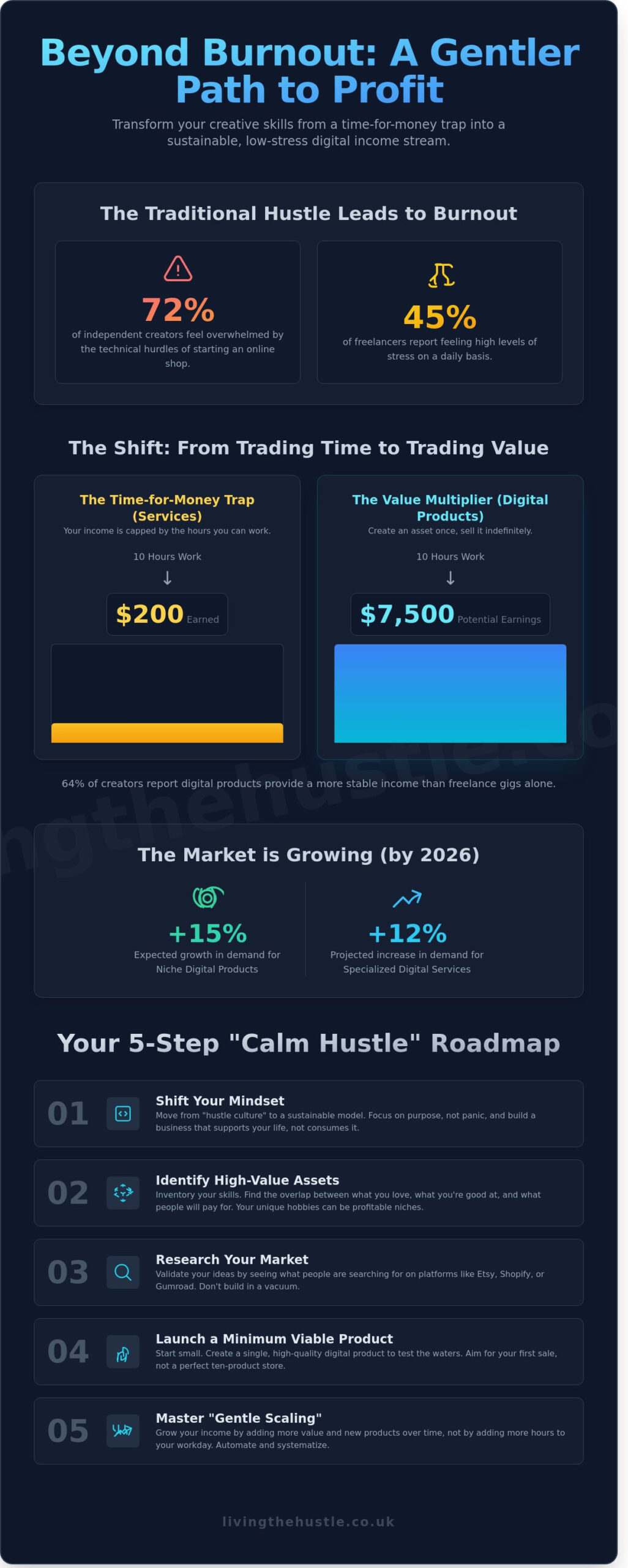
The 5-Step Roadmap to Launching Your First Digital Side Hustle
You don't need a massive team or a huge budget to start your journey. You just need a clear path that respects your time and energy. Building a digital business is about working smarter, not harder, by following a logical sequence that protects you from burnout. Let's walk through the five steps to get your ideas off your hard drive and into the hands of customers.
- Step 1: Market Research (without the headache). This isn't about complex spreadsheets. It's about finding where demand meets your talent. By using data-driven tools, you can identify keywords with high search volume and low competition. Look for niches where products have at least 1,200 monthly searches but fewer than 500 competing shops.
- Step 2: Creating your Minimum Viable Product (MVP). The MVP is your safety net. Instead of spending 60 hours on a 50-page workbook, create a 5-page “quick start” guide. This allows you to test the market's appetite without risking your mental health. Your first product shouldn't be ‘perfect,' just ‘helpful.'
- Step 3: Choosing your ‘Vessel'. Your vessel is the platform that holds your shop. Etsy is often the best choice for beginners because it reached over 95 million active buyers in 2023. This built-in traffic means you don't have to shout into the void to find your first customer.
- Step 4: Setting up a ‘Calm' marketing system. A calm system relies on evergreen traffic. Unlike the constant churn of some social platforms, a single search-optimized pin or blog post can drive sales for 12 months or longer. This is how you build a business that works on autopilot while you focus on living your life.
- Step 5: Reviewing and refining. Reviewing your progress is the final piece of the puzzle. Look at your shop's conversion rate every 30 days. If you're seeing a rate lower than 1.5%, it's a signal to adjust your SEO or your main listing image based on real data, not guesswork.
Research and Creation: The Foundation
Success starts with validation. When you monetize your creative skills, you're solving a specific problem for a specific person. Using tools like eRank for Etsy Sellers helps you make data-driven decisions by showing you exactly what shoppers are typing into the search bar. This removes the emotional weight of “hoping” something sells and replaces it with the confidence of knowing there's a hungry audience waiting for your solution.
Marketing with Purpose, Not Panic
You don't have to be on every platform to succeed. Focus on Pinterest and SEO for sustainable, long-term traffic that doesn't require you to post five times a day. Pinterest functions as a visual search engine where 450 million users look for inspiration and products. Combine this with modern video strategies from Reels to Revenue to capture attention quickly. Remember, building an email list is the ultimate insurance policy for your creative business because you own that connection regardless of algorithm changes. When you finally monetize your creative skills, these systems ensure your income remains steady even when you're taking a well-deserved break.
Ready to take your next step? Explore our digital workbooks to find the gentle guidance you need to launch your shop today.
Building Your Creative Empire Without the Overwhelm
Growth is a double edged sword for many artists and makers. When you first decide to monetize your creative skills, every new sale feels like a victory. But once you hit consistent milestones, like your first 100 sales or £2,000 month, the workload can quickly become heavy. You might find yourself working until 11 PM just to keep up with orders. This is where many talented people quit because the “dream” starts to feel like a stressful second job. To avoid this, you must transition from a solo worker to a business owner who values time as much as profit.
Managing your time during a growth spurt requires a shift in mindset. You don't need more hours; you need better leverage. This is the core of “Gentle Scaling.” Instead of simply taking on more custom work that drains your energy, focus on adding products that don't require your physical presence for every transaction. A 2023 study of 1,500 digital entrepreneurs found that those who focused on scalable digital assets reported 40% less stress than those doing bespoke services. Once you have a product that sells while you sleep, you can Build Your Blog Brand Without the Overwhelm, ensuring your long term growth stays steady and calm.
Consider these three pillars for scaling gently:
- The 80/20 Rule: Identify the 20% of your products that bring in 80% of your revenue. Focus your energy there and let the rest go.
- Standard Operating Procedures: Write down exactly how you create your files or package your items. This saves 15% of your mental energy by removing decision fatigue.
- Batching: Dedicate specific days to creation and others to admin. Mixing tasks can reduce productivity by up to 40% due to context switching.
Systems for the Sustainable Creator
Staying focused requires more than just willpower; it requires a physical anchor. Using a structured tool like the Calm Creators Content Planner allows you to map out your entire month in under 30 minutes. This system prevents the 9 PM panic about what to post on social media. You also need to master the power of “No.” If a custom project offers a low margin but takes 10 hours, it's okay to decline. Protecting your peace is the only way to keep your creativity alive for the long haul.
Your Next Step: From Skill to Society
You've already proven you can monetize your creative skills by taking those first brave steps. Now, it's time to find your people. Community is the antidote to the isolation of the “hustle.” When you join other “Calm Hustlers,” you realize that your struggles aren't unique. You can look at a Passive Income Review to see exactly what's possible when you stop guessing and start following a proven framework. The Passive Income Society is designed to be your logical next step. It provides the system you need so you can spend more time creating and less time worrying about the “how.” You have the talent; let's build the empire that supports your life instead of consuming it.
Your Calm Path to Creative Freedom Starts Now
You've seen how to move away from the burnout of constant client work. By 2026, the shift toward digital products will be the standard for anyone who wants to monetize your creative skills without losing their peace of mind. We've walked through the 5-step roadmap to launch your first side hustle and explored why trading value beats trading time every single day.
You don't have to figure this out alone or stay stuck in a cycle of overwhelm. I've already helped over 5,000 students navigate this exact path using a gentle, calm approach that actually works. You deserve a business that supports your life rather than draining it. Whether you're a total beginner or a seasoned pro looking for a change, the right mentor makes all the difference. It's time to build something that lasts.
You've got the talent and the vision. Let's take that first gentle step together toward the creative freedom you've been dreaming of.
Frequently Asked Questions
Can I really monetize my creative skills if I'm a total beginner?
You can absolutely start to monetize your creative skills even if you are just beginning your journey. Most successful digital product sellers started with zero professional experience. According to a 2023 Etsy seller report, 82% of shops are run by individuals working alone from home. You don't need a fancy degree to succeed. You just need a gentle start with a simple tool like Canva to create your very first printable.
What are the most profitable creative skills to monetize in 2026?
Digital planning and AI assisted design are projected to be top earners by 2026. The digital planner market is expected to grow by 18% annually through the next three years. Focus on creating high value assets like Notion templates or specific social media kits. These products solve immediate problems for busy small business owners. They are often willing to pay a premium for solutions that save them five hours of work each week.
Do I need expensive software like Adobe Creative Cloud to start?
You don't need a pricey Adobe subscription to build a profitable business. Over 135 million people use Canva monthly because it's intuitive and offers a powerful free version. Many creators earn their first $1,000 using only free tools like Photopea or Google Docs. As your confidence grows, you can reinvest your profits into more advanced software. Starting with a zero dollar budget is a perfectly smart and sustainable strategy for any new creator.
How much money can I realistically make from a digital product side hustle?
Most new creators earn between $50 and $500 in their first three months of consistent posting. While some top tier shops report over $10,000 in monthly revenue, a more realistic goal for a calm side hustle is $1,200 per month within your first year. This income often comes from selling 40 to 60 individual digital items. When you monetize your creative skills this way, you create a reliable stream of income that grows over time.
Is Etsy too saturated for new creative sellers to succeed?
Etsy isn't too crowded if you focus on a specific, underserved niche. There are over 96 million active buyers on the platform as of late 2023, and they're constantly looking for fresh designs. Instead of making generic wall art, try creating minimalist budget trackers for preschool teachers. Narrowing your focus helps you stand out. It allows you to connect with people who need your exact style without feeling lost in a sea of competitors.
How do I protect my creative work from being stolen or copied online?
You should use clear watermarks and include a specific Terms of Use PDF with every download. Registering your work with the U.S. Copyright Office costs about $45 and provides strong legal backing. If someone copies your design, you can file a DMCA takedown notice. Most platforms like Etsy or Shopify process these within 48 hours. This simple step helps protect your intellectual property while you focus on growing your business with peace of mind.
How much time per week do I need to invest to see results?
You can see real progress by investing just 5 to 7 hours per week into your shop. This schedule allows you to create two new products and spend 60 minutes on basic SEO research. Building a business shouldn't lead to burnout or panic. A slow, steady pace of one hour per day is often more sustainable than a 12 hour weekend sprint. This gentle approach ensures you stay motivated for the long haul.
What if I don't feel like an ‘expert' in my creative field yet?
You only need to be two steps ahead of the person you are helping to provide immense value. To monetize your creative skills effectively, focus on solving one specific problem rather than mastering an entire industry. In a 2022 survey, 65% of customers said they prefer buying from relatable, independent creators rather than giant corporations. Your unique perspective is exactly what your future customers are looking for. Don't wait for a title to start sharing.