

What if the “right” price for your new workbook had nothing to do with what your loudest competitor is charging? Let's be honest; for the 62% of creative entrepreneurs who report feeling intense math anxiety, staring at a blank spreadsheet and wondering how to price digital products feels like a recipe for a headache. You likely worry that your price is too high, or worse, that your work isn't “good enough” to justify a profit. It's easy to get stuck in a loop of comparison that leaves you feeling drained instead of excited.
I understand that feeling of being stuck. You want a sustainable business that feels calm rather than hectic. This guide provides a stress-free framework to help you land on a profitable number for your 2026 launches without the overwhelm of complex math or imposter syndrome. We will walk through a simple three-step method to value your expertise, calculate your “peace of mind” margin, and launch with total confidence in your actual value.
Key Takeaways
- Move from panic to purpose by viewing your pricing as a meaningful value-exchange rather than just a way to recover your costs.
- Master the essentials of how to price digital products using a calm strategy that balances market benchmarks with your unique creative worth.
- Identify the “invisible” expenses and 2026 market realities, including platform fees and the rising premium on human-curated quality.
- Follow a gentle, five-step framework to find your perfect price point by researching your market floor and highlighting your unique value-add.
- Gain the confidence to run pricing experiments and handle customer feedback with grace as you scale your digital hustle sustainably.
The Psychology of Pricing: Moving from Panic to Purpose
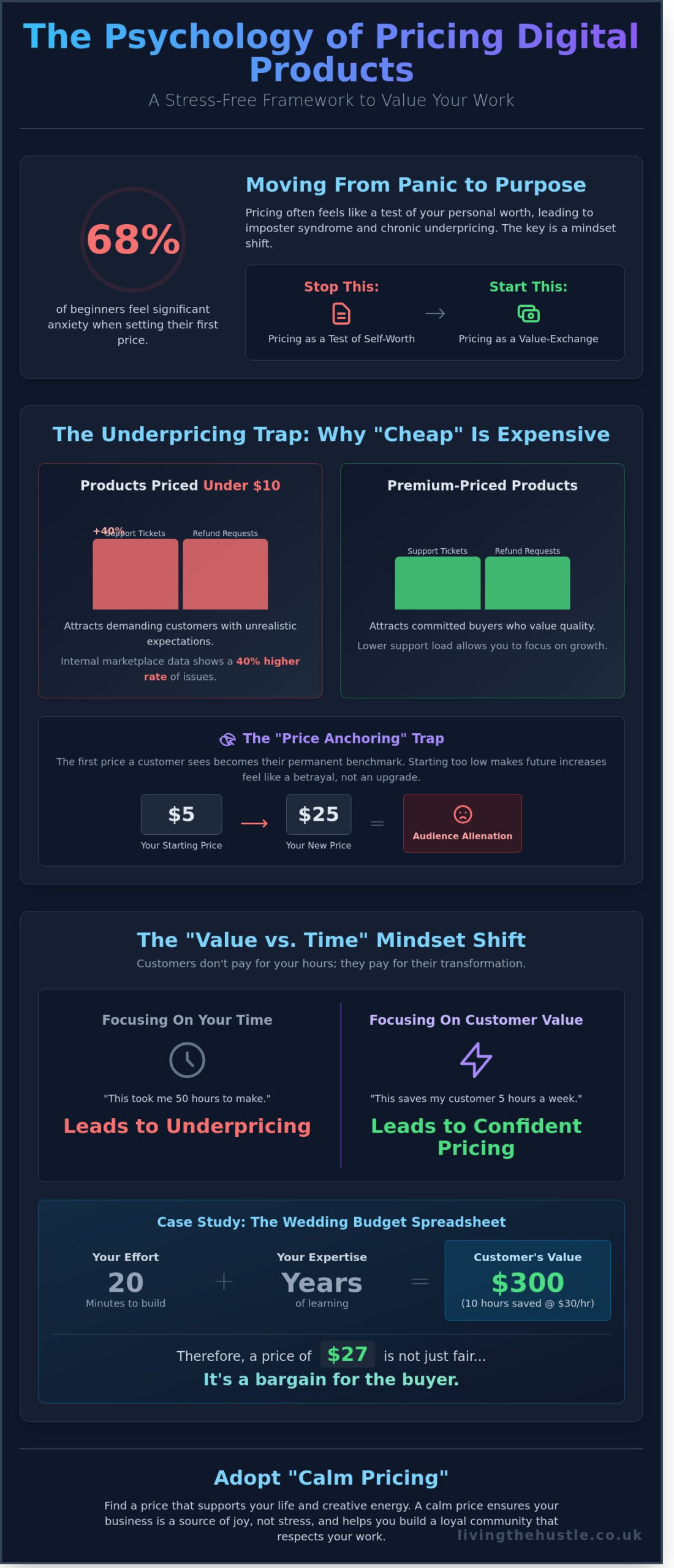
Pricing your creations often feels like an emotional rollercoaster. You've poured your heart into a planner or a guide, yet the moment you need to attach a dollar sign, panic sets in. A 2023 survey of 1,500 digital creators found that 68% of beginners felt significant anxiety when setting their first price. This happens because we often view pricing as a test of our personal worth. Instead, we need to view it as a value-exchange. You aren't just selling a PDF; you're selling a solution that helps someone else grow, learn, or save time. When you understand core pricing strategies, you can move away from guesswork and toward a sustainable business model.
Many new sellers fall into the “Imposter Syndrome” trap. You might think, “Who am I to charge $47 for this?” This mindset leads to chronic underpricing. Learning how to price digital products requires you to detach your self-esteem from your shop's checkout button. If your product solves a real problem, it has objective value regardless of how you feel on a Tuesday morning. Low prices don't just hurt your wallet; they can actually damage your brand perception. In the digital space, a “cheap” price tag often signals “cheap” quality to a discerning buyer.
We advocate for a concept called “Calm Pricing.” This isn't about maximizing every single cent through aggressive tactics. It's about finding a number that supports your life and your creative energy. A calm price allows you to provide excellent customer service without feeling resentful. It ensures your business is a source of joy rather than another item on a stressful to-do list. When your pricing is purposeful, you can stop reacting to competitors and start building a loyal community that respects your work.
Why Underpricing is a Business Trap
Low prices often attract the most demanding customers. Internal data from several major digital marketplaces suggests that products priced under $10 see a 40% higher rate of support tickets and refund requests compared to premium items. Budget buyers often have unrealistic expectations or lack the commitment to actually use the product. Furthermore, once you've branded yourself as the “budget option,” raising your prices by 50% or 100% later can alienate your existing audience. Price Anchoring is the psychological phenomenon where the first price a customer sees for a brand becomes the permanent benchmark for all future purchases. If you start at $5, a jump to $25 feels like a betrayal rather than an upgrade.
The “Value vs. Time” Mindset Shift
One of the hardest lessons in how to price digital products is realizing that your “hours worked” don't matter to the customer. They aren't paying for your sweat; they're paying for their own transformation. If you spend 50 hours making a product that no one needs, its value is zero. Conversely, if you create a 10-minute template that saves a small business owner 5 hours of manual data entry every week, that template is incredibly valuable.
- The Transformation: Focus on where the customer is now versus where they will be after using your product.
- The Time-Saving Factor: Calculate the hourly wage of your target audience to see how much money you're actually saving them.
- The Expertise Premium: Remember that they're paying for the years it took you to learn how to make that 10-minute template.
Consider a specific example. A wedding budget spreadsheet might only take an expert 20 minutes to build in Excel. However, for a stressed bride, that spreadsheet prevents 10 hours of research and potential mathematical errors. If she values her time at $30 per hour, you've just handed her $300 worth of value. Charging $27 or $37 for that solution isn't just fair; it's a bargain for the buyer and a win for your business.
Core Pricing Strategies: Which One Fits Your Hustle?
Choosing a price for your digital creation often feels like a shot in the dark. You don't want to overcharge and scare people away, but you also don't want to undervalue your hard work. Many beginners start with Cost-Plus pricing. This involves calculating your expenses and adding a small profit margin. While this works for physical items like hand-poured candles, it's usually the wrong choice for digital assets. Since your cost to replicate a file is essentially zero, Cost-Plus pricing often leads to “race to the bottom” prices that don't reflect your expertise or the time you spent designing.
Instead, your goal is to find a sustainable balance that honors your creativity and meets your customers where they are. Understanding various pricing strategies for digital products helps you move away from guesswork and toward a confident, calm business model. When you know how to price digital products based on logic rather than emotion, you remove the stress from your launch day.
The Pros and Cons of Competitor Benchmarking
Looking at what others charge is a smart first step. It gives you a “floor” and a “ceiling” for your niche. In a 2023 analysis of digital downloads, researchers found that 72% of buyers compare at least three similar products before clicking “buy.” You can use tools like eRank for Etsy Sellers to see exactly what successful shops are charging. This data prevents you from pricing yourself out of the market entirely.
- Identify Gaps: Are there dozens of $5 budget planners but no $40 comprehensive life-management systems? That “premium” gap is your opportunity.
- Avoid the “Slave” Trap: Don't feel forced to match the lowest price. If a competitor sells for $2, they might be relying on massive volume that you don't need to chase yet.
- Benchmark Features: Compare what you offer. If your competitor provides 10 templates and you provide 50, your price should reflect that extra value.
Value-Based Pricing: Charging for Results
This is the gold standard for digital creators because it focuses on the transformation you provide. If you're wondering how to price digital products like courses or high-end workbooks, look at the “pain point” you solve. A 2024 industry report showed that customers are 40% more likely to pay a premium price if the product promises a specific, measurable result, such as “Save 5 hours of admin time every week.”
Educational products usually command higher prices than simple creative assets because they offer a shortcut to a skill. If you want to increase your product's perceived value so you can charge what you're truly worth, check out The Art of Design. This guide helps you create professional assets that look and feel expensive, making it easier for customers to justify a higher price point.
Tiered Pricing for Every Audience
You don't have to pick just one price. Tiered pricing allows you to capture different segments of your audience simultaneously. A common model is the “Good, Better, Best” approach. Data from several SaaS and digital product platforms suggests that roughly 65% of customers will choose the middle option. This “anchor” effect makes your middle tier look like the most sensible value while still offering a “budget” entry point for beginners and a “VIP” package for those who want everything you offer.
Start small, stay consistent, and remember that your price isn't set in stone. You can always adjust as you grow. If you're feeling overwhelmed by the technical side of things, you might find it helpful to explore our gentle business guides designed for creative souls just like you.
Factoring in the “Invisible” Costs and 2026 Realities
Pricing isn't just about what you want to earn; it's about what you need to keep. When you're figuring out how to price digital products, you have to look at the numbers that don't show up on your initial sales notification. Many creators feel a sense of panic when they see their first payout because they forgot to account for the “invisible” expenses that eat away at profit margins. These include platform fees from Etsy or Shopify, transaction fees from processors like Stripe, and the rising costs of digital marketing. If you don't build these into your base price, you aren't running a business; you're funding a hobby.
By 2026, the digital market has shifted. We've moved past the initial shock of AI and into a period where “human-curated” quality is the new gold standard. While AI tools have lowered the barrier to entry for everyone, they've also created a sea of generic, low-value products. To stand out, you need a “Profit Buffer.” This is an extra percentage added to your price that covers future growth, such as hiring a virtual assistant or upgrading your software subscriptions. You want to price for the business you're building, not just the one you have today.
Sustainable passive income requires a balance. If your price is too low, you'll be forced into a cycle of constant active promotion just to stay afloat. A healthy price point allows your products to sell themselves while covering the automated tools that keep your shop running 24/7. Understanding the psychology of pricing helps you realize that customers often equate a higher price with higher quality, especially in a world where cheap AI content is everywhere.
The Etsy Fee Breakdown for 2026
Etsy remains a powerhouse for digital creators, but its fee structure requires careful planning. As of 2026, you should expect the following deductions from every sale:
- Listing Fee: $0.20 per item, renewed every four months.
- Transaction Fee: 6.5% of the total sale price.
- Payment Processing: 3% plus a flat $0.25 fee (standard for US sellers).
- Offsite Ads: 12% to 15% if a buyer clicks an ad before purchasing.
To calculate your “Take-Home Pay,” subtract these totals from your list price. If you sell a digital planner for $10, you might only see about $8.50 after standard fees. While “Free Shipping” is a phrase often seen on Etsy, it's a misnomer for digital files. Instead, focus on the “Instant Download” aspect as your primary value-add. This immediate gratification justifies your price point without the headache of physical logistics.
Pricing in the Age of AI
Don't let the rise of AI scare you into lowering your prices. While a bot can generate a basic template in seconds, it cannot replicate your unique eye for design or your personal brand. Buyers in 2026 are tired of generic “AI-style” graphics; they're looking for soul, connection, and proven results. Your personal brand acts as a shield against price wars with generic competitors. When customers trust your voice, they'll pay a premium for your expertise.
If you're feeling overwhelmed by how to stand out in this crowded market, the Passive Income Society offers a clear path to building a brand that commands higher prices. Learning how to price digital products effectively means recognizing that your time, your curation, and your “human touch” are your most valuable assets. Don't be afraid to charge what you're worth; your future self will thank you for the calm, sustainable business you've built.
The Calm Creator Pricing Framework: 5 Steps to Your Perfect Number
Pricing shouldn't feel like a high stakes guessing game that leaves you feeling anxious. When you are learning how to price digital products, the goal is to find a number that honors your energy while remaining accessible to your dream customers. This framework helps you move away from “panic pricing” and toward a sustainable, profitable strategy.
Step 1: Research the Market Floor. Start by identifying the lowest price point in your specific category. In early 2024, data from major marketplaces showed that the bottom 20% of listings often compete solely on price. You need to know this number so you can intentionally move away from it. Selling at the floor often leads to burnout because you have to move massive volume just to cover your basic software subscriptions.
Step 2: Identify your Unique Value Add. Ask yourself what makes your version better than the $5 checkout aisle version. Perhaps you include a 10 minute video tutorial or a bonus checklist that saves the buyer two hours of work. If your product solves a problem 30% faster than a competitor, your price should reflect that time saved.
Step 3: Calculate your Life-Support Minimum. You must know what you actually need to earn to stay in business. Total your monthly expenses, such as your $15 Canva subscription, your email marketing platform, and Etsy's 6.5% transaction fees. If your overhead is $100 a month and you want to profit, pricing a workbook at $2 means you need 50 sales just to break even. That is a heavy lift for a beginner.
Step 4: Test with a Beta or Launch Price. Use a limited 48 hour window to offer a “Founding Member” discount. This gathers essential data on how your audience reacts to the product. If 85% of your traffic leaves without buying, your price or your messaging might be misaligned. If you sell out your initial “beta” slots in two hours, it is a clear signal that you can safely increase your price for the full launch.
Step 5: Review and Adjust Quarterly. Your price is not permanent. Every 90 days, look at your sales velocity. If your conversion rate is higher than 5%, you likely have room to increase your price by $5 or $10. This gentle adjustment ensures your business grows alongside your expertise.
Step-by-Step Market Research
To get started, use specific keywords in your niche to find the top 10 sellers. Don't just look at their prices; read their 2 star and 3 star reviews. If 40% of customers complain that a competitor's planner is “too cluttered,” you can market your “minimalist” version as the solution. Set your price 10% to 20% above the niche average. This small gap acts as a psychological signal that your product offers higher quality and better support than the budget options. This is a core pillar of how to price digital products for long term success.
Using Bundles and Upsells to Increase Order Value
Another way to boost profit without finding new customers is the “Bundle and Save” strategy. Digital products have zero manufacturing costs, so combining three related items into a discounted pack is pure profit. You can also create “Add-ons” that serve as a natural next step. For example, the Calm Creators Content Planner is a high value tool that helps users organize their ideas. A seller might offer a small “Caption Template” pack as a $7 add-on at checkout, which can increase the total order value by 25% instantly.
Ready to build a business that feels as good as it looks? Start your calm creator journey today and learn to sell with confidence.
Testing, Scaling, and Growing with Confidence
Setting your initial price isn't a life sentence. It's actually the beginning of a conversation with your audience. Many new creators feel a sense of panic when they hit “publish,” worrying they've aimed too high or too low. If you're still wondering how to price digital products effectively, remember that your price is a flexible tool, not a static monument. You have the permission to change it as you gather more data and build more authority in your niche.
When you encounter “Price Resistance,” it's easy to feel discouraged or tempted to slash your rates immediately. Instead, handle these moments with grace and curiosity. If a potential customer mentions the price is too high, see it as an opportunity to clarify the value. A 2024 survey of digital entrepreneurs found that 62% of customers who questioned a price were actually looking for more information about the specific transformation the product provided. You don't need to apologize for your pricing. Instead, focus on the 10+ hours of work your template saves them or the specific problem your guide solves.
Strategic sales can boost your revenue without damaging your brand's integrity. Avoid the “permanent sale” trap, which trains customers to never pay full price. Instead, use time-limited events. Data from the E-commerce Growth Lab shows that brands using 48-hour flash sales twice per quarter see a 14% higher customer retention rate compared to those with constant discounts. This approach keeps your “hustle” calm and predictable rather than desperate.
As your business matures, you might find that a single product isn't enough to serve your community. This is when you move toward a “Collection” or a “Society” model. Bundling three related products into a “Starter Kit” at a 15% discount increases your average order value while providing a more complete solution for your buyers. It's a gentle way to scale your income while deepening your impact.
Running a 30-Day Pricing Test
To find your “Sweet Spot,” you need to track your conversion rates at two different price points over a month. Start with your baseline price for 15 days, then adjust it by 20% for the remaining 15 days. Look for the point where your total profit is highest, even if the number of individual sales drops slightly. A successful pricing test requires a minimum of 100 unique visits to ensure the data is statistically relevant. This methodical approach removes the guesswork from how to price digital products and replaces it with clear, actionable numbers.
The Path to Passive Income
Pricing correctly is the engine that drives your freedom. When you move away from underpricing, you generate the surplus needed to reinvest in your business. You might decide to put 15% of your monthly profits into automated ads or a better email platform to reduce your manual workload. This transition turns your side project into a sustainable source of joy rather than another item on your “to-do” list. You deserve to build a business that supports your life, not one that drains it. If you're ready to stop guessing and start growing, I invite you to explore the Passive Income Society for a complete roadmap to building your digital empire with confidence and calm.
Your Profitable Path Toward 2026 Success
Pricing your work doesn't have to feel like a stressful guessing game. By using the 5 step Calm Creator Framework, you can move away from the panic of 2025 and into a profitable 2026. You've learned how to account for those 3 hidden costs like software subscriptions and transaction fees that often eat into your margins. Understanding how to price digital products is the first step toward a business that supports your life instead of draining it. It's about finding that sweet spot where your customers feel valued and your bank account feels healthy.
You don't have to navigate this path alone. I've helped over 4,000 beginner side-hustlers move from overwhelm to clarity with step-by-step guidance from a mentor who has been there. We focus on calm growth that avoids the burnout of traditional hustle culture. If you're ready to stop second-guessing your worth and start seeing real results, there's a seat waiting for you. Ready to build a digital product business that actually sells? Join the Passive Income Society today!
Your creativity is valuable. Believe in your numbers, trust the process, and take that next gentle step toward your goals.
Frequently Asked Questions
How do I know if my digital product is priced too low?
You know your price is too low if your conversion rate exceeds 12% on cold traffic. While high sales volume feels good, a rate this high often means you're leaving significant profit behind. If you've sold 100 units in 30 days without a single question about the cost, try raising your price by $5. This gentle adjustment helps you find the sweet spot where your value is truly respected.
Should I look at Etsy prices when setting my own rates?
Use Etsy prices as a starting point, but don't let them dictate your total worth. Researching the top 10 sellers in your niche gives you a baseline range, which is often between $7 and $29 for standard printables. Focus 80% of your energy on the unique transformation you provide rather than matching the lowest bidder. Your specific expertise justifies a higher price point than a generic, mass-produced template.
Is it better to offer a free trial or a discount for digital products?
Discounts are generally more effective than free trials for digital downloads. A 2024 marketing study found that a 20% discount code converts 4 times better than a 3 day trial for one-time purchases. Trials work best for software, but for a workbook or guide, a limited-time sale creates the urgency needed to help your customers take that first step with confidence and excitement.
What is the average profit margin for digital products in 2026?
The average profit margin for digital products in 2026 is expected to sit between 75% and 90%. Because you don't have shipping or inventory costs, your main expenses are platform fees and your 2 hour weekly marketing routine. Learning how to price digital products correctly ensures you keep most of that revenue. This high margin is why digital assets are the best way to build a calm business.
How often should I raise my prices for digital downloads?
You should review and potentially raise your prices every 6 months. Data shows that 65% of successful creators increase their rates by at least 15% after adding new bonuses or updating their content. If you haven't touched your pricing since January 2024, it's time for a tiny nudge upward. This keeps your business growing alongside the value and experience you gain every single day you show up.
Can I charge more for products made with Canva?
You can absolutely charge premium prices for Canva products because your customers are buying a result, not a tool. A well-designed 30 page lead magnet template can easily sell for $37 or more. Most buyers lack the 5 hours required to design it themselves, so they're happy to pay for the time you've saved them. Your creativity and layout skills are what hold the real value for them.
What should I do if a customer says my product is too expensive?
Listen to their feedback, but remember that 80% of price complaints come from people who aren't your target audience. If a customer says it's too expensive, calmly explain the specific benefits, like the 10 hours of work your product saves them. You can also offer a smaller entry-level product for $12 to help them get started without feeling overwhelmed by a larger financial investment right away.
Do I need to charge tax on digital products sold globally?
Yes, you generally need to collect tax based on the buyer's location. Since the 2024 update to global digital tax laws, over 85 countries require VAT or GST on digital sales. Using a platform like Shopify or LemonSqueezy handles this automatically for you. Understanding these rules is a vital part of how to price digital products so you don't lose your 25% profit margin to unexpected tax bills.