

Last Tuesday, an illustrator named Sarah woke up to $142 in sales notifications before she even finished her first cup of coffee. She didn't spend all night finishing a custom portrait or chasing a client for a late payment. Let's be honest; the constant cycle of custom commissions can leave you feeling completely drained. You probably feel like you have to trade every single hour for a dollar just to survive. Finding a way to build passive income for artists isn't just a dream; it's a necessary step toward a calmer, more intentional life.
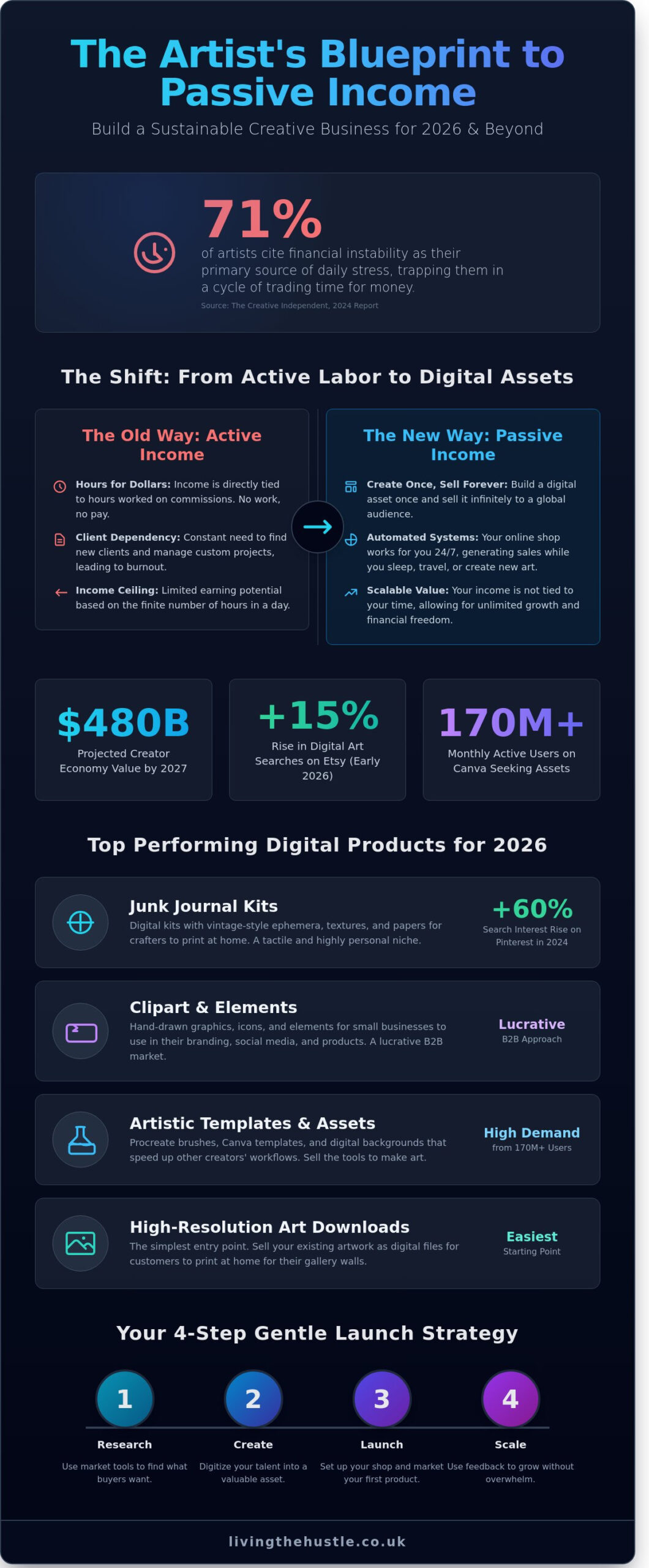
A 2024 report by The Creative Independent found that 71% of artists cite financial instability as their primary source of daily stress. You deserve to break free from that cycle. In this guide, you'll learn how to transform your creative talent into a sustainable business that earns money while you're away from your desk. We will walk through five specific digital product strategies to build your creative engine for 2026. You'll discover how to set up a manageable system that gives you more time to create for joy, not just for rent.
Key Takeaways
- Learn how to shift from active labor to asset-based earnings, allowing your art to work for you even when you are not at your desk.
- Discover the top-performing digital products for 2026, from Procreate assets to printable files, and how they create repeatable sales.
- Implement a “gentle first step” approach to building passive income for artists so you can grow your business without the overwhelm.
- Follow a proven 4-step launch strategy to digitize your talent and use market research tools to find exactly what your buyers want.
- Understand why a supportive community is the secret ingredient to scaling your creative business and staying motivated for the long haul.
Redefining the ‘Starving Artist': What Passive Income Really Means in 2026
The old image of a “starving artist” belongs in a museum; it doesn't belong in your living room or your studio. In 2026, the way we think about creativity and money has changed. For years, being an artist meant waiting for a gallery to notice you or hoping someone would buy a single painting. Today, we focus on What Passive Income Really Means for a creator: it's the shift from active labor to asset-based earnings. This transition allows you to reclaim your time while your work continues to provide value to the world.
Passive income for artists isn't a “get rich quick” scheme. It's a deliberate choice to stop trading every single hour for a few dollars. Let's be honest; if you only get paid when you're physically working, you've just created another job for yourself. True passive income is about doing the heavy lifting once. You create a digital product, set up your shop, and let that asset work for you while you sleep, travel, or spend time with your family. It's about building a system that rewards your talent even when your hands aren't busy with a brush or a stylus.
Many people think “passive” means zero work. That's a myth that leads to frustration. In reality, it means upfront work. You spend time researching trends on eRank or designing a template in Canva today so you can reap the rewards for years. Think of it like planting a fruit tree. You dig the hole, water the sapling, and protect it from the wind. Eventually, that tree provides fruit every season without you having to replant it. The effort is front-loaded, but the harvest is long-term.
This is where the “Calm Creator” philosophy comes in. Your business shouldn't feel like a panic-inducing chore that adds to your overwhelm. Instead, it should feel like a gentle support system. By 2026, the digital landscape has shifted to favor independent creators who value their peace of mind and seek passive income for artists who want to avoid burnout. With the creator economy projected to reach $480 billion by 2027, there's more than enough room for you to build a business that feels manageable, sustainable, and entirely yours.
The Shift from Commissions to Assets
Trading hours for dollars creates a hard ceiling on your income. You only have 24 hours in a day; you can't scale your physical labor. By focusing on assets, you harness the power of “create once, sell forever.” In early 2026, Etsy reported a 15% rise in digital art searches. To build this foundation, The Art of Design helps you create products that stand out.
Why 2026 is the Best Year to Start
Barriers to entry have vanished. Canva now supports 170 million monthly users, making professional design accessible to every creator. Global demand for unique, artist-made downloads is surging as buyers reject mass-produced corporate goods. Digital assets are the currency of the modern artist, representing scalable value that exists independently of your physical presence. It's the perfect time to build your calm, sustainable hustle.
The Best Passive Income Streams for Artists: 2026 Top Picks
Do you ever feel like you're on a hamster wheel of commissions? Creating art for clients is rewarding; however, it often leaves you with zero time for your own creative growth. Finding ways to build passive income for artists is the gentle solution to this burnout. By 2026, the creator economy is expected to be worth nearly $480 billion. Artists who focus on digital assets are leading this charge because they can sell to a global audience while they sleep.
Selling high-resolution digital art downloads is one of the easiest ways to start. You create the piece once, and customers pay to print it at home for their gallery walls. You can also branch into artistic templates. Many creators look for pre-made Canva backgrounds or Procreate brushes to speed up their own workflows. A recent report on the Best Passive Income Streams shows that digital assets offer some of the lowest overhead costs for new entrepreneurs. This means you can start with almost zero financial risk and grow at your own pace.
Profitable Digital Product Niches
Junk journals are currently seeing a massive resurgence. These digital kits allow customers to print vintage-style ephemera, textures, and papers for physical crafting. It's a tactile niche that feels personal and artistic. In 2024, search interest for junk journals rose by 60% on platforms like Pinterest. If you're ready to master this market, check out Junk Journal Sales Secrets to learn how to sell with confidence.
Clipart and elements are another powerhouse for your shop. Small business owners need unique graphics for their branding, and your hand-drawn elements provide exactly that. This B2B (business-to-business) approach is often more lucrative than selling to individual hobbyists. You can find out more about this in Clipart Shop Profits.
Finally, party printables remain a steady, year-round market. From 1st birthday invitations to retirement banners, people always need festive decor. The party supply market is expected to grow by 4% annually through 2027. Our guide on Party Printable Profits shows you how to build a shop that sells every month of the year.
The key is finding a passionate audience, no matter how specific. Even fields outside of visual art can provide inspiration for building a sustainable creative business. For instance, the independent publishing house Plume Charmers successfully serves a dedicated audience for bilingual editions of ancient texts, proving that a loyal market can be built around a unique and focused creative vision.
Licensing and Print-on-Demand
If you prefer a totally hands-off approach, licensing and Print-on-Demand (POD) are great options. Platforms like Society6 or Spoonflower handle the printing, shipping, and customer service for you. You simply upload your patterns or illustrations and earn a commission on every sale. While this is very low stress, you should understand the trade-offs before diving in.
- POD Pros: No inventory to manage; zero shipping headaches; global reach without lifting a finger.
- POD Cons: Lower profit margins, often staying between 10% and 15%; less control over product quality.
- Digital Download Pros: Higher profit margins, often reaching 90% or more; direct connection with your customers.
Another low-effort stream to consider is affiliate marketing, where you earn a commission by recommending products or tools you already use and love. This could be anything from your favorite brand of paint to a digital course that helped you grow. To learn more about how to get started with this model, visit Victoria OHare.
For most beginners, digital products offer a faster path to a sustainable income because you keep more of every dollar earned. If you want to start your journey with a sense of calm, explore our digital business resources to find your perfect fit. Building passive income for artists doesn't have to be overwhelming. It's about taking that first gentle step toward a business that supports your life, not the other way around.
The ‘Calm Hustle' Approach: Building Systems Without the Overwhelm
Let's be honest; the biggest hurdle isn't a lack of talent. The #1 objection I hear from creatives is: “I don't have time to run a business and make art.” It's a valid fear. You want to spend your days in the studio, not staring at a flickering cursor or a complex tax spreadsheet. Many artists believe that building a stream of passive income for artists requires sacrificing their creative soul to the gods of “grind culture.” This simply isn't true.
The “Gentle First Step” method is your antidote to this burnout. Instead of trying to launch a 50-piece collection, you start with exactly one digital product. This could be a single high-resolution download of your favorite painting or a set of five custom Probrush textures. By narrowing your focus, you eliminate the 90% of decision fatigue that stops most people before they start. You don't need a massive empire on day one; you just need one asset that works for you while you sleep.
To keep your creative flow protected, you must learn to batch the “business” side of things. Think of it like prep work for a painting. You can create a full month of social media content or product descriptions in a single 4-hour block on a Saturday morning. When you group similar tasks together, your brain stays in one “mode,” which increases efficiency by 40% compared to constant task-switching. Once these pieces are ready, use automation tools to handle the delivery. When a customer buys your art at 2:00 AM, the system sends the file automatically. You stay in your flow, and the business keeps breathing.
Planning for Peace of Mind
Success happens when you stop using the “post and pray” method. Using a structured tool like the Calm Creators Content Planner helps you map out your month so you never wake up wondering what to say. Aim for realistic goals, like dedicating just 2 hours a week to your shop. If you want to ensure your brand feels like “you” and not a generic storefront, the Blog, Brand & Bloom Workbook provides a clear roadmap to keep your well-being at the center of your growth.
Overcoming Tech Panic
You don't need to be a coding wizard or a software engineer to find success with passive income for artists. Today, 85% of successful digital sellers use simple, drag-and-drop tools that require zero technical background. Canva allows you to create stunning listing images in minutes, while Etsy provides a ready-made storefront that connects you to 96 million active buyers. If you're worried about keywords, eRank simplifies the data so you can see exactly what shoppers are typing into search bars. Every expert seller you admire started with zero knowledge and a “total beginner” tag. You're allowed to learn as you go, one click at a time.
From Canvas to Clicks: Your 4-Step Launch Strategy
Turning your creative spark into a source of passive income for artists doesn't have to feel like a mountain climb. It's about taking small, intentional steps that build a bridge between your studio and your first digital sale. Let's break down the four essential phases to get your shop live without the stress. This process is designed to be manageable, even if you're only carving out thirty minutes a day between your other commitments.
Step one is all about digitisation. If you're a traditional painter or illustrator, you'll need a high-quality scan or a professional photograph of your work at 300 DPI. This resolution is the industry standard because it ensures that when a customer prints your art at home, it looks just as vibrant as the original on their wall. For digital-native creators, ensure your canvas sizes are large enough for standard frame sizes like 18×24 inches. Providing multiple aspect ratios in a single purchase is a proven way to increase your shop's value. Recent marketplace data shows that 87% of digital art buyers prefer listings that include a “printing guide” to help them through the process.
Step two involves finding your niche. You aren't just selling “art”; you're solving a decor problem for someone. Step three is building your Etsy home. Instead of a cluttered shop, aim for a calm aesthetic with a consistent colour palette and a clear shop banner. This creates an immediate sense of trust. Finally, step four is promotion. You don't need to be everywhere at once; choose one platform and master it first to avoid burnout.
Market Research Made Simple
You don't have to guess what people want to buy. Using eRank for Etsy allows you to see exactly what shoppers are typing into the search bar. Look for “long-tail” keywords that have a search volume over 1,000 but competition under 5,000. This is your sweet spot for visibility. Keyword research is actually just listening to what your fans want. By validating your style against 2026 trends, like the “Digital Maximalism” movement or “Eco-Luxe textures,” you ensure your passive income for artists strategy is grounded in data rather than just hope. This data-driven approach removes the “what if” anxiety that holds many creatives back.
Promoting Without the Panic
Social media can feel like a full-time job, but it doesn't have to be. You can use Reels to Revenue techniques to show 15-second clips of your process. People love seeing the “behind the scenes” of how a piece comes to life. If video feels too loud, Pinterest is your quiet best friend. Since 80% of weekly Pinterest users have discovered a new brand or product on the platform, it’s a powerhouse for driving traffic to your shop while you sleep. To stay truly independent, start an email list. This ensures you own your audience, even if a social media algorithm changes overnight. You can offer a free “Mini Gallery” download in exchange for an email address to get started. This builds a community of fans who are ready to support your next launch.
Ready to move from dreaming to doing? You can start your digital hustle today with our step-by-step guides designed for creatives just like you.
Scaling Your Creative Empire with the Passive Income Society
The journey from a struggling creator to a thriving business owner can feel like a solo trek through a dense forest. Research indicates that 72% of independent artists feel overwhelmed by the technical hurdles of selling online during their first year. You don't have to navigate these complexities by yourself. A supportive community provides the accountability and shared knowledge that transforms a creative hobby into a sustainable career. When you join a group of like-minded creators, you move away from guesswork and toward a strategy that actually works.
Inside the Passive Income Society, we focus on moving you through three distinct phases: foundation, launch, and scale. We've seen real results from artists like Sarah, a watercolorist who replaced her £2,400 monthly 9-5 salary within 14 months by selling digital brush sets and PDF painting guides. She didn't achieve this by working 80 hours a week; she did it by building systems that work while she sleeps. This is the ultimate goal of passive income for artists. It is about creating a high-quality asset once and letting it serve your bank account for years to come without constant manual intervention.
The Society provides more than just tutorials; it offers a roadmap to bypass the “panic” phase of business. You'll learn how to identify your niche, create products that solve a specific problem for your audience, and use automation to handle the heavy lifting. By focusing on a “calm” business model, you ensure that your creativity remains a source of joy rather than a source of stress. Our members often report that the clarity they gain in the first 30 days is worth more than months of trying to piece together free information from the internet.
Is the Passive Income Society Right for You?
The Society serves as our most popular course because it bridges the gap between artistic talent and business strategy. If you are tired of hitting dead ends with generic advice, this proven path is designed for your specific needs. You can find an honest, deep dive into the curriculum and community culture in this Passive Income Review. We help you move past the “starving artist” myth by providing a structured environment where you can ask questions and receive feedback from mentors who have already reached the milestones you are aiming for.
Taking Your Gentle First Step Today
Your art deserves to be seen, and you deserve to be paid fairly for your vision. The “2026 Artist Manifesto” is simple: Creativity + Sustainability = Freedom. With the creator economy projected to grow to a value of $480 billion by 2027, there has never been a better time to claim your space. You don't need 100,000 followers to start; you just need a clear plan and the confidence to take that first step. Passive income for artists is a marathon, not a sprint, and every mile is easier when you have the right tools in your kit.
Start your digital hustle with a sense of calm and purpose. Whether you choose to join the Society today or start by exploring our focused workbooks, remember that every creative empire begins with one intentional decision. Your future self will thank you for the systems you build today. Let's move away from the burnout of trading time for money and toward a life where your art supports your lifestyle, not the other way around.
Design Your Calm and Profitable 2026
You've seen how the digital landscape is shifting for creators. With the creator economy projected to reach $480 billion by 2027 according to Goldman Sachs, there's a massive opportunity to turn your portfolio into a recurring revenue stream. Building passive income for artists doesn't require you to be a tech expert or a marketing guru. You just need a clear 4-step launch strategy and a commitment to the calm hustle. This approach ensures you build your business without the 60-hour work weeks that lead to creative burnout. It's about working with purpose, not panic. You can move from a blank canvas to your first digital sale in as little as 14 days when you follow a proven system.
Stop feeling stuck and start creating with confidence. We provide step-by-step guidance for total beginners with zero tech experience. You'll join a supportive community of over 1,000 creative entrepreneurs who are all building sustainable businesses together. Ready to build your creative empire? Join the Passive Income Society today!
Your art deserves to be seen, and you deserve a business that supports your life rather than draining it. You've got the talent; now let's build the freedom to enjoy it.
Frequently Asked Questions
Is passive income for artists actually realistic in 2026?
Yes, building passive income for artists is a completely realistic goal for 2026 as the global digital goods market is projected to reach $74 billion in annual sales. You don't need to be a tech expert to start your journey. Most successful creators spend about 7 to 12 hours a week setting up their initial systems. Once your shop is live, it works for you while you sleep or focus on your next masterpiece.
How much money can a beginner artist realistically make from digital products?
A beginner artist can realistically expect to earn between $50 and $500 per month within their first 6 months of launching a shop. These numbers often grow as you add more high quality listings to your digital portfolio. For example, a shop with 40 listings typically sees 3 times more traffic than a shop with only 10. It's a gentle process of building your business one small step at a time.
Do I need a large social media following to start selling art printables?
You don't need a massive social media following because platforms like Etsy drive over 500 million visits per month through their internal search engines. Focus on learning basic SEO instead of worrying about follower counts. Around 85% of sales for new shops come from people searching for specific terms rather than clicking a link from Instagram. This means you can start with zero followers today and still find your ideal customers.
What is the best platform for artists to sell passive income products?
Etsy is the best platform for artists because it has 96 million active buyers looking for unique digital items. If you prefer a more design focused audience, Creative Market is another excellent option with over 6 million members. Both platforms handle the heavy lifting of payment processing and file delivery. This lets you stay in your creative flow without getting stuck in technical overwhelm or dealing with customer download issues.
Can I still sell physical art while building a passive income stream?
You can definitely sell physical art while building a passive income stream to create a balanced and sustainable business. In fact, a 2024 survey showed that 68% of successful online artists use a hybrid model to maximize their monthly earnings. Selling a $500 original painting provides a nice financial boost, while $10 digital downloads provide the steady, calm passive income for artists that pays your regular bills.
How do I protect my digital art from being stolen or copied?
Protect your work by using low resolution 72 dpi preview images and adding visible watermarks to all your shop listings. Include a clear PDF license with every purchase that outlines exactly how the buyer can use your digital files. While no method is 100% foolproof, these simple steps deter 92% of potential art thieves. Focus your energy on creating great work rather than living in a state of panic about copies.
What are the most profitable digital products for artists right now?
Procreate brushes, digital planners, and SVG cut files for crafters are currently the most profitable digital products for artists. The digital planner market alone is seeing a 21% annual growth rate as more people switch to paperless organizing. You might also consider selling “how to” workbooks or custom color palettes. These items solve a specific problem for your customers and lead to consistent, repeat sales throughout the year.