

Have you ever dreamed of a side hustle that works for you, even while you sleep? But then the overwhelm kicks in. The thoughts of “I'm not creative enough,” “the tech is too confusing,” or “where do I even start?” can feel completely paralyzing. Let’s be honest-the idea of building a business from scratch can feel chaotic. But what if there was a calmer way? Creating passive income digital products isn't about stressful launches or a frantic hustle; it's about building a sustainable, gentle business that fits your life.
This guide is your gentle first step. Forget the panic and the guesswork. We are going to walk you through a clear, simple plan to create and sell your very first digital product, even if you’re a total beginner with zero design skills. By the end, you'll have a list of profitable ideas you can actually create and the confidence to finally get started. It's time to trade that feeling of being stuck for a feeling of empowerment. Ready to build your calm hustle?
Key Takeaways
- Discover the “create once, sell forever” model that makes digital products a perfect fit for a calm, sustainable side hustle.
- Uncover profitable digital product ideas you can bring to life today, even if you have zero design experience.
- Follow a simple 5-step roadmap to launch your first item and begin your journey with passive income digital products.
- Learn the beginner-friendly way to start selling your creations without the tech overwhelm of building your own website.
What Are Digital Products? (And Why They’re Perfect for Passive Income)
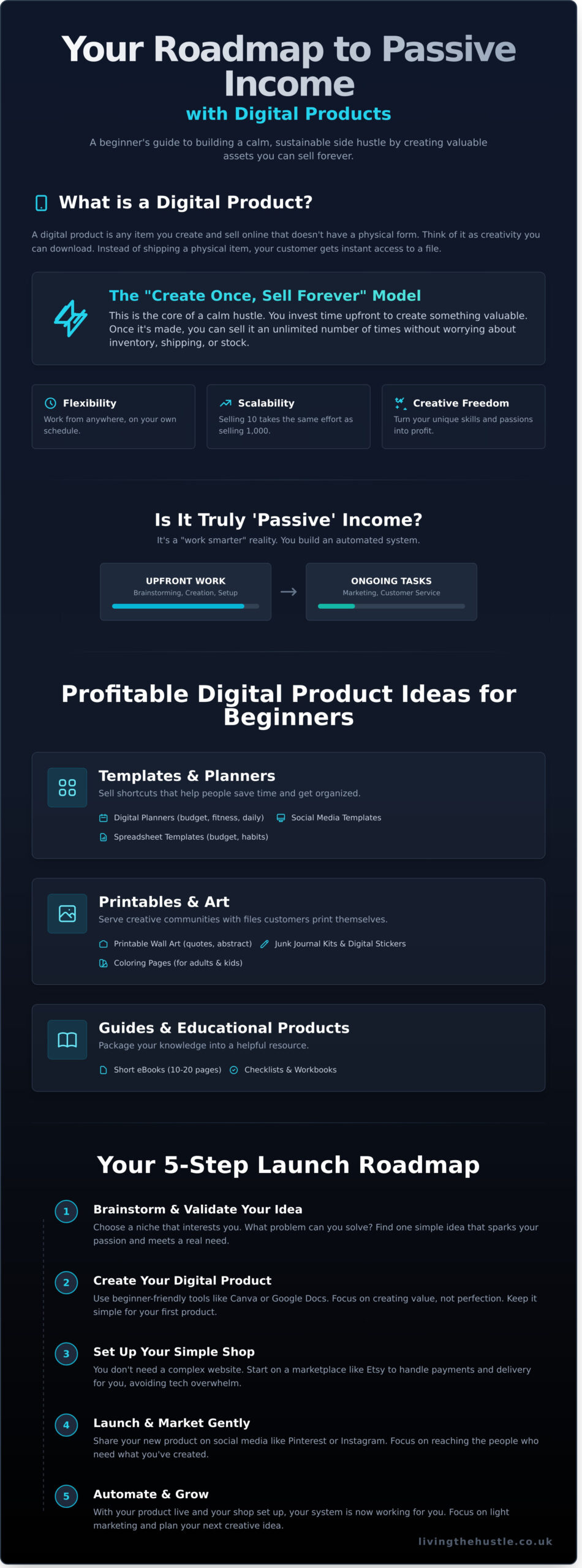
Ever bought a printable planner on Etsy or downloaded an eBook? You’ve purchased a digital product. In simple terms, a digital product is any item you create and sell online that doesn't have a physical form. Think of it as creativity you can download.
This is where the magic of the ‘create once, sell forever' model comes in. Unlike a handmade mug or a t-shirt, you don’t need to worry about inventory, shipping, or running out of stock. You invest your time and energy upfront to create something valuable, and then you can sell it an unlimited number of times. This is the foundation of a calmer hustle-building a business that works for you, without the burnout of constant fulfillment. The world of passive income digital products offers incredible benefits:
- Flexibility: Work from anywhere, on your own schedule.
- Scalability: Selling 10 products takes the same effort as selling 1,000.
- Creative Freedom: Turn your unique skills and passions into profit.
Examples of Digital Products You See Every Day
You’re probably already interacting with digital products daily. They range from simple, helpful tools to in-depth learning experiences. Some popular examples include:
- eBooks and workbooks
- Digital planners and journal templates
- Stock photos and digital art prints
- Online courses and workshops
- Niche products like custom phone wallpapers or social media filters
The concept can also extend to digital services that solve a highly specific problem. For example, some platforms are built entirely around helping international visitors overcome language and logistical barriers to attend local events. If you're curious about how such a niche service works, you can learn more about Jasumo Tickets.
Is It Truly ‘Passive' Income? A Realistic Look
Let’s be honest-the term “passive” can be a little misleading. It’s not about getting rich quick with zero effort. A better way to think about it is building an automated system. To understand the model, it helps to know the textbook definition. If you're asking, What is passive income?, it's generally defined as earnings from a venture in which a person is not actively involved on a day-to-day basis.
For digital products, this means you do the heavy lifting upfront: brainstorming, creating, and setting up your online shop. Once your product is live, your focus shifts to lighter, ongoing tasks like marketing and occasional customer service. It’s not a “no-work” dream, but it is a “work-smarter” reality that can bring you income while you sleep, travel, or focus on your next creative idea.
The Most Profitable Digital Product Ideas for Beginners in 2025
Feeling a little overwhelmed by all the options? Let's be honest, the world of passive income digital products can feel huge at first. But the best part is, you don't need to be a graphic design wizard to create something valuable. The key to a calm hustle is starting with one simple product that aligns with your passions.
These ideas are all beginner-friendly and solve real problems for people. At their core, all these products are simply assets you create once and can sell infinitely. If you're new to the concept, you can get a great overview of what digital products are and see why they are so powerful for creators. The secret is to choose one idea that sparks your interest and take that first gentle step.
Templates & Planners
Templates are fantastic because you're selling a shortcut. You are helping someone save time, feel more organized, and achieve a professional result without the stress. They are incredibly popular and easy to create with tools like Canva or even Google Sheets.
- Digital Planners: Help busy students, entrepreneurs, or parents organize their lives. You can create daily, weekly, budget, or fitness planners that they can use on a tablet.
- Social Media Templates: Perfect for small business owners who struggle with branding. Create beautiful, easy-to-edit post templates for Instagram, Pinterest, or Facebook.
- Spreadsheet Templates: Target individuals or small businesses with simple, effective templates for budgeting, project management, or habit tracking.
Printables & Art
If you have a creative spark, the world of printables is a gentle and rewarding place to start. These are digital files that customers download and print themselves, meaning no shipping and no inventory for you. It's pure profit after the initial creation.
- Printable Wall Art: Offer affordable and instant decor for people who want to personalize their space without breaking the bank. Think inspirational quotes, abstract designs, or nursery art.
- Junk Journal Kits: Serve the massive crafting community by providing themed kits, digital stickers, and ephemera for their scrapbooking and journaling projects.
- Coloring Pages: Create intricate designs for adults seeking a mindful activity or simple, fun pages for kids needing entertainment.
Guides & Educational Products
Never underestimate your own knowledge! Turning your hobby, skill, or passion into a simple guide is one of the most direct ways to build a business that feels authentic to you. You are an expert in something-it's time to share it.
- Short eBooks or Guides: Do you know how to bake sourdough, care for houseplants, or write great emails? Package that knowledge into a focused 10-20 page guide.
- Checklists & Workbooks: Help people achieve a specific goal with an actionable tool, like a “30-Day Decluttering Challenge” workbook or a “New Puppy Essentials” checklist.
- Niche Online Training: Even highly specialized career skills can be packaged into a digital format. A successful example is the Auto Finance Course, which teaches a specific professional path online.
To see how a specialized skill can be turned into a comprehensive digital product, you can learn more about Auto Finance Course, which has successfully created an entire business around this model.
Your 5-Step Roadmap to Creating Your First Digital Product
Feeling a little overwhelmed by the idea of actually making something from scratch? Take a deep breath. This isn't about becoming a tech wizard overnight. This is your gentle, step-by-step guide to turning a simple idea into your first product. Each step is designed to be manageable, helping you build confidence and momentum on your journey to creating passive income digital products.
Step 1: Choose a Profitable Niche & Idea
The best ideas often come from what you already know. Start by brainstorming: What are you passionate about? What skills do you have? Most importantly, what problem can you solve for someone else? Think about things like helping people organize their finances, plan their meals, or learn a new creative skill.
Once you have a few ideas, do some simple market research. Hop on Etsy or Pinterest and search for your concept (e.g., “social media templates” or “homeschooling printables”). See what's popular and what customers are asking for. To confirm there's real demand, you can use a tool like eRank to validate your ideas with real data. You can learn more about how to use eRank for Etsy sellers and take the guesswork out of it.
Step 2: Create Your Product with Simple Tools
You do not need expensive, complicated software to get started. Your goal right now is to create a ‘Minimum Viable Product' (MVP)-a simple, effective first version that solves the core problem for your customer. Perfection can wait!
- For visual products like planners, templates, and printables, Canva is your best friend. It's intuitive, packed with free elements, and designed for non-designers.
- For text-based products like eBooks, guides, or workbooks, Google Docs or Google Slides are perfect. They are free, easy to use, and simple to export as a PDF.
Focus on creating something clean, helpful, and easy to use. If you want to build your confidence and design skills, exploring a course on the art of digital product design can be a fantastic next step.
Step 3: Package & Price Your Product
Once your creation is ready, you need to package it for your customer. This is simpler than it sounds. Most digital products are delivered as a PDF file, which keeps formatting consistent across all devices. If you have multiple files, you can compress them into a single .ZIP folder for easy downloading.
When it comes to pricing, don't fall into the trap of a race to the bottom. Instead of asking “What's the cheapest I can sell this for?”, ask “What is the value of the solution I'm providing?” Research competitors on Etsy to get a feel for the market range, but price your product based on the transformation or convenience it offers. Your expertise is valuable!
How to Sell Your Digital Products (The Beginner-Friendly Way)
You’ve created something amazing. Now, where do you actually sell it? This is where many new creators feel a wave of overwhelm. Do you need to build a complicated website? Learn how to code? The short answer is no. Let's keep this calm and simple.
Think of it like this: you can either build your own shop from the ground up on an empty street (your own website) or open a stall in a bustling, popular market (an online marketplace). For your gentle first step into selling passive income digital products, we’re heading straight to the market.
Why Etsy is the Best Place to Start
While platforms like Gumroad and SendOwl are great for when you grow, Etsy is the perfect starting point for beginners. It removes the biggest hurdles so you can focus on creating, not on complex tech. Here’s why it works so well:
- Low Barrier to Entry: Setting up an Etsy shop is incredibly straightforward. You can get your first product live in under an hour without any technical skills. It’s designed for creators, not developers.
- A Massive, Built-in Audience: This is Etsy’s superpower. Millions of people are already on the site every single day, actively searching for products just like yours. You don't have to spend months trying to find your first customer; they are already there.
- Automated Delivery: Once someone buys your product, Etsy automatically delivers the digital file to them. This is the “passive” part in action! You make a sale, and the system handles the rest, whether you’re sleeping or on vacation.
Setting Up Your First Etsy Listing
Getting your product seen is all about creating a listing that is both beautiful and easy for buyers to find. Don't panic; this is simpler than it sounds. Focus on these three core elements to make your listing shine:
1. Use Attractive Mockups: Since customers can't physically hold your digital product, you need to help them visualize it. Use clean, professional mockup images that show your planner on a tablet or your wall art in a frame. This builds trust and makes your product feel tangible.
2. Write Keyword-Rich Titles: Think like your customer. What words would they type into the search bar? Include those in your title. Instead of “Printable Planner,” try “Minimalist Daily Planner Printable, A4 & Letter, Instant Download.” It's specific and packed with terms people search for.
3. Maximize Your 13 Tags: Etsy gives you 13 “tags” to help categorize your item. Use all of them! Think of synonyms and related phrases for your product, like “digital journal,” “wellness planner,” “productivity tool,” and “goodnotes template.” This is how you ensure your passive income digital products get discovered.
Feeling ready to take that gentle first step? You can find more in-depth guides and resources over at livingthehustle.co.uk.
Common Myths & Fears About Digital Products (Debunked)
That little voice of doubt can be loud, can't it? As soon as you get excited about an idea, the “what ifs” and “I can'ts” creep in. Let's be honest-these fears are completely normal, but they don't have to be roadblocks. They are simply hurdles we can learn to step over with a little confidence and a clearer perspective.
Let's gently debunk the three biggest myths that hold aspiring creators back from building their own passive income digital products business.
Myth #1: ‘The Market is Too Saturated'
It’s easy to look at a platform like Etsy and feel like you've missed the boat. But “busy” doesn't mean “full.” The secret isn't to compete with everyone, but to connect with your people. You do this by niching down. Instead of a generic “social media template,” create “calm and airy Canva templates for florists.” Your unique voice, style, and perspective are your greatest assets. Remember, new customers seeking fresh solutions enter the market every single day.
Your unique voice and perspective are what will make you stand out. Following other creators on their journey can be a great source of inspiration and a reminder that there's room for everyone. For a relatable, real-world look into this creative process, check out {OOAB} Only One Afi Blog.
Myth #2: ‘I'm Not a Designer or Tech-Savvy'
If the thought of complex software makes you want to hide, take a deep breath. You don't need to be a graphic designer to succeed. Simple, user-friendly tools like Canva are designed for beginners. More importantly, customers value solutions over flashy designs. A clean, simple, and effective budget tracker that solves a real problem will always outperform a complicated but beautiful one. Start with templates and focus on being helpful.
Myth #3: ‘I Don't Have Time to Build a Business'
Your schedule is already packed, I get it. The beauty of this calmer hustle is that it doesn't demand a 40-hour work week. You can build it in small, manageable pockets of time, often by outsourcing other parts of your life. For instance, a time-saving service like Hustle Laundry can free up hours each week, giving you the space to focus on your creative projects.
To make the most of those small pockets of time, it's essential to manage not just your schedule but your well-being. For many women, hormonal fluctuations can impact mood and focus, making it even harder to stay on track. If you're looking for ways to support your body's natural rhythm and maintain that calm focus, you can learn more about dietary approaches.
- 30 minutes today: Brainstorm product ideas.
- 30 minutes tomorrow: Outline one of those ideas.
- 30 minutes this weekend: Create a simple first draft.
This isn't about adding stress; it's about investing small bits of time now to create an asset that works for you long-term. That is the entire goal of creating passive income digital products-to reclaim your time in the future.
Feeling a little more confident? Every expert was once a beginner who decided to start despite their fears. You can find more gentle guidance and resources over at livingthehustle.co.uk.
Your Journey to a Calmer Hustle Starts Now
You've just walked through the entire roadmap-from sparking an idea to debunking the fears that hold so many back. The key takeaway is this: building a business with passive income digital products isn't about stressful, sleepless nights. It’s about creating something valuable, one gentle step at a time. You now have the foundational knowledge to choose a profitable idea and a simple framework to bring it to life, proving you don't need to be a tech genius to succeed.
This ‘calm hustle' approach is a fantastic way to build assets, but it's one of many strategies for achieving financial freedom. For instance, some people focus on physical assets like real estate, a path detailed by coaching firms such as Property-CEO for aspiring investors.
If you're feeling inspired but craving a little more guidance, the Passive Income Society was created for you. Instead of guessing, you can learn a proven, gentle method for building your shop from scratch. You’ll be welcomed into a community of supportive creators who are on the same journey. It’s the perfect next step for total beginners who want a clear plan without the overwhelm. Ready for a step-by-step guide? Discover the Passive Income Society course.
Your calm, creative business is waiting for you. You have everything you need to begin.
Frequently Asked Questions
How much money can you realistically make selling digital products?
Let's be honest, the income range is huge. Some sellers make a few hundred dollars a month, while others build six-figure businesses with passive income digital products. Your earnings depend on your niche, product quality, and marketing. Instead of chasing a specific number, focus on creating one high-quality product that genuinely helps someone. The income will follow that value, allowing you to build a sustainable, calm business without the pressure of unrealistic goals.
What is the easiest digital product to create and sell for a beginner?
Your gentle first step into digital products should feel manageable, not overwhelming. For most beginners, the easiest products to create are simple printables like checklists, planners, or wall art. You can design these using free and user-friendly tools like Canva, without needing any advanced tech skills. This allows you to learn the process of creating and listing a product with confidence, building a foundation for more complex items later on.
Do I need my own website to sell digital products?
Absolutely not! This is a common myth that causes a lot of overwhelm for new sellers. Marketplaces like Etsy are a perfect place to start because they already have a massive audience of buyers. They handle the complicated parts like payment processing, allowing you to focus purely on creating great products. You can always build your own website later, but it's not a requirement to get started and make your first sale.
How do you handle customer service and refunds for digital items?
Customer service can be calm and simple. Since digital items can't be returned, most sellers have a no-refund policy, which you should state clearly in your listings. For support, many questions are repetitive, like “How do I download my file?”. Create a simple FAQ document or a few pre-written responses to answer these common queries instantly. This saves you time and ensures your customers feel supported without adding stress to your day.
How long does it take to start making passive income from digital products?
Building a truly passive income stream takes time and upfront effort. It's a marathon, not a sprint. While you might make your first sale within a few weeks, it typically takes 3 to 6 months of consistent effort in creating and marketing to see steady, reliable income. The goal is to create a library of quality products that sell on their own, but that foundation requires patience and purposeful work at the start.
What are the startup costs for selling digital products on Etsy?
The startup costs on Etsy are refreshingly low, which is why it's such a great platform for beginners. Your main cost is the $0.20 USD listing fee for each product, which lasts for four months. Beyond that, your biggest investment is your time. You can use free design software like Canva to create your products, meaning you can launch your digital product shop for less than the price of a coffee. It's a very gentle entry into entrepreneurship.