

Have you ever looked at your Etsy deposit and felt a small pinch of confusion because the numbers didn't quite add up to your expectations? It is incredibly common to feel “nickel and dimed” by small, unexpected charges that seem to appear out of nowhere. You might be asking yourself, what are the hidden costs of selling on etsy, especially when you are just trying to build a peaceful and profitable side project. It's hard to feel confident in your growth when you're worried that Offsite Ads or currency conversion fees might eat your entire profit margin.
We believe that your creative journey should be a source of joy, not a cause for financial stress. That's why we have created this calm, mentor-led guide to help you understand exactly where every cent goes. You deserve to know your true take-home pay so you can price your items for real sustainability and peace of mind. No more guessing or fearing the end-of-month statement.
This guide provides a clear checklist of every fee you'll encounter in 2026. We will break down everything from the standard 6.5% transaction fee to the mandatory Offsite Ads for high-earning shops. By the end, you'll have the clarity you need to use resources like our Blog, Brand & Bloom Workbook to grow a business that supports your life without the guesswork.
Key Takeaways
- Gain a clear understanding of the 2026 fee landscape so you can confidently distinguish between mandatory platform costs and optional growth tools.
- Uncover exactly what are the hidden costs of selling on etsy, from tiny recurring listing renewals to the specific fees unique to digital product shops.
- Navigate the complexities of Offsite Ads and currency conversions with a simple framework that protects your hard-earned profit margins.
- Learn how to move past “vanity metrics” and calculate your true take-home pay using a calm, methodical approach to your shop's finances.
- Explore how shifting toward digital inventory can help you neutralize high platform fees and create a more peaceful, sustainable business model.
Understanding the Etsy Fee Landscape in 2026
Entering the marketplace for the first time can feel like a big step, but it doesn't have to be a stressful one. Many creators worry about what are the hidden costs of selling on etsy before they even post their first item. It's helpful to see these fees not as obstacles, but as a small investment in a platform that works for you. The Etsy fee structure is a combination of fixed listing costs and percentage-based transaction charges. By understanding this balance, you can move forward with a sense of calm and control over your new creative venture.
Etsy remains a powerful choice for beginners because it eliminates the need to build a website from scratch. When you open a shop, you're tapping into a massive, global audience that is already looking for unique items. Understanding Etsy's business model helps you see why they take a cut of your sales. They provide the security, the technical infrastructure, and the built-in traffic that would otherwise cost you significant time and money to generate on your own. In exchange for this visibility, Etsy charges a percentage of each transaction, allowing you to scale your costs alongside your success.
The Visible Fees: Listing and Transactions
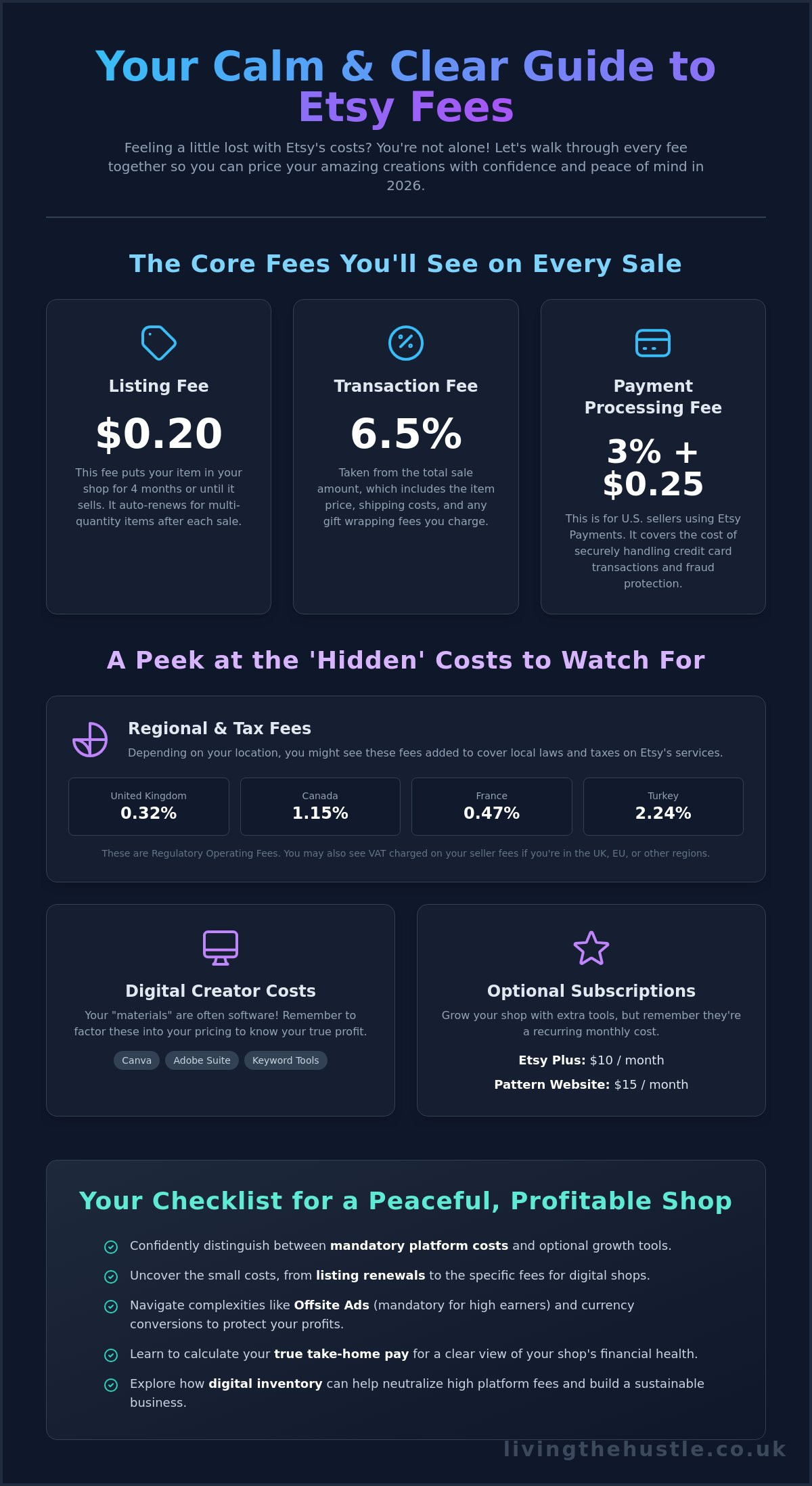
Every time you publish a product in your shop, you pay a $0.20 listing fee. This keeps your item active for four months or until it sells. If you have multiple quantities of one item, Etsy will automatically renew the listing for another $0.20 after a sale occurs. It's a small, manageable amount, but it’s helpful to keep an eye on your “auto-renew” settings to stay in control of your budget. When you make a sale, Etsy takes a 6.5% transaction fee. This percentage applies to the total amount you charge your customer, which includes the item price, shipping fees, and any gift wrapping charges you might offer.
Etsy Payments and Processing
Most sellers use Etsy Payments to handle their money safely. It's a mandatory part of the platform for most regions, ensuring that your customers can pay with ease using their preferred methods. This service comes with its own cost, which is separate from the standard transaction fee. For U.S. sellers, the processing fee is 3% of the total sale plus a flat $0.25 per transaction. While it might feel like another layer of expense, it covers the heavy lifting of credit card processing and fraud protection. If you're just getting started, you might find our guide on how to set up an Etsy shop in 2026 a helpful companion as you navigate these initial steps. Getting these basics right is the first step in uncovering what are the hidden costs of selling on etsy and building a shop that truly thrives.
The “Invisible” Costs: What You Do Not See on the Pricing Page
While the basic listing and transaction fees might seem straightforward, many sellers find themselves feeling “nickel and dimed” by smaller charges that don't appear on the main marketing pages. It's completely natural to feel a bit confused when your deposit is lower than you expected. When you are trying to understand what are the hidden costs of selling on etsy, you have to look beyond the $0.20 listing fee. These “invisible” costs are often the difference between a shop that barely breaks even and one that provides true peace of mind. By identifying them early, you can build a more sustainable and joyful business.
VAT and Regulatory Operating Fees
If you're selling from the UK, EU, or several other regions, you might notice a charge for Value Added Tax (VAT) on your seller fees. This isn't VAT on the items you sell, but rather a tax on the services Etsy provides to you. Additionally, Etsy has introduced Regulatory Operating Fees in several countries to cover local compliance costs. Seeing these clearly in your Payment Account dashboard is the first step to a guide to Etsy fees that actually helps you plan your profit. As of June 2026, these specific rates include:
- United Kingdom: 0.32%
- Canada: 1.15%
- France: 0.47%
- Turkey: 2.24%
Software and Design Tool Subscriptions
Digital product sellers often face a unique set of expenses that physical shops don't have. Since you aren't paying for bubble wrap or postage, your version of what are the hidden costs of selling on etsy lives in your tech stack. You might pay for design tools like Canva or Adobe, or keyword research software to help your products stand out in search. These monthly subscriptions are essential for creating high-quality inventory, and they should be factored into your pricing strategy just as carefully as physical materials. If you want to dive deeper into this model, you can read our How to Sell Digital Products on Etsy: Your Calm Beginner’s Guide.
Finally, keep an eye on optional subscriptions like Etsy Plus ($10 per month) or Pattern ($15 per month). These services offer features like custom web addresses or extra listing credits, but they can quietly increase your overhead if you aren't using them to their full potential. If you feel overwhelmed by these numbers, using a tool like our Blog, Brand & Bloom Workbook can help you organize your business thoughts and find a sustainable path forward without the stress.
Offsite Ads and Currency Conversion: The Real Profit Killers
Does the idea of Etsy taking a large chunk of a single sale make you feel a bit uneasy? It's a valid concern, especially when you are trying to figure out what are the hidden costs of selling on etsy that don't show up on the surface. Beyond the standard transaction fees we have already covered, two major factors can significantly impact your bottom line: Offsite Ads and currency conversion. These aren't just small charges; they can represent a substantial portion of your price if you haven't budgeted for them. Offsite Ads can automatically claim a portion of your revenue if a sale originates from an external search engine.
The Offsite Ads Dilemma: To Opt-In or Opt-Out?
Etsy invests heavily in advertising your products on external platforms like Google, Facebook, and Pinterest. Instead of charging you for every click, they use a “success fee” model, meaning you only pay when a sale actually happens. If you have earned less than $10,000 in the past 365 days, this fee is 15% of the total sale amount. At this level, you have the choice to opt-out in your settings if you prefer to drive your own traffic. However, once your shop hits that $10,000 milestone, the fee reduces to 12% and becomes mandatory. While it might feel frustrating to lose that control, remember that these are sales you likely wouldn't have made otherwise. The calmest way to manage this is to ensure your profit margins are healthy enough to absorb a 12% or 15% hit without causing financial stress. You are building a business that can handle growth, and this is just one part of that expansion.
Currency Conversion and Deposit Fees
If you live outside the United States or list your products in a currency that doesn't match your bank account, you need to be aware of conversion costs. Etsy charges a 2.5% fee on the sale amount to convert your funds into your local currency. This might not sound like much on a single sale, but it adds up quickly over dozens of transactions. Many sellers are surprised by this because it's a “silent” charge that happens during the deposit process. To avoid this, always try to list your items in the same currency as your payment account. If you're selling internationally, using a tool like eRank for Etsy Sellers can help you see how your prices look to customers in different countries. Understanding these global mechanics is essential when calculating what are the hidden costs of selling on etsy. It allows you to stay focused on your creative work while knowing your finances are being handled with care and precision.
How to Calculate Your True Profit Margin (The Calm Way)
Have you ever felt a rush of excitement after a sale, only to feel a bit deflated when you see the final deposit in your bank account? It is a common experience for many creators. While it is tempting to focus on your total revenue, that number is often just a “vanity metric” that doesn't tell the whole story. Profit is the only number that truly matters for your peace of mind. Understanding what are the hidden costs of selling on etsy is the first step toward reclaiming your time and ensuring your creative work actually supports your life. By moving from guessing to knowing, you can replace financial anxiety with a sense of quiet confidence.
The most effective way to manage your shop's health is the “Buffer Method.” This involves building a small safety margin into your pricing to account for those variable charges we discussed earlier. Instead of worrying if an Offsite Ad will “ruin” your profit, you price your items as if every sale might include that fee. If the fee doesn't apply, you simply have a little extra profit to celebrate. Reviewing your Etsy Payment Account once a month doesn't have to be overwhelming. Set a recurring date, grab a cup of tea, and look at your numbers with curiosity rather than fear.
A Simple 5-Step Profit Calculation
- Step 1: Decide on your “take-home” pay. How much do you want to keep in your pocket for this specific item?
- Step 2: Add the $0.20 listing fee and the 6.5% transaction fee.
- Step 3: Factor in the payment processing fee (3% + $0.25 for U.S. sellers) and any local VAT or Regulatory Operating Fees.
- Step 4: Include a 12% to 15% buffer for potential Offsite Ads. This acts as “insurance” for your margins.
- Step 5: Finalize your price and compare it to the market average to ensure you are staying competitive while remaining profitable.
Tools for Financial Clarity
Manual tracking is almost always better than guessing when you are building a long-term business. It helps you spot trends and realize exactly when it is time to raise your prices to protect your energy. You can use the Calm Creators Content Planner to keep your business growth organized and visible. When you see your costs and profits laid out clearly, the technical side of entrepreneurship feels much more manageable. If you are ready to stop feeling “nickel and dimed” and start building a brand with intention, our Blog, Brand & Bloom Workbook provides the perfect framework to help you organize your finances and your future.
Building a Profitable Digital Product Business Without the Stress
While it is easy to find online communities focusing on the negative aspects of fees, your journey doesn't have to be defined by frustration. Many people claim it is impossible to make money on the platform anymore, but that simply isn't true for those with a clear strategy. Digital products are the ultimate hedge against platform costs because they eliminate the overhead of physical inventory, packaging, and shipping. When you remove those traditional expenses, understanding what are the hidden costs of selling on etsy becomes a much lighter task. You can focus on your creativity while your digital files serve as a sustainable foundation for passive income.
Transitioning from a “hustle” mindset to a peaceful, long-term business requires a shift in how you view your time. Instead of trading hours for dollars, you create high-value assets like templates or clipart once and sell them indefinitely. This model allows you to absorb transaction fees comfortably because your production cost per sale eventually drops to nearly zero. Professional training is a wonderful way to skip the expensive “trial and error” phase that leaves many new sellers feeling stuck. By following a proven path, you can build a shop that supports your well-being instead of draining your energy.
Scaling with Confidence
One of the best ways to protect your profit margins is to reduce your reliance on paid advertising. Mastering Etsy SEO in 2026: The Calm Guide to Getting Your Digital Products Found ensures that your items appear in front of the right buyers naturally. When your organic traffic is strong, the impact of Offsite Ads feels like a bonus rather than a burden. If you want to focus on high-value niches, the Template Creators Society helps you build a scalable brand with confidence. It is much easier to navigate what are the hidden costs of selling on etsy when you have a community of creators sharing their insights and successes with you.
Your Next Steps to Passive Income
If you are ready to skip the confusion and start seeing real progress, the Passive Income Society is our most popular choice for dedicated creators. It provides the clarity you need to solve the fee puzzle once and for all. You don't have to figure everything out on your own. Joining a community of mentors who have navigated these challenges before you can turn a stressful project into a manageable and joyful endeavor. Your dream of a peaceful, profitable shop is entirely achievable. Every successful business has a small cost of doing business, but with the right digital strategy, those costs become a simple, predictable part of your growth. Take a deep breath and start building the life you deserve today.
Step Into Your Future with Financial Clarity
Building a shop that truly thrives starts with understanding the numbers behind your creativity. You have now seen how standard listing fees and transaction percentages work together with less obvious charges like regulatory fees and Offsite Ads. Knowing exactly what are the hidden costs of selling on etsy removes the fear from your business planning; it gives you the power to price your items for real, sustainable profit. You don't have to feel overwhelmed by the technical side of entrepreneurship when you have a clear, methodical path forward.
If you are ready to skip the confusion and build your digital empire with a supportive mentor by your side, we invite you to join the Passive Income Society and master Etsy without the overwhelm. As our most popular course for digital sellers, it provides step-by-step guidance focused on calm, sustainable growth. You deserve a business that brings you peace of mind and financial freedom. Take that next step today with confidence and a quiet heart. Your dream shop is waiting for you.
Frequently Asked Questions
Is it free to start an Etsy shop in 2026?
It is not entirely free, but the barrier to entry is very low. You don't have to pay a monthly subscription for a standard shop; however, you will pay $0.20 for every item you list. This small cost keeps your product active for four months. It is a manageable way to start your creative journey without a large upfront investment, allowing you to grow at your own peaceful pace.
How much does Etsy actually take per sale for digital products?
For a typical U.S. sale, Etsy takes roughly 10% to 13% of the total price. This includes the 6.5% transaction fee and the payment processing fee of 3% plus $0.25. If you are selling digital products, these percentages are your primary overhead. Knowing these numbers helps you price your templates or clipart for true profit and long-term sustainability.
Can I opt-out of Etsy Offsite Ads?
You have the choice to opt-out if your shop has earned less than $10,000 in the last 365 days. If you cross that revenue milestone, the ads become a mandatory part of your business. The fee also drops from 15% to 12% for those higher-earning shops. Many sellers find peace by simply pricing their items to accommodate these ads from the very beginning.
What is the most expensive fee for new Etsy sellers?
The Offsite Ads fee is often the most significant expense for newer shops. At 15% of the total sale price, it can feel surprising if you haven't budgeted for it. Learning exactly what are the hidden costs of selling on etsy allows you to set prices that protect your take-home pay. By adding a small buffer to every item, you can stay calm even when Etsy's marketing brings you a successful ad-driven sale.
Do I have to pay VAT on my Etsy fees if I live in the UK?
Yes, you will likely see VAT applied to the fees Etsy charges you. This is a tax on the service Etsy provides, not on the products you sell. In the UK, you also pay a 0.32% Regulatory Operating Fee. These small charges are automatically deducted from your balance. You can find a clear breakdown in your Payment Account dashboard whenever you need a moment of clarity.
Are there hidden costs if my shop is in a different currency?
A 2.5% currency conversion fee is applied if your listing currency is different from your bank account's currency. This is a major factor when considering what are the hidden costs of selling on etsy for international creators. To keep your finances simple and calm, always set your shop currency to match your local bank account. This small adjustment ensures you keep more of your hard-earned money.
How do I avoid losing money on low-priced digital items?
The best way to protect your margins is to avoid pricing items too low. Flat fees like the $0.20 listing fee and $0.25 processing fee stay the same regardless of the price. This means they eat a much larger percentage of a $2.00 item than a $10.00 item. Consider bundling smaller digital products together to create higher-value listings that support your financial goals.
What happens if a customer returns a digital product regarding fees?
When you issue a full refund, Etsy typically credits the 6.5% transaction fee and the processing fee back to your account. However, the original $0.20 listing fee is usually not refunded. Since digital products are usually final sale, you won't encounter this often. It is still helpful to know so you can manage your shop with a sense of total confidence and control.