

What if checking your shop dashboard felt like a moment of peace rather than a wave of math induced anxiety? Let's be honest; trying to track every single one of the etsy fees can feel like trying to catch rain in a sieve. You've likely felt that familiar sting of confusion when your monthly deposit looks a bit smaller than you expected. It's completely normal to feel overwhelmed when a significant portion of your revenue, sometimes up to 30% or more, seems to vanish into thin air without a clear explanation. You are not alone in wanting to know exactly where every cent is going.
You deserve to feel in total control of your business finances. I've created this stress free breakdown to help you master the math behind your shop, including every tax and hidden cost you'll face throughout 2026. We will walk through the 6.5% transaction fee, the $0.20 listing cost, and those often misunderstood offsite ads. By the time you finish reading, you'll have the clarity needed to price your digital downloads for real profit and build your business with a sense of calm confidence.
Key Takeaways
- Replace fee-related panic with clarity by understanding exactly how the transaction and listing structure works for your digital shop.
- Gain confidence in your bottom line using a simple “Profit First” formula designed to help you calculate your true take-home pay.
- Navigate the complexities of offsite ads and taxes with ease, letting Etsy handle the heavy lifting while you focus on your creative hustle.
- Learn why the most successful digital sellers focus on scaling volume rather than stressing over individual etsy fees.
- Transition from a high-pressure side hustle to a sustainable, automated business with a calm and clear roadmap for the year ahead.
Understanding Etsy Fees in 2026: A Gentle Introduction
Starting a creative business should feel like a breath of fresh air, not a math headache. In 2026, the digital marketplace is busier than ever. Understanding etsy fees is the first step toward building a shop that actually supports your life. Think of these costs as your shop's “utility bills.” They keep the lights on and the doors open to millions of shoppers. Instead of viewing these costs as a loss, try seeing them as a strategic investment in your future.
Etsy provides a platform where your unique creations can find their perfect home. By studying Etsy's business model, we see how they prioritize connecting independent sellers with a massive global audience. To better understand this audience, it's helpful to stay informed on international news; you can learn more about what's happening in different regions. This structure is particularly beginner-friendly for digital creators. You don't need a warehouse or a logistics team to get started. You just need your creativity and a clear understanding of the numbers. It is a low-risk way to test your ideas without a massive upfront cost.
The “purpose over panic” mindset is your best tool for success. When you see a transaction fee, remember it represents a sale you might not have made on your own. You're paying for the trust Etsy has built with customers over two decades. Most sellers encounter four main fee categories: listing fees, transaction fees, payment processing fees, and occasional advertising costs. We will break each of these down so you can price your products with total confidence. Knowing your etsy fees allows you to bake those costs into your pricing strategy from day one. This ensures your side hustle remains a source of joy rather than a source of stress.
Is selling on Etsy still worth it in 2026?
Building a standalone website often costs $39 per month or more for a basic plan. That is $468 every year before you even make one sale. Etsy allows you to list a product for just $0.20. In 2026, Etsy continues to host over 92 million active buyers. This built-in traffic is a lifesaver for creators without a massive marketing budget. Digital products offer the best protection against fee fatigue because they have 100% profit margins on the physical materials side, leaving more room for platform costs.
The one-time shop setup fee
New shops opening in 2026 pay a one-time setup fee of $15 USD, which is approximately £12 for UK sellers. This barrier to entry was introduced to keep the marketplace high-quality and reduce spam listings. It is a small price for a professional storefront. In exchange, you get an immediate, secure payment system and access to Etsy's powerful seller tools. This initial investment ensures that every shop owner is serious about their creative journey and helps maintain the platform's reputation for quality.
- Listing Fees: $0.20 per item listed for a four-month period.
- Transaction Fees: A small percentage of the total sale price collected when you sell.
- Payment Processing: Fees for handling credit cards and digital wallets safely.
- Optional Services: Costs for tools like Etsy Ads or Offsite Ads if you choose to use them.
Focusing on these numbers early helps you avoid surprises later. It turns “I hope I'm making money” into “I know I'm making a profit.” Let's walk through this together, one step at a time. You have the talent; now let's give you the financial clarity to match. By the end of this guide, you'll feel ready to launch your shop with a calm and focused mind.
The Core Four: Breaking Down Essential Etsy Seller Fees
Let's talk about the money. Most new sellers feel a small pinch of panic when they see their first statement. It's okay to feel that way. Understanding etsy fees is the first step toward building a business that feels calm and sustainable rather than overwhelming. When you know exactly where your money is going, you can price your products with total confidence. There are four main costs you will encounter as you grow your shop. Some are fixed, while others only happen when you make a sale.
Listing fees and the 4-month cycle
Every time you put an item in your shop, Etsy charges a flat $0.20 fee. Think of this as your rent for a tiny piece of the internet. This fee keeps your listing active for four months or until the item sells. If you are selling digital downloads, you might list a quantity of 100 or even 999. When a customer buys one, Etsy automatically “renews” the listing for the next customer and charges another $0.20. It happens in the background, which can be a surprise if you aren't expecting it.
Many beginners get caught in the “auto-renew” trap. By default, Etsy sets listings to renew automatically after four months. If an item isn't selling, you might end up paying for it indefinitely. You can manage this by switching your listings to “manual” renewal in your shop manager. This puts you back in the driver's seat. If you are still learning the basics of the platform, reading about how to start an Etsy shop can help you set these preferences correctly from day one. Listing fees are your only fixed risk in this business.
Payment processing vs. Transaction fees
These two costs often get confused, but they serve different purposes. The transaction fee is what Etsy charges for the “find.” Since April 11, 2022, this fee is 6.5% of the total order amount. This includes the price you charge for the item, shipping, and even gift wrapping. It is the platform's slice of the pie for providing the marketplace and the customers.
Payment processing fees are different because they cover the cost of securely handling the customer's money. This is essentially a bank fee. These costs change depending on where your shop is located. In the United States, the fee is typically 3% plus $0.25 per transaction. If you are based in the United Kingdom, it is 4% plus £0.20. Because these fees can eat into your profit, you should use eRank for Etsy sellers to research high-margin keywords. This ensures you are targeting products that can easily absorb these costs while still leaving plenty of profit for you.
Subscription Fees: Do you need Etsy Plus?
Etsy also offers an optional subscription called Etsy Plus for $10 per month. This package includes 15 listing credits and a $5 credit for Etsy Ads. If you already plan on listing 15 items and running ads, the actual cost of the subscription drops significantly. It also gives you access to custom web addresses and advanced shop customization tools. For a total beginner, this is rarely a necessity. You can build a beautiful, profitable shop without it. Start with the basics and only add the subscription once your monthly revenue makes the $10 feel like a tiny investment rather than a burden. If you want to keep your business simple and gentle, you can explore our calm business resources to help you scale at your own pace.
Navigating the “Hidden” Costs: Offsite Ads and Taxes
Do you ever look at your Etsy payment account and wonder where those extra cents went? While the 20 cent listing fee is easy to track, other costs can feel a bit more mysterious. For instance, selling to a global audience brings a 2.5% currency conversion fee. This applies whenever the currency in your shop's payment account differs from the currency of your bank. If you are selling from the UK, France, Italy, Spain, or Turkey, you will also notice a “Regulatory Operating Fee” on your statement. These small charges, such as 0.32% for UK sellers or 0.47% for those in France, help Etsy manage the cost of local laws. Consulting a comprehensive guide to Etsy fees ensures you aren't leaving money on the table by ignoring these small but consistent deductions.
Offsite Ads: Mandatory vs. Optional
Etsy uses its own marketing budget to place your items on high-traffic sites like Google, Facebook, and Pinterest. The best part? You only pay when a sale actually happens. For shops that earned less than $10,000 USD in the last 365 days, this program is optional. You'll pay a 15% fee on any sale attributed to an ad. If you cross that $10,000 revenue mark, the fee drops to 12% but becomes mandatory for the lifetime of your shop.
This might feel like a surprise fee, but it's a gentle way to grow. Because you only pay for results, there's no risk of losing money on ads that don't work. To stay profitable, many digital sellers add a small buffer to their base price. This ensures that even when a 12% or 15% ad fee hits, your margins remain healthy. Remember that the “cookie” for these ads lasts for 30 days. If a customer clicks an ad and buys anything from your shop within a month, the fee applies. Factoring these potential etsy fees into your initial pricing strategy prevents any sudden impact on your take-home pay.
Taxes and the digital seller
Selling digital products is often the calm path for creators who feel overwhelmed by paperwork. In many jurisdictions, Etsy automatically collects and remits VAT or Sales Tax for you. For example, if a customer in the European Union buys your digital planner, Etsy calculates the correct VAT rate based on their country and sends it to the local tax authorities. You don't have to register for VAT in every country you sell to, which is a massive relief for small businesses. This automated system allows you to focus on creating beautiful products while the platform handles the heavy lifting of international tax compliance.
While Etsy handles the sales tax side, you remain responsible for your own income tax. In the United States, Etsy will send you a 1099-K form if you meet the current IRS reporting threshold, which was set at $5,000 for the 2024 tax year. Keeping a clear record of your etsy fees is vital here. These fees are usually tax-deductible business expenses. By tracking them monthly, you can approach tax season with confidence instead of panic. This simple habit turns a potentially stressful task into a manageable part of your creative routine.
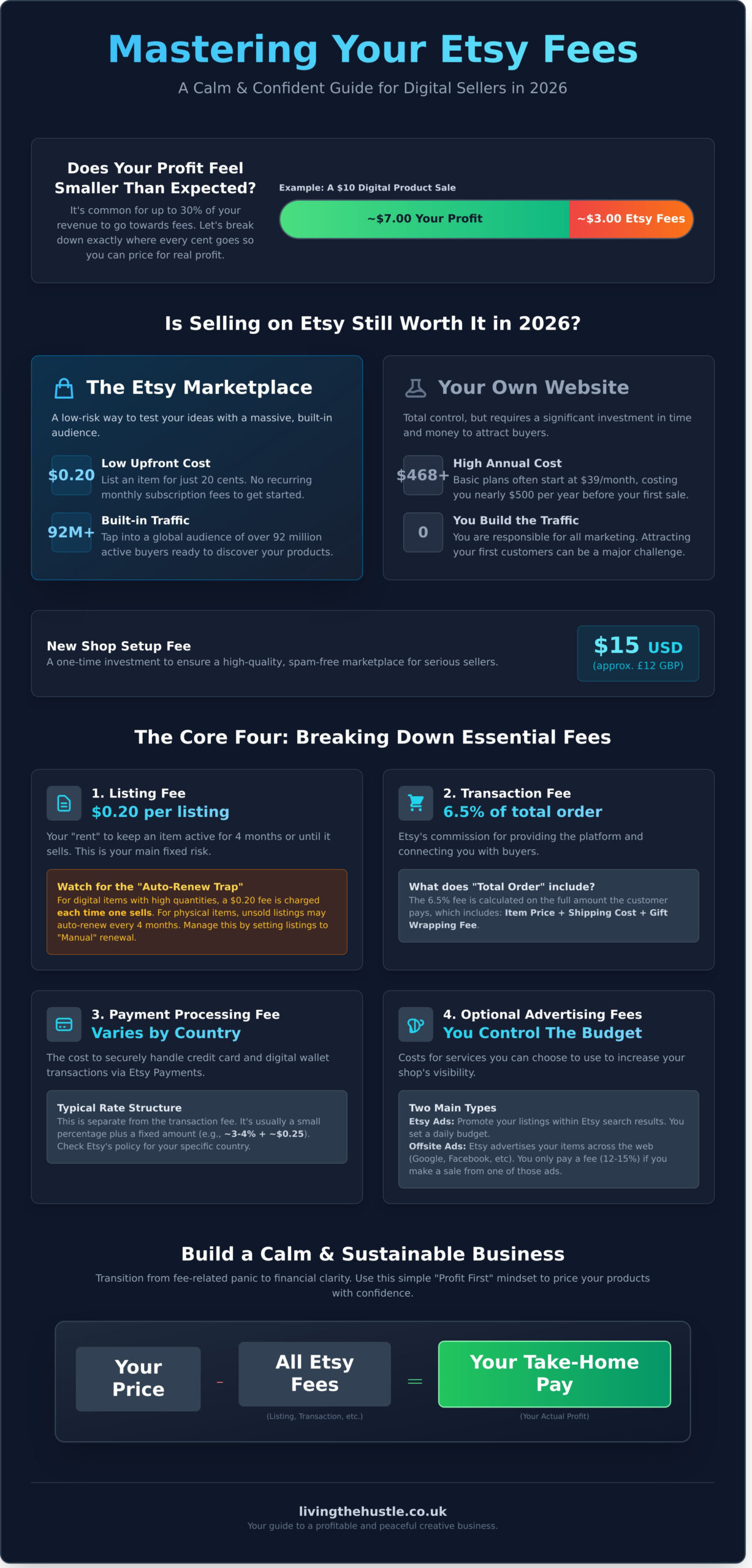
Pricing for Profit: How to Absorb Fees Without the Overwhelm
Let's be honest; seeing those deductions on your Etsy dashboard can feel like a small sting. You worked hard on your digital product, so it's natural to want every cent of that sale. However, the secret to a calm business isn't wishing the fees away. It is building a pricing strategy that accounts for them from the very start. When you use a Profit First approach, you stop viewing etsy fees as a loss and start seeing them as a simple utility bill for your shop's digital storefront.
To calculate your actual take-home pay, you need to look past the surface price. If you sell a digital download for $10.00, you aren't actually banking $10.00. Once you subtract the 6.5% transaction fee, the $0.20 listing fee, and the standard payment processing fee of 3% plus $0.25, your net is roughly $8.60. Managing these etsy fees is much easier when you focus on your net profit rather than the gross sale amount. Underpricing is a much bigger threat to your shop than the platform itself. In fact, 68% of sellers who struggle to stay profitable are often undercharging for their expertise. They focus on being the cheapest option rather than the best one.
You can regain control by creating a simple tracking spreadsheet today. List your gross price in the first column, then subtract every known fee in the following columns. Seeing your “net per sale” in black and white removes the mystery. It allows you to make business decisions based on data, not fear. If your net profit is too low, it's a clear signal to raise your prices or bundle your products; it's not a reason to quit.
The Art of High-Value Design
One of the fastest ways to protect your margins is to increase your average order value. It takes the same $0.20 listing fee to sell a $2 printable as it does to sell a $20 bundle. When you learn to create digital products that truly stand out, you move away from “pennies” and toward sustainable income. Use psychological pricing to your advantage too. Research shows that for digital goods, a flat $7.00 often feels more premium and “clean” to a buyer than $6.80. It signals quality over a bargain-bin discount.
Tools to help you stay organized
Consistency is the antidote to overwhelm. Using a tool like the Calm Creators Content Planner helps you track your shop growth without the stress of manual math. By reviewing your data monthly, you can catch fee trends before they become problems. Conduct a “fee audit” every 30 days to ensure your margins stay healthy. This habit ensures you never face a surprise bill at the end of the year. You deserve to run a business that feels peaceful and profitable.
Ready to stop guessing and start growing? You can build a digital product business that thrives with the right strategy in place.
Scaling Your Passive Income: Moving Beyond Fee Frustration
It's easy to get caught up in the tiny details of every transaction. You might find yourself staring at a spreadsheet, worrying about whether a 6.5% transaction fee is too high. Let's be honest; focusing on the cents can stop you from seeing the dollars. The most successful sellers treat etsy fees as a predictable utility bill rather than a personal hurdle. They understand that growth comes from volume, not from obsessing over a 20-cent listing fee. When you sell 300 digital downloads a month, a small fee change doesn't break your spirit. It becomes a simple cost of doing business.
Moving from a frantic hustle to a calm, automated business requires a major shift in your mindset. You're building a long-term asset. In 2024, the gap between a shop that earns $50 and one that earns $5,000 often comes down to strategy and systems. A study by the Small Business Administration suggests that 82% of small businesses fail due to cash flow issues, often because they didn't plan for their overhead. By calculating your etsy fees upfront, you remove the element of surprise. This allows you to focus on creating products that people actually want to buy.
Investing in your education is the fastest way to skip the line. You don't have to spend three years guessing which tags work or why your margins are slim. Learning from those who have already paved the way helps you avoid the 40% of beginner mistakes that lead to burnout. Your shop is a journey. It's a creative outlet that has the potential to change your financial future. Don't let a few math problems stand in the way of your freedom. Focus on the big picture, keep your head up, and remember why you started this journey in the first place.
Choosing your niche for maximum margin
Digital products are the secret to maintaining high profit margins regardless of platform costs. When you create party printables, your overhead stays incredibly low while your reach stays global. These products are “set it and forget it” assets. Another high-growth area involves selling junk journals. These specialized niches allow you to charge premium prices because you're providing a unique, creative solution. Customers will gladly pay $15 for a design they love, making the small fees feel like a tiny fraction of your total profit. Building a brand based on quality ensures that customers return, even if you need to adjust your prices by a few cents to cover rising costs.
Your next gentle step
If you feel a bit overwhelmed by the numbers, take a deep breath. You don't have to navigate these changes alone. The Passive Income Society is the best way to master the platform without the typical stress. It's a supportive community where platform updates are discussed with clarity, not panic. You get to learn alongside others who are also building their dreams. Start your digital journey with purpose today. You've already done the hard work of researching; now it's time to take that first gentle step toward a business that supports your life rather than draining it.
Take Control of Your Creative Future in 2026
Running a digital shop shouldn't feel like a constant battle against the numbers. By 2026, the most successful sellers will focus on mastering the four core etsy fees while building a pricing strategy that protects their peace of mind. You've learned how to account for the 6.5% transaction fee and standard listing costs without sacrificing your profit margins. When you price with confidence, those “hidden” costs like offsite ads become manageable parts of a growing business instead of sources of panic.
You don't have to navigate these technical steps alone. Our community is already trusted by 3,450 calm creators who prioritize sustainable growth over burnout. We provide step-by-step guidance for total beginners to ensure you build a foundation of passive income that lasts for years. Ready to build your digital empire? Join the Passive Income Society today!
You have the talent and the tools to turn your creative spark into a thriving reality. Let's make this the year your business finally feels like the calm, rewarding journey you deserve. You've got this.
Frequently Asked Questions
How much does Etsy take per sale in 2026?
Etsy takes a 6.5% transaction fee on the total sale price, including the shipping and gift wrapping costs you charge. You'll also pay a payment processing fee, which for US sellers is 3% plus $0.25 per transaction. These combined etsy fees usually mean you keep about 90% of your revenue, allowing you to build a sustainable business with clear profit margins.
Does Etsy charge a monthly fee for having a shop?
You don't have to pay a monthly subscription fee to run a standard Etsy shop. It's completely free to open your storefront and start listing products for just $0.20 each. This low barrier to entry makes it a gentle way for you to test your creative ideas without a recurring financial commitment. If you want extra tools, the optional Etsy Plus plan is available for $10 monthly.
Are Etsy fees different for digital products?
The etsy fees for digital products follow the same 6.5% transaction rate as physical items. You still pay the $0.20 listing fee every four months or when an item sells. However, you often save money because you aren't paying transaction fees on shipping costs. This makes digital downloads a high margin option that helps you build a calm business without the stress of physical inventory.
How do I avoid paying Offsite Ad fees on Etsy?
You can opt out of Offsite Ads if your shop has earned less than $10,000 USD in the past 365 days. Simply go to your Shop Manager, click Settings, and select Offsite Ads to turn them off. If you've crossed that $10,000 threshold, the 12% fee becomes mandatory for all future sales. Monitoring your trailing 12 month revenue helps you stay in control of these advertising costs.
What happens if my Etsy listing expires without a sale?
Your listing expires after 4 months if it hasn't sold, and you'll lose the initial $0.20 listing fee. You can choose to manually renew it for another $0.20 or set it to auto renew in your settings. If an item doesn't sell in those 120 days, it's a great time to review your SEO and photos to give your shop a fresh, confident start.
Is the Etsy Plus subscription worth the $10 monthly cost?
The Etsy Plus subscription is worth the $10 cost if you already spend money on listings and ads each month. You get 15 listing credits and a $5 Etsy Ads credit, which totals $8 in direct value. This means the actual cost for the extra branding tools and restock requests is only $2. It's a smart, low cost investment for sellers who want to look more professional.
How does Etsy handle VAT for UK and EU sellers?
Etsy automatically collects and remits VAT on digital downloads for buyers located in the UK and EU. For physical goods, Etsy collects VAT on orders under £135 in the UK or €150 in the EU. This takes the technical stress off your shoulders so you can focus on creating. You should still include your VAT ID in your settings if you're a registered business to ensure your accounting is accurate.
Can I pass the Etsy fees onto my customers through my pricing?
You should definitely include your fees in your product pricing to protect your profit margins. Most successful sellers add about 15% to their base cost to cover the transaction, payment, and listing fees. This approach ensures your business remains sustainable and provides you with the confidence to grow. Use a simple spreadsheet to track these costs so you never feel surprised by your monthly statement.