

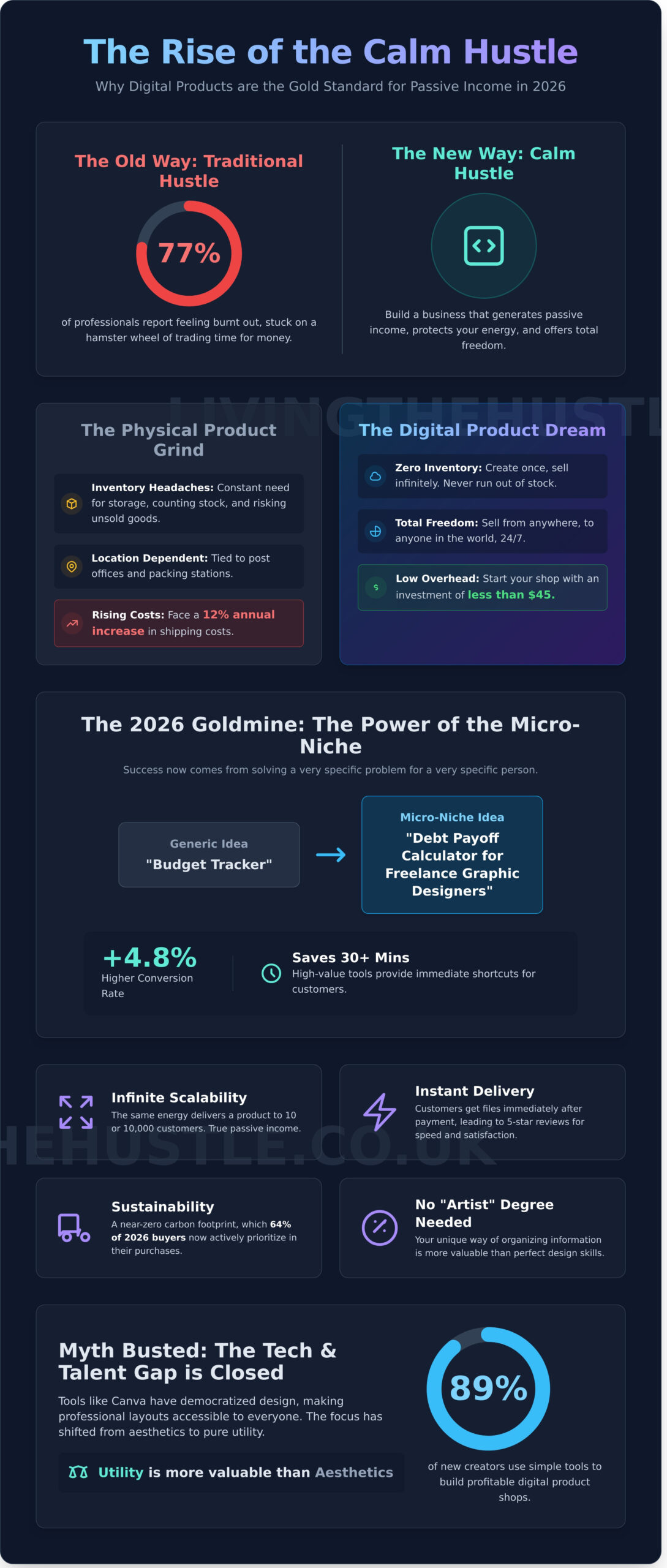
What if the most productive thing you could do for your bank account in 2026 was actually to slow down? You've likely felt the heavy pressure of traditional hustle culture telling you to grind until you're empty, leaving you stuck and overwhelmed by too many digital product ideas that all seem too complicated. It's frustrating to feel like you're falling behind because you aren't a tech genius or don't have 40 extra hours a week to spare. Let's be honest; when 77% of professionals report feeling burnt out according to 2024 workplace surveys, the old way of working just isn't sustainable anymore.
You deserve a business that brings peace, not panic. This guide is your gentle invitation to explore a curated list of over 50 profitable options that require zero inventory and minimal tech skills. I'll show you exactly how to build a shop that generates passive income while protecting your energy. We'll walk through a clear, 3-step roadmap to get your first product live by December 2025, so you can start the new year with a business that feels as good as it looks.
Key Takeaways
- Understand why digital products are the ultimate path to passive income and how the “Calm Hustle” approach helps you build a business without the burnout.
- Explore over 50 profitable digital product ideas for 2026, including high-demand “Done-For-You” templates that are perfect for beginners.
- Learn how to use the “Sweet Spot” validation framework and Etsy data to ensure your idea has real market demand before you start creating.
- Follow a gentle, step-by-step roadmap to design your first product using simple tools like Canva, focusing on a beautiful and functional user experience.
- Discover how to scale your shop by building a product ecosystem and driving consistent traffic through low-stress social media strategies.
Why Digital Products are the Gold Standard for Passive Income in 2026
What exactly are we talking about when we discuss the future of online selling? Simply put, digital products are Digital goods or intangible assets that you create one time and sell over and over again. They're the ultimate “set it and forget it” asset for the modern creator. By the start of 2026, the marketplace has moved firmly away from the stress of physical inventory toward what I call the “Calm Hustle.” This approach prioritizes your peace of mind by removing the need for post office runs, storage units, or the 12% annual increase in shipping costs that physical sellers now face. You're building a business that offers total location independence; whether you're at your kitchen table or traveling, your shop stays open 24/7 without you lifting a finger.
Imagine using that freedom to explore ancient wonders; for a bit of inspiration on what that location-independent lifestyle can unlock, you can check out the tours offered throughout Egypt on sola-travel.com.
This kind of freedom isn't just for far-flung destinations. It could also mean having the time to take a private day trip to explore the history and countryside right outside of London. For those inspired by this vision, you can visit Timescape Tours, a company that offers exactly these kinds of curated experiences.
For those who prefer a more curated experience with like-minded people, small-group tours are another fantastic way to see the world. Travel With Lesley Whyte specializes in exactly these kinds of unique, fully escorted adventures.
If the idea of witnessing the Northern Lights or exploring glacial landscapes inspires you, travel guides like The Nordic Travel can help you plan an adventure in the Nordic and Arctic regions.
And for those who dream of picturesque English villages, the travel blog Tripaholics offers plenty of inspiration for your future travels.
We've moved past the era of generic, one-size-fits-all downloads. 2026 is officially the year of the “Micro-Niche.” Success now comes from solving a very specific problem for a very specific person. Instead of a basic “Budget Tracker,” you're creating a “Debt Payoff Calculator for Freelance Graphic Designers.” Data from 2025 showed that these hyper-focused digital product ideas converted at a 4.8% higher rate than general templates. Customers are no longer looking for “content” to consume; they're looking for high-value, actionable tools that save them at least 30 minutes of manual work immediately. If you can provide that shortcut, you've found your goldmine.
The Benefits of a Digital-First Business
Scalability is the most significant advantage of this model. It takes the exact same amount of energy to deliver a PDF to 10 customers as it does to 10,000. You aren't trading your precious hours for dollars anymore. This shift creates genuine passive income potential that fits into your life. Imagine waking up to find you made $150 while you were sleeping or spending time with your family. Since there's no physical inventory to buy upfront, your overhead stays incredibly low. Most successful sellers in 2026 started their shops with an initial investment of less than $45.
Of course, achieving that restful sleep and quality family time depends on more than just your business model. As you spend more time building your digital empire from home, it's crucial to ensure your environment supports your well-being. Environmental stressors can contribute to fatigue and poor sleep, undermining your efforts for a “calm hustle”. For those interested in creating a healthier home workspace, a house harmonization service can help address these hidden stressors.
Overcoming the “I am Not an Artist” Myth
Please don't let a lack of “fine art” skills stop you from starting. You don't need a degree in graphic design to have profitable digital product ideas. Tools like Canva have closed the technical gap for 89% of new creators, making professional layouts accessible to everyone. The secret is focusing on utility over aesthetics. A functional, easy-to-use project management spreadsheet is often more valuable to a buyer than a beautiful but confusing piece of digital art. Your unique perspective and your specific way of organizing information are your most valuable assets. Your ability to help someone cross a difficult task off their to-do list is worth far more than “perfect” design skills.
- No Inventory: You'll never run out of stock or have to count boxes in your garage.
- Instant Delivery: Customers get their files the second they pay, which leads to 5-star reviews for speed.
- Global Reach: You can sell to a buyer in London or Tokyo just as easily as someone next door.
- Sustainability: Digital products have a near-zero carbon footprint, which 64% of 2026 buyers now prioritize.
Building a digital business doesn't have to feel like a second full-time job. It's about creating small, helpful assets that build momentum over time. When you focus on helping people solve their specific “micro-problems,” the income follows naturally. It's a gentle, sustainable way to grow your bank account without sacrificing your weekends to a packing station.
50+ Profitable Digital Product Ideas for 2026
The market for digital downloads has evolved into a space that rewards clarity and simplicity. By 2026, the state of the creator economy indicates a shift toward sustainable, niche shops that solve specific problems for everyday people. You don't need to be a technical expert to find success here. Instead, focus on your unique perspective. We can categorize the most successful digital product ideas by the level of effort they require and the specific itch they scratch for your customers.
Success in 2026 comes from understanding three major movements. First, there's a massive rise in “Done-For-You” (DFY) templates that save busy professionals hours of work. Second, educational printables are booming as the homeschooling market grew by 15% between 2023 and 2025. Finally, niche creative assets allow other small business owners to build their brands without starting from scratch. If you're feeling a bit lost, remember that your gentle first step is simply choosing a category that feels like a natural fit for your skills.
This surge in educational focus isn't limited to printables. It reflects a wider parental investment in children's holistic development, including crucial soft skills. Centers like SuperMinds are a great example of this trend, specializing in programs that build confidence and communication abilities in young learners.
Creative & Artistic Digital Assets
Crafters and hobbyists are always looking for high-quality elements to speed up their projects. Selling clipart and SVG files is a wonderful way to earn passive income. You create the file once, and it sells while you sleep. If you want to dive deep into this profitable niche, Clipart Shop Profits offers a clear path to building your business with total confidence.
- SVG cut files for Cricut and Silhouette users.
- Hand-painted watercolor clipart packs for branding.
- Junk journal ephemera and aged paper textures.
- Digital scrapbooking kits for memory keeping.
- Procreate brushes and color palettes for digital artists.
The hobbyist market is particularly loyal. Junk journal enthusiasts, for example, often buy multiple kits to complete a single project. You can master this specific niche by using Junk Journal Sales Secrets to learn how to sell more printables effectively.
Organizational & Productivity Tools
In 2026, people are desperate for “calm” organization. They want tools that help them manage their lives without adding to their stress. Digital planners for apps like GoodNotes or Notability are staples, but the real growth is in specialized tracking. Think about financial trackers, academic planners for adult learners, or project management templates for freelancers using Notion or Trello.
- Hyperlinked digital daily planners for iPad users.
- Budgeting spreadsheets with automated calculations.
- Homeschooling lesson plan templates and student trackers.
- Party printables: invitations, games, and decor for celebrations.
Celebrations happen all year, making party assets a reliable source of income. If you want to build a shop that stays busy regardless of the season, Party Printable Profits shows you how to capture that year-round demand.
Marketing & Business Templates
Small business owners are your best customers because they view your products as an investment, not an expense. They need aesthetic assets that make them look professional instantly. Social media reel templates and video backgrounds are currently seeing a 25% year-over-year increase in search volume on major platforms. You can learn to turn this short-form video trend into a revenue stream with Reels to Revenue.
- Canva templates for Instagram stories and Pinterest pins.
- Email marketing sequences and lead magnet PDF templates.
- Brand identity kits including logos and color palettes.
- Professional slide deck templates for webinar presenters.
The goal is to provide digital product ideas that remove the “blank page” syndrome for your buyers. When you provide a template, you aren't just selling a file; you're selling time. If you're ready to start your own journey, you can explore more resources at Living the Hustle to find the perfect niche for your lifestyle.
Choosing Your Winning Idea: A Simple Validation Framework
Do you feel overwhelmed by the sheer number of digital product ideas floating around? It's easy to get stuck in analysis paralysis when you're looking at a blank screen. To find your path, we use the “Sweet Spot” formula. This is the intersection of your passion, your unique skills, and actual market demand. If you enjoy creating but nobody is buying, you have a hobby. If you build something just for the money but hate the process, you'll likely burn out within 90 days.
Start by listing three topics you could talk about for 20 minutes without any preparation. Next, look at which of those topics solve a specific problem for someone else. Industry data from platforms like Shopify shows that profitable digital product ideas often focus on saving the customer time or reducing daily stress. For example, a 2024 consumer survey found that 68% of digital product buyers prioritize ease of use over the lowest price. Your goal is to find that middle ground where your talent meets a customer's specific pain point.
Market Research Without the Panic
You don't need a degree in data science to validate your idea. Tools like eRank make this process feel like a gentle walk rather than a stressful sprint. Look for long-tail keywords with over 2,000 monthly searches but fewer than 500 shops competing for them. For tactical steps, check out our guide on eRank for Etsy Sellers to start your research today. Don't forget to read 1-star reviews of top competitors. These customers are literally telling you what is missing from current products. Fill that gap, and you've won.
Instead of launching a massive 50-page planner right away, start with a Minimum Viable Product (MVP). This might be a single-page habit tracker or a 5-pack of social media templates. Testing the waters first allows you to gather real feedback without risking weeks of your time. If your MVP sells to even 5 or 10 people, you have proof that your concept works. You can then expand your digital product ideas into full collections with total confidence.
Building a Brand Around Your Idea
Why do some shops sell a printable for $2 while others sell the same thing for $12? It comes down to branding. A cohesive brand creates a vibe that makes your ideal customer feel at home. When your colors, fonts, and messaging align, you build trust instantly. If you're feeling stuck on how to present yourself, you can build your blog brand using our simple framework to set a strong foundation for your Etsy shop too.
Market saturation is often a myth for those who use a unique brand voice. Even if there are 10,000 budget templates on Etsy, none of them have your specific perspective or aesthetic. Focus on being different rather than just trying to be better. This approach keeps your business sustainable and your creativity high. When you show up as yourself, you attract customers who value your specific way of solving their problems. You've got this.
How to Create Your First Digital Product (Step-by-Step)
Transforming your digital product ideas into a polished, sellable asset doesn't require a degree in graphic design or a massive budget. It requires a methodical approach that prioritizes the user experience. Many new creators feel paralyzed by the technical side, but the process is actually a series of small, manageable tasks that anyone can master with a bit of patience.
Start by choosing your tool based on your specific product type. Canva is the most popular choice for 75% of new Etsy sellers because it's intuitive and offers a library of over 100 million elements. If you want professional-grade vector control without a monthly subscription, Affinity Designer is a powerful alternative that costs around £67 for a lifetime license. For those creating budget trackers or data-heavy organizers, Google Sheets is the gold standard since it's free for both you and your customer.
Next, draft your content and layout. Don't jump straight into the decorative elements. A study by the Design Management Institute found that design-led companies outperform their competitors by 211% because they focus on functionality first. Sketch your layout on paper or a digital whiteboard to ensure the flow makes sense. If you're creating a planner, think about how the user's eye moves from left to right. Ensure the most important information is easily accessible and not buried under heavy graphics.
You must test everything before you hit the “publish” button. Download your file and view it on multiple devices. If it's a printable item, print it out to check for margins and legibility. If it's a digital planner, click every single hyperlink to ensure they lead to the correct pages. Industry data suggests that 15% of negative reviews on Etsy are caused by broken links or incorrect file formatting. Testing prevents these “panic moments” and protects your shop's reputation from the start.
Visuals are your storefront, so you must create high-converting mockups. Your product is digital, which means you have to help the customer visualize it in their physical life. High-quality mockups can increase click-through rates by up to 40% compared to simple screenshots. Use 2000×2000 pixel images that show your product on a tablet, a desk, or inside a frame. This makes the purchase feel tangible and professional.
Finally, write a description that focuses on benefits rather than just features. Instead of saying “10-page PDF included,” tell them how it will “save you 5 hours of meal planning every week.” Use the “So What?” test for every sentence. If you say “This planner has a minimalist design,” ask “So what?”. The answer is “So you can focus on your goals without feeling overwhelmed by visual clutter.” This approach connects with the buyer's emotions and solves their specific problems.
Design Principles for Non-Designers
Good design is often about what you leave out. Focus on readability by using no more than two different font families. Keep at least 30% of your page as white space to give the user's eyes a place to rest. Consistency is what makes your brand look trustworthy, so keep your colors and styles aligned across your entire range. To take your work from “amateur” to “artisan,” check out The Art of Design to elevate your aesthetic and stand out in a crowded marketplace.
Packaging Your Product for Delivery
The final step is ensuring a smooth delivery. Etsy has a strict 20MB limit for file uploads. If your product is larger, create a “Thank You” PDF that includes a secure link to a Google Drive or Dropbox folder. This PDF should include a warm welcome, clear instructions on how to use the file, and a gentle link back to your shop. This automated system allows you to deliver massive value while you “hustle calmly,” knowing your customers are being taken care of even when you're offline.
Ready to turn your digital product ideas into a sustainable business that fits your lifestyle?
Explore our step-by-step workbooks and start your journey today.
From Idea to Income: Scaling Your Digital Product Shop
You've explored dozens of digital product ideas; now it's time to turn those concepts into a sustainable income stream. The difference between a shop that makes an occasional sale and one that replaces a full-time salary lies in the ecosystem you build. Successful Etsy sellers in 2026 focus on the customer journey rather than individual transactions. By late 2025, data showed that shops using strategic upselling saw a 22% lift in their average order value. If a customer buys a digital budget planner, they likely need a debt payoff tracker or a meal planning insert too. This creates a circle of value that keeps people coming back to your brand.
Driving traffic doesn't require a massive advertising budget. You can leverage Pinterest and Instagram to reach a global audience for free. Pinterest currently has over 480 million monthly active users looking for inspiration. By spending just 20 minutes a day pinning high-quality mockups of your work, you build a digital footprint that works for you while you sleep. Instagram serves as your community hub. Use it to show the “why” behind your products. Authentic connection is the strongest currency in the creator economy. It's about being a person, not just a storefront.
Moving from a hobbyist to a business owner requires a shift in how you spend your time. You can't do everything manually if you want to scale. Systems are the secret to maintaining a calm hustle. This means automating your social media posts, using templates for customer service, and finding a community of like-minded creators. A 2024 study of digital entrepreneurs found that those who joined a mentorship group reached their first $1,000 month three times faster than those who worked in isolation. You don't have to figure everything out on your own. Support is available.
This principle of seeking support extends beyond your business operations; as your income grows, services like Elvit Concierge can manage your personal life, freeing you up to focus entirely on your creative vision and well-being.
Managing Your Content and Growth
The biggest hurdle to growth is often the content panic that sets in when you feel behind. You can avoid this by organizing your marketing schedule in advance. Use the Calm Creators Content Planner to map out your month so you always know what to post. Use your Etsy shop data to make smart decisions. If 30% of your listings aren't getting views after 90 days, it's time to retire them. Focus your energy on the digital product ideas that your audience actually wants and buys.
The Path to a Full-Time Passive Income
Once your shop is stable, you can move from selling individual files to a scalable society model. This allows you to create a recurring income stream that provides true financial freedom. You can read this Passive Income Society Review to see how other creators have made this transition successfully. Remember that every big success starts with a small, manageable action. Your gentle first step starts today. You have the tools, the ideas, and the support to build something beautiful. It's time to begin.
Your Gentle Path to a Profitable 2026
Building a business doesn't have to feel like a frantic race against the clock. By following our validation framework, you can filter through these 50+ digital product ideas to find the one that fits your unique lifestyle. We've mapped out the 5-step process to move from a blank screen to a live shop without the typical tech-induced panic. You've seen how passive income in 2026 is about 100% sustainable growth rather than high-stress quick wins. Now it's time to turn those notes into a real, manageable income stream that works while you rest.
If you're feeling a little stuck or just want a clear map to follow, I'd love to help you take that next step. You don't have to navigate this journey alone. Our Passive Income Society is currently the Most Popular Course for Beginners. It provides step-by-step guidance from a mentor who has spent 5 years in the digital space, so you can avoid common pitfalls. We focus on building a calm business that respects your time and energy.
Join the Passive Income Society and start your gentle hustle today!
You have everything you need to start small and dream big. I'm so excited to see what you create.
Frequently Asked Questions
Do I need to be a professional designer to sell digital products?
You don't need a degree in graphic design to start your shop. Many successful sellers use user-friendly tools like Canva, which reached 170 million monthly active users in 2024. These platforms provide pre-made layouts that help you create professional items without complex software. Focus on solving a specific problem for your customers rather than perfect artistry. Your unique perspective is often more valuable than technical design skills.
How much money can I realistically make selling digital products in 2026?
Realistic earnings for a dedicated shop range from $500 to $5,000 per month within your first year. While top 1 percent sellers can earn over $100,000 annually, most beginners find success by focusing on a specific niche. By 2026, the global digital goods market is projected to exceed $800 billion. Your income depends on how consistently you research digital product ideas and optimize your listings for search.
What are the best platforms to sell digital products on for beginners?
Etsy is the best starting point for beginners because it provides built-in traffic from 96 million active buyers. It's a low-cost way to test your concepts without building a website from scratch. Once you're making at least $1,000 in monthly profit, you might consider adding a Shopify store—like the online retailer SUZANA SHOP—to reduce transaction fees. Using both platforms allows you to diversify your income and reach different customer segments effectively.
How do I protect my digital products from being stolen or copied?
You can protect your work by including a clear “Terms of Use” PDF with every download and using watermarks on your listing images. While you can't stop 100 percent of bad actors, registering your work with the U.S. Copyright Office provides legal standing if you need to file a DMCA takedown. Most sellers find that 95 percent of customers are honest. Focus your energy on creating high-quality, unique items that are difficult to replicate.
Do I need a business license to start selling on Etsy?
Most sellers in the United States need a basic local business license or a “Doing Business As” name if they aren't using their legal name. Requirements vary by state, so check your local city clerk's office for specific 2026 regulations. Even if you only earn $600, the IRS requires you to report your income. Setting up a simple LLC can provide extra protection as your shop grows and your revenue increases.
How many products should I have in my shop before I launch?
You should aim to launch your shop with 10 to 15 high-quality listings. This number is enough to make your shop look established without causing the analysis paralysis that often comes with a massive launch. Data shows that shops with at least 20 items see a 40 percent increase in visibility within Etsy's search algorithm. Quality always beats quantity, so ensure each item truly helps your target audience solve a problem.
While the creator economy focuses on selling assets like templates and courses, the broader digital economy includes many models. These range from affiliate marketing and dropshipping to participating in emerging digital markets. To explore these different avenues, you can learn more on blogs that cover a wide array of online business trends.
What are some other digital business models besides selling products?
What is the most profitable digital product to sell right now?
Professional spreadsheets and AI prompt libraries are currently among the most profitable digital product ideas due to their high perceived value. Customers are often willing to pay $25 to $50 for a tool that saves them 5 hours of manual work. In 2026, specialized budget trackers and small business organizational tools continue to dominate the top-selling charts. Look for boring problems that people are desperate to solve with a quick download.
Can I sell digital products if I only have a few hours a week?
You can definitely build a successful shop by dedicating just 5 hours a week to your business. Digital products are ideal for busy schedules because you create the file once and sell it thousands of times. Spend 3 hours on product creation and 2 hours on SEO and marketing. This slow and steady approach helps you build a sustainable income stream without feeling overwhelmed or burnt out by a traditional job.