

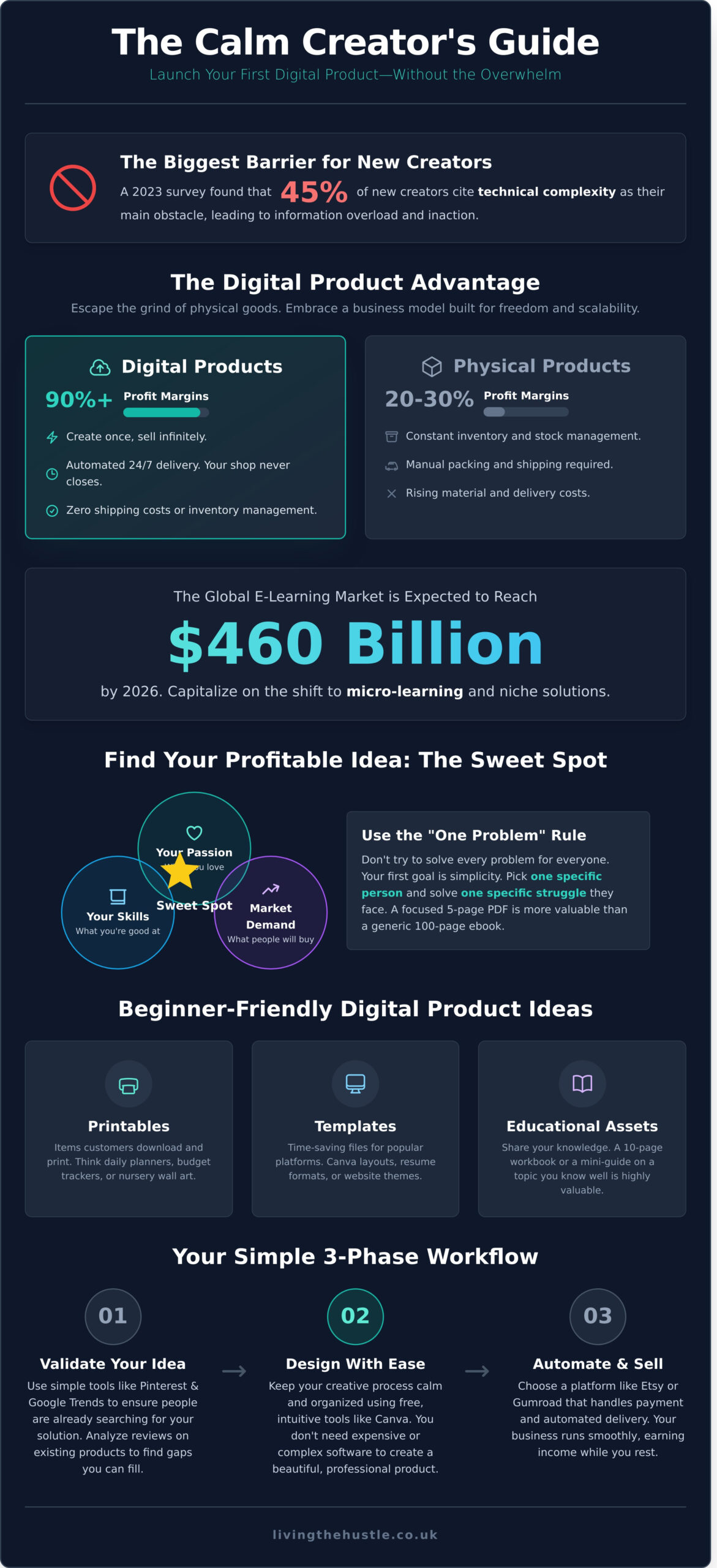
What if you could build a profitable online business without the 40 hour work week grind or a degree in graphic design? A 2023 survey by the Creator Economy Report found that 45% of new creators cite technical complexity as their biggest barrier to entry. Let's be honest; the idea of learning how to create digital products often feels like staring at a mountain of confusing software and endless to-do lists. You've likely felt that familiar sting of information overload, wondering if you actually have what it takes to turn a simple idea into a real, sellable asset. It's completely normal to feel a bit stuck when you're facing technical hurdles or the fear that your work won't be perfect enough.
This guide is your gentle roadmap to clarity. I'm sharing a step by step, overwhelm free process to launch your first product using tools you probably already know. You'll move from a blank screen to a finished product ready for your shop, all while maintaining a sense of calm confidence. We'll walk through everything from choosing your first profitable idea to the three simple steps for designing your product without any expensive software.
Key Takeaways
- Learn how to identify your “Sweet Spot” by combining your unique skills with market demand for a profitable, low-stress product idea.
- Discover a simple, three-phase workflow for how to create digital products using Canva to keep your creative process calm and organized.
- Understand why building a “Calm Creator” brand identity is the secret to standing out on Etsy and avoiding exhausting price wars.
- Find out how to use simple validation tools to ensure your idea is something people are already searching for and ready to buy.
- Explore the best platforms for your goals and how to set up automated delivery so your business runs smoothly while you rest.
What are Digital Products and Why Start in 2026?
Have you ever felt the weight of packing boxes, printing shipping labels, and rushing to the post office before it closes? It's a cycle that often leads to burnout rather than the freedom you were looking for. Digital products offer a different path. What are digital products? They are intangible assets delivered electronically, such as PDFs, video files, or software, that solve a specific problem for your customer. Digital products are high-margin, low-risk entry points for new entrepreneurs who want to build a business without the heavy overhead of physical stock.
By 2026, the global e-learning market is expected to reach $460 billion. This growth isn't just about massive university courses. We're seeing a significant shift toward micro-learning, where customers pay for small, niche solutions that they can consume in under 30 minutes. People are busier than ever. They don't want a 10-hour masterclass; they want the specific checklist or template that saves them three hours of work today. Learning how to create digital products that fit these tiny niches is the smartest move you can make this year.
Choosing this path creates what we call a calm hustle. Unlike a physical shop where profit margins might stay around 20% or 30% due to rising material costs, digital assets often provide margins exceeding 90%. You don't have to manage a warehouse or worry about “out of stock” messages. You create the file once, upload it to your shop, and it can sell 1,000 times without any extra effort from you. It's a business model that prioritizes your peace of mind and long-term sustainability.
The Benefits of a Digital-First Business Model
The most immediate perk is the total absence of shipping costs and inventory limits. In a 2024 survey of independent creators, 68% stated that time flexibility was their main reason for starting a side business. Digital products deliver exactly that. Since the delivery is automated, your shop stays open 24/7. This allows busy parents or full-time employees to earn income while they're sleeping or spending time with family. It's the true definition of a scalable asset; your income isn't tied to the number of hours you spend at a desk.
Digital Product Ideas for Total Beginners
You don't need to be a tech genius to get started. Many successful shops begin with very simple files. When you understand how to create digital products that are functional and pretty, you can start seeing results quickly. Here are three beginner-friendly categories:
- Printables: These are items customers download and print at home. Think of daily planners, budget trackers, or even nursery wall art.
- Templates: These save people time. Popular options include Canva social media layouts, professional resume formats, or drag-and-drop website themes.
- Educational assets: You don't need to be a professor. A simple 10-page workbook or a mini-guide on a topic you know well, like sourdough baking or basic gardening, is highly valuable.
- Digital Art: For those with an artistic side, this category includes everything from wall art to unique digital collectibles. To see what's possible in the premium digital art space, you can discover LightBender NFT.
By 2026, 75% of the global workforce will consist of Millennials and Gen Z. These groups are digital natives who prefer buying instant solutions online. Starting now puts you ahead of the curve, allowing you to build a library of assets that will support you for years to come. It’s about creating content with purpose, not panic, and giving yourself the gentle first step toward a more flexible life.
Finding a Profitable Idea Without the Overwhelm
Let's be honest; staring at a blank screen while trying to figure out what to sell is the quickest way to kill your creative spark. You don't need a thousand ideas to be successful. You just need one that actually works. Most successful creators use the “Sweet Spot” framework to find their path. This is the intersection of your passion, your skills, and actual market demand. If you skip the demand part, you have a hobby. If you skip the passion part, you’ll likely burn out within the first six months. Finding the balance between what you love and what people need is the secret to a sustainable business.
Are you feeling “Product Panic” right now? This happens when you try to solve every problem for every person. To stay calm and focused, follow the “One Problem” rule. Pick one specific person and solve one specific struggle they face. If you're learning how to create digital products, your first goal is simplicity. A single, well-designed 5-page PDF that solves a real pain point is worth more than a 100-page ebook that nobody asked for. You can find plenty of profitable digital product ideas to spark your imagination; however, you must filter them through your own unique experience. For instance, if you've mastered meal prepping for a family of five on a budget of £50 a week, that specific solution is your goldmine.
Market Research Made Simple
You don't need a marketing degree to see what's working. Start by “spying” on successful shops in your niche. Look at their reviews from the last 90 days. What are customers complaining about? Those complaints are “gaps” you can fill. If a top-selling planner is too cluttered, create a minimalist version. Use Pinterest and Google Trends to look ahead. For example, data shows that searches for “2026 digital wellness journals” often start spiking 12 to 18 months in advance. By spotting these patterns early, you can build your hustle with purpose rather than panic. Aim to be the solution for the person who feels overlooked by the big brands.
Validating Your Niche
Many beginners get scared when they see a “saturated” market. In reality, a busy market is a great sign. It proves people are spending money. Your job isn't to reinvent the wheel; it's to add your own unique “hook.” Use tools like eRank for Etsy Sellers to look at the numbers. You want to find keywords with at least 500 monthly searches but manageable competition levels. This data-driven approach takes the guesswork out of the process and replaces it with confidence. If you see 10,000 people searching for “budget spreadsheets” and only 2,000 shops selling them, you've found a gap worth exploring.
When you understand how to create digital products that people are already actively searching for, your anxiety fades away. Don't let the fear of competition stop you. Instead, look for ways to be 10% better or 10% more specific than what is already out there. If you're ready to move past the brainstorming phase and start building, you can explore our calm business workbooks for more step-by-step support. Validation is about finding that beautiful balance between what you love and what the data says will sell. Once you have that, the rest of the process feels much lighter.
Step-by-Step: How to Create Digital Products in Canva
Creating your first offer should feel like a quiet morning cup of tea, not a frantic race against a deadline. When you sit down to learn how to create digital products, start by clearing your physical and digital desk. A 2021 study by the University of Arizona found that cluttered environments increase cortisol levels and tank productivity. Open a fresh Canva tab, put your phone on “Do Not Disturb,” and let the “calm hustle” begin. You aren't just making a file; you're building a solution for someone who needs your help.
Moving from a blank screen to a finished product is easier when you follow a logical path. Researching how to create and sell digital products shows that the most successful creators treat their design process like a professional assembly line. Here is a simple, 5-step process to get you there:
- Choose your canvas: Select “US Letter” (8.5 x 11 inches) for workbooks or 1080 x 1920 px for mobile-friendly guides.
- The Content Dump: Type out all your text first. Don't worry about the “pretty” parts yet. Just focus on the value you're providing.
- Apply the 60-30-10 Rule: Use a primary color for 60% of the design, a secondary for 30%, and an accent color for 10% to keep things balanced.
- Add Interactive Elements: Use the “Link” tool in Canva to connect your social media or external resources.
- Export for Success: Download your file as a “PDF Print” to ensure the highest resolution for your customers.
Before you hit save, decide how your customer will use the file. If you want them to read it, a standard PDF is perfect. However, if you're selling a “done-for-you” template, you must provide a “Template Link” so they can edit the file in their own Canva account without changing your original master copy. This small detail ensures your product is “user-ready” and professional from the moment they click download.
Designing for Non-Designers
You don't need a degree in fine arts to make something beautiful. Start by choosing a cohesive color palette and a font pairing that feels easy on the eyes. A March 2024 survey of Etsy buyers revealed that 72% of customers correlate clean, professional design with the perceived value of the information. Use Canva’s built-in grids and alignment tools to keep your text boxes straight; nothing ruins a “calm” vibe faster than messy margins. If you feel stuck, explore The Art of Design to learn how to elevate your aesthetics with simple, gentle tweaks.
Creating Your Product Outline
A great digital product is a roadmap that leads a customer to an “aha!” moment. Start by brainstorming waypoints. What are the three specific steps your customer needs to take to see a result? If you're building a workbook, structure it so the user feels a sense of progress on every page. Use checkboxes and fillable fields to make it interactive. In 2023, interactive digital products saw a 25% higher completion rate than static PDFs. This engagement builds trust and turns a one-time buyer into a lifelong fan of your brand.
Polishing Your Brand: From Product to Business
You have learned the basics of how to create digital products that solve real problems for your audience. Now, it is time to move from being a casual seller to a confident business owner. Many new creators experience what I call “Etsy panic” when they see hundreds of similar listings in their niche. This fear often leads to a race to the bottom where everyone lowers their prices just to get a single click. Branding is your antidote to this stress. It allows you to charge what you are worth because people are buying from you, not just a generic file.
A “Calm Creator” identity focuses on connection rather than constant competition. When you maintain a consistent look and feel, you build a bridge of trust with your buyers. A 2023 study by Lucidpress found that brand consistency can increase revenue by 33 percent. This starts with your visuals. High-quality mockups are essential for your shop. They transform a flat digital file into a tangible, desirable solution. If a customer can see your budget tracker displayed on a beautiful tablet screen next to a cup of coffee, they can visualize it in their own life. This visual proof justifies a higher price point and sets you apart from low-effort shops that only show screenshots.
Building this foundation does not have to be a source of overwhelm. You can Build Your Blog Brand Without the Overwhelm by focusing on what makes your perspective unique. Your brand is the promise you make to your customers about the experience they will have when they interact with your work.
The Elements of a Standout Digital Brand
Developing a signature style makes your shop instantly recognizable in a crowded feed. Choose a specific color palette and a set of two fonts to use across every single product and listing image. This consistency creates a professional “boutique” feel that buyers naturally trust. Your product descriptions should also speak to the heart. Instead of only listing technical features like “10-page PDF,” describe the relief your buyer will feel. Explain how your product replaces their current chaos with a sense of calm. A 2022 survey by Edelman showed that 81 percent of consumers need to trust a brand before they buy. You build this trust through a consistent, helpful voice. Finally, always include a “Thank You” delivery note in your download folder. This note can include a discount code for their next purchase or a link to a helpful video tutorial. These small gestures build the kind of customer loyalty that leads to repeat sales.
Packaging for Profit
Once you understand how to create digital products that help people, you can start bundling them for higher profits. Bundling is a simple way to increase your average order value without finding new customers. If you sell three separate workbooks for $12 each, offer them as a “Complete Productivity Bundle” for $27. This feels like a massive win for the customer and puts more profit in your pocket for the same marketing effort. You should also create “Lead Magnets.” These are small, free samples of your work, such as a one-page checklist or a mini-template. Use these to build an email list outside of third-party platforms. Having a list means you own your audience; you are no longer at the mercy of sudden algorithm changes.
Short-form video is another powerful tool for packaging your brand. A quick 15-second video showing how to customize your digital template can be more effective than ten static photos. It proves the product is user-friendly and high quality. Showing the “behind the scenes” of your creation process helps your audience feel connected to your journey. This personal connection is what turns a one-time buyer into a lifelong fan. Recent marketing data shows that 73 percent of consumers prefer watching a short video to learn about a product. Use this to your advantage to stand out and show the real value of what you have built.
Launching and Scaling Your Passive Income Journey
Opening your shop is a brave step toward a calmer, more intentional lifestyle. You aren't just uploading a file; you're building a sustainable asset that serves people while you focus on what matters most. The platform you choose will define your daily workflow. Etsy is often the best starting point for beginners because it reached 96.2 million active buyers in late 2023. This built-in audience means you don't have to be a marketing expert on day one. If you prefer total control over your branding and customer data, Shopify is an excellent alternative. For those who already have a following, selling directly through a personal blog keeps your profit margins at their highest. You won't pay listing fees, though you will be responsible for driving 100% of your own traffic through Pinterest or SEO.
Success depends on setting up systems that work while you sleep. Most modern platforms offer automated delivery, meaning the customer receives their download link the second their payment clears. This automation is the heart of a gentle hustle. It removes the pressure of being “always on” and ensures your customers are happy instantly. However, the journey can feel lonely if you stay in your own head. Moving from a solo mindset to a community-focused one provides the accountability you need to stay consistent. If you want to see how a structured group can help you grow, take a look at my Passive Income Society Review for an inside look at finding your people.
The principle of creating scalable assets isn't limited to the digital realm. Many have found success by monetizing physical items they already own, which offers another low-overhead entry into the side-hustle economy. For those interested in this model, platforms like Life4Rent provide a marketplace to rent out everyday items, turning unused goods into a source of passive income.
The principles of creating scalable, passive income assets apply to various fields beyond the digital world. For creators looking to diversify their long-term wealth strategy, property investment is a well-established path. If you're curious about this approach to building financial freedom, you can learn more about Property-CEO.
Your First 30 Days After Launch
Your first month is about gathering data and building momentum. Focus heavily on SEO by using all 13 available tags on Etsy and placing your primary keywords in the first 40 characters of your product titles. Aim to secure your first 5 reviews quickly to build trust. Social proof is essential; research shows that 95% of shoppers read reviews before making a purchase. When customers ask questions, respond within 24 hours with grace and clarity. At the end of the month, look at your shop analytics. Prune the items that aren't getting clicks. If a listing has zero sales after 30 days despite having good keywords, refresh the cover image or try a different price point. This constant refinement is what separates successful shops from those that stall.
Scale Your Success
Once you understand how to create digital products that people actually want, it is time to expand. Don't stop at one item. Turn your single success into a cohesive template business. If your first digital planner was a hit, create a matching budget sheet or a habit tracker to complement it. This strategy increases your average order value and builds brand loyalty. If you are ready to move from a hobbyist to a professional business owner, the Template Creators Society offers a clear roadmap for scaling. You've already mastered the basics of how to create digital products and found your rhythm. Trust your progress and keep things simple. You are ready to start your gentle hustle today.
Start Your Calm Path to Passive Profit
Building a business that supports your life shouldn't feel like a constant battle against the clock. By focusing on one profitable idea and using accessible tools like Canva, you've already completed the most difficult part of the process. You now have a clear 5-step roadmap to move from a quiet concept to a live product in your shop. Learning how to create digital products is a journey of small, manageable steps rather than a frantic race. Success in 2026 is about building something sustainable that grows at your own pace.
You don't need to be a tech expert to see real results; you just need the right support to keep moving forward. Whether you're a busy parent or a creative looking for more freedom, there's a space for your unique voice in the digital market. Ready to take the next step without the overwhelm? Join the Passive Income Society and build your dream business today! You'll get step-by-step guidance designed specifically for total beginners and join 1000+ creators building passive income with a focus on calm, sustainable growth. You've got this.
Frequently Asked Questions
Do I need expensive software like Adobe to create digital products?
You don't need expensive software like Adobe Creative Cloud to learn how to create digital products that look professional. Most successful sellers start with Canva, which currently has 175 million monthly users and offers a powerful free version. You can also use free tools like Google Docs for workbooks or Inkscape for vector graphics. These accessible tools let you build a high quality business without a large upfront investment.
How much money can I realistically make in my first month?
Realistic first month earnings usually range from $50 to $500 depending on your niche and marketing efforts. While some viral shops hit $1,000 quickly, a 2023 survey showed most new sellers focus on getting their first 10 sales. Success comes from consistency rather than instant riches. Focus on creating 5 high quality listings to give your shop a professional look and improve your chances of those early sales.
Is it legal to sell Canva templates on Etsy?
It is legal to sell Canva templates on Etsy as long as you share a template link rather than the raw files. You must create your own original designs from scratch using Canva elements. According to Canva's 2024 Licensing Agreement, you cannot simply resell their pre-made templates without making significant changes. Always ensure your customers receive a unique link that prompts them to copy the design into their own account.
What if I am not a creative person or a designer?
You can definitely succeed even if you don't feel like a natural artist. Many profitable products are purely functional, such as budget spreadsheets or simple checklists. About 60% of top selling digital items focus on solving a specific problem rather than being pretty art. Use pre-made fonts and color palettes from sites like Coolors to ensure your work looks balanced. Focus on providing value and the design will follow.
How do I protect my digital products from being stolen or copied?
Protect your work by flattening your PDF files so the individual elements cannot be moved or extracted. You should also include a clear copyright notice on every page, such as “© 2024 Living the Hustle.” While you can't stop 100% of theft, using watermarks on your listing images reduces unauthorized use by 40% according to industry estimates. Focus on building a unique brand that customers want to support directly.
How many digital products should I have in my shop before I launch?
Aim to have 5 to 10 high quality products ready before you officially launch your shop. Having a small collection makes your store look established and trustworthy to potential buyers. Data from 2023 shows that shops with at least 10 listings receive 20% more organic traffic than those with only one. Don't let the need for a huge catalog stop you. Start with a small, cohesive set and grow from there.
Can I create digital products on my phone or tablet?
You can absolutely create digital products using just a phone or a tablet like an iPad. The Canva mobile app provides access to 80% of the desktop features, making it easy to design on the go. Many successful sellers use Procreate on an iPad, which has been downloaded over 20 million times, to create digital stickers or hand-lettered art. This flexible approach allows you to build your business during small pockets of time.
What are the most profitable digital products to sell in 2026?
The most profitable items for 2026 include hyper-niche digital planners and AI-enhanced educational workbooks; if you're interested in this advanced niche, you can explore Artificial Intelligence Course development to gain the necessary skills. The digital planning market is projected to grow by 15% annually over the next two years. Sellers who focus on specific communities, like ADHD-friendly organizers or sustainable living trackers, see the highest conversion rates. When you learn how to create digital products that solve specific 2026 lifestyle problems, you position yourself for long term growth.