

On a Tuesday morning in October 2023, Sarah opened her inbox to find the one email every digital creator dreads: a notice of intellectual property infringement. Her heart sank as she thought about the three years of hard work she had poured into her shop potentially vanishing in a single click. If you are staring at a similar notification right now, please take a deep breath. You aren't alone, and this doesn't have to be the end of your creative journey. Learning how to deal with etsy copyright issues is a vital skill for every shop owner, and it's something you can handle with a clear head.
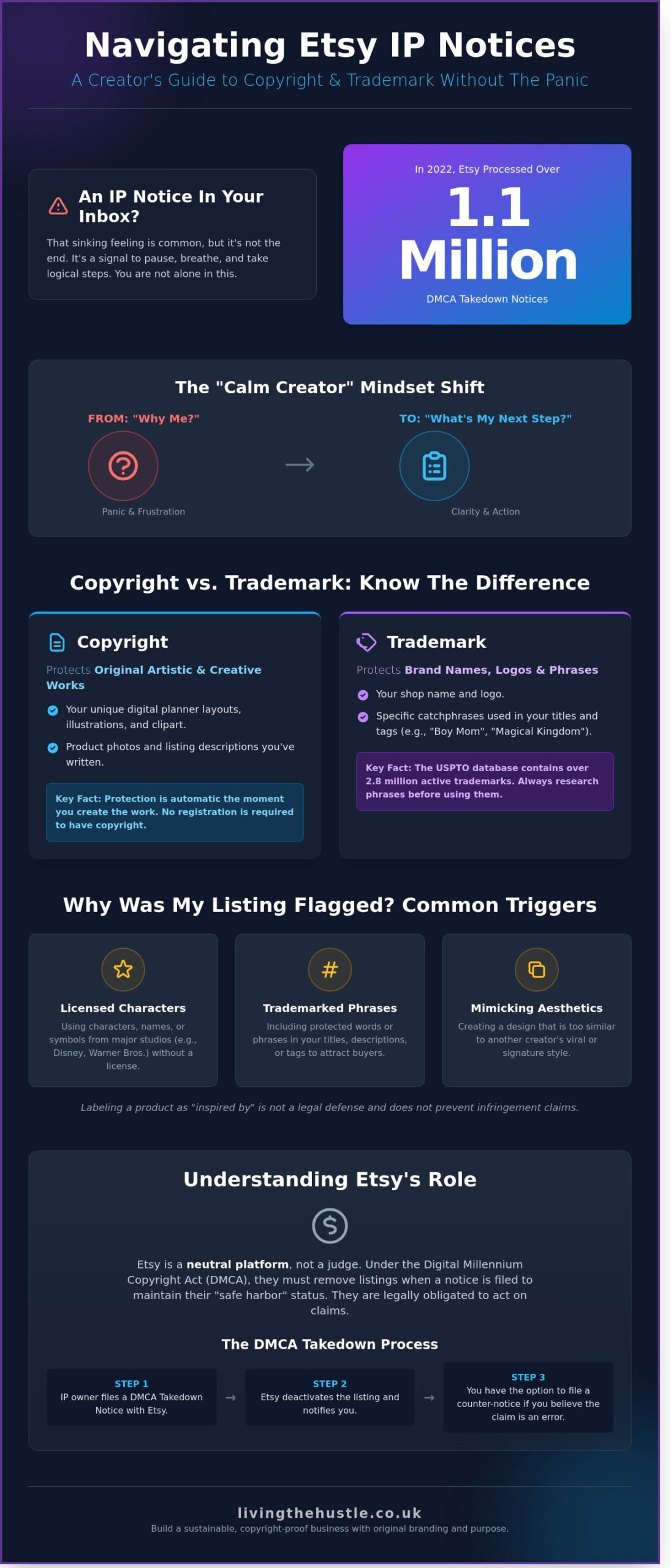
It's completely normal to feel a mix of fear and frustration when legal jargon like DMCA or Trademark starts flying around. You've worked hard to build your brand, and the thought of a shop suspension is truly stressful. Considering Etsy's 2022 Transparency Report showed they processed over 1.1 million takedown notices, you are certainly not the only one facing this hurdle. In this guide, I'll show you how to navigate these notices and protect your digital products without the typical overwhelm. We will walk through the steps to resolve your current issue, look at current policy requirements, and set up a simple system to keep your original work safe from copycats.
Key Takeaways
- Learn to decode intellectual property notices with confidence, understanding exactly how Etsy’s role as a platform affects your shop.
- Discover the essential legal differences between copyright and trademark so you can keep your digital planners and templates safe.
- Follow a methodical, stress-free plan for how to deal with etsy copyright issues without letting panic take the driver's seat.
- Gain practical steps to protect your hard work from copycats and learn how to handle situations where others use your original designs.
- Shift your focus toward building a sustainable, copyright-proof business that relies on original branding and purpose rather than worry.
Understanding Etsy Copyright Issues Without the Panic
It is 2:00 AM, and your phone pings with an email from Etsy legal. Your heart drops, and your stomach ties itself in knots. You aren't alone in this experience. In 2022, Etsy reported removing over 1.9 million listings for policy violations, including intellectual property issues. An infringement notice is simply a formal claim from a brand or creator stating that your listing uses their protected work without permission. It is important to remember that Etsy doesn't act as a judge or jury in these situations. Under the Digital Millennium Copyright Act of 1998, they're a neutral platform provider. They must remove the content to maintain their “safe harbor” status and protect their own business. Receiving one notice doesn't mean your shop is over. It is a signal to pause, breathe, and learn how to deal with etsy copyright issues with a clear head.
Some reports come from a human creator who found your work and felt it was too similar to theirs. Others come from massive automated sweeps. In 2023, many sellers experienced bot-driven takedowns related to specific trademarked keywords during high-volume shopping seasons. Bots don't see nuance or artistic intent; they only see a data match. Understanding this distinction helps take the “personal” sting out of the notification. You aren't being targeted because you're a bad person; a system or a legal team is simply doing its job.
Why Did I Receive a Notice?
Digital sellers often face these hurdles because of three main triggers. These include using licensed characters from major studios, including trademarked phrases in titles or tags, or mimicking the specific aesthetics of a viral design. The DMCA takedown is a legal notification process used by intellectual property owners to request the removal of infringing material from a website. Usually, Etsy starts with a listing deactivation. This removes the specific item from public view but leaves your shop open. A full shop suspension typically happens only after multiple repeated violations or if the shop is deemed a high risk to the platform's community standards.
The “Calm Creator” Mindset Shift
When that email arrives, your first thought might be “Why me?” while seeing hundreds of other shops selling the same thing. It's a valid frustration. However, focusing on others won't save your shop or your peace of mind. Shift your focus from “Why me?” to “What is the next logical step?” Responding in anger to the reporting party usually backfires. It creates a paper trail that could hurt your case if you ever need to file a counter-notice. You can build a business with purpose, not panic. If you're feeling stuck on how to move forward, exploring the art of design can help you create original work that keeps your shop safe and your confidence high. Learning how to deal with etsy copyright issues starts with accepting where you are and moving forward with a gentle, professional plan.
Copyright vs. Trademark: Knowing What You’re Dealing With
Understanding the difference between a copyright and a trademark is your first step in learning how to deal with etsy copyright issues without the panic. These two legal concepts often get lumped together, but they protect very different parts of your creative business. One covers the actual art you create, while the other covers the names and phrases that identify your brand to the public. When you know which is which, you can build your shop with a sense of calm and confidence.
Copyright: Protecting the Creative Expression
Copyright is the legal protection for original artistic works. This includes your photos, written text, and specific design layouts. For digital creators, this means the unique way you've arranged a PDF planner or the specific strokes in your hand-drawn clipart. Copyright exists the moment you create the work. You don't need to file paperwork for the protection to begin, though formal registration offers extra benefits in court. If you're worried about accidentally mimicking someone else, The Art of Design is a wonderful resource to help you develop a style that is 100% yours.
Trademark: Protecting the Brand and Phrases
Trademarks are different because they protect brand identifiers like logos, business names, and specific catchphrases. This is where many digital sellers run into trouble. You might create a completely original design, but if you include a trademarked phrase like “Boy Mom” or “Magical Kingdom” in your title or tags, your listing can be flagged. As of early 2024, the USPTO database contains over 2.8 million active marks. It's a smart habit to search their TESS system before you finalize a product name. To save time, you can also use eRank for Etsy to help identify keywords that might carry trademark risks.
Many sellers believe that labeling a product as “inspired by” a famous brand provides a safety net. This is a common misconception. If a customer could reasonably confuse your digital template with an official Disney or Starbucks product, you're likely infringing. Etsy's 2023 transparency report showed that they processed over 1 million intellectual property reports, and many of these involved “fan art” that crossed the line into infringement.
- Copyright: Protects the “stuff” you made (the drawing, the layout, the guide).
- Trademark: Protects the “source” (the brand name, the slogan, the logo).
- The Goal: Create original content that doesn't rely on someone else's brand recognition.
It only takes five minutes to search a phrase on the USPTO website, and that small step protects the business you've worked so hard to build. By staying focused on your unique voice, you'll find that how to deal with etsy copyright issues becomes a matter of simple prevention rather than stressful damage control.
How to Respond to an Etsy Infringement Notice: A Step-by-Step Plan
Getting a takedown notice can make your heart race, but it is not the end of your shop. Take a deep breath. Learning how to deal with etsy copyright issues is about being methodical rather than emotional. You have a clear process to follow that protects your business while keeping your peace of mind intact. By staying calm, you can turn a stressful moment into a valuable learning experience for your digital hustle.
Step 1: Audit the Flagged Content
Open the notice and look at the specific listing Etsy removed. You need to be your own toughest critic here. Compare your work to the reporting party's work side by side. Is the design itself similar, or did you accidentally use a trademarked phrase in your title? According to data from intellectual property reports in 2023, nearly 35% of digital product disputes stem from keywords and metadata rather than the actual artwork. Check your digital folders for licenses. If you bought a font or graphic pack last year, ensure you still have the license certificate that proves your right to use it for commercial sales.
Step 2: Decide on Your Response Strategy
You have three main paths to take after your audit. Your choice depends entirely on the facts you uncovered during your review. Use these options to move forward with confidence.
- Option A: Accept and Delete. If you realize you made a mistake or used a “fan art” term you shouldn't have, let the listing go. This is the safest way to move forward and focus on creating original work that you own completely.
- Option B: File a DMCA Counter-Notice. Use this path only if you are 100% sure the claim is a mistake or a case of “copycat” bullying. Once you file, the reporting party has 10 business days to prove they have started a court action against you. If they don't, Etsy generally restores the listing.
- Option C: Reach Out Directly. Sometimes a friendly, professional email can resolve things. Show them your valid license or offer to change a specific tag. If they see you are a real person acting in good faith, they may choose to retract the notice.
Step 3: Clean Up Your Shop
One notice is a lesson; multiple notices can lead to a permanent shop suspension. Spend an hour auditing your remaining listings to ensure they are safe. Are you using tags that might trigger automated trademark bots? Use this moment to tighten your systems and remove any vulnerabilities. If you want a structured way to build a safe, sustainable shop from the ground up, check out this Passive Income Society Review. It is a helpful resource for creators who want to grow their income with purpose and clarity. Understanding how to deal with etsy copyright issues now will save you hours of stress as your business scales.
Protecting Your Own Digital Products from Copycats
Finding your unique digital templates on someone else's shop feels like a punch to the gut. You've poured hours into your designs, so seeing a copycat try to “hustle” with your hard work is incredibly draining. Before you panic, remember that you have tools to handle this calmly and professionally. Knowing how to deal with etsy copyright issues effectively ensures you stay in control of your creative assets.
Start by discouraging theft before it happens. Always use watermarks on your listing images. They don't have to be ugly; a light, repeated logo at 20 percent opacity does the trick. Ensure your digital files are “flattened” as high-resolution JPEGs or PDFs so buyers cannot pull apart your individual design elements. If you sell Canva templates, always share them via a template link rather than the original source file to protect your master copy.
Try the gentle approach first. Send a polite, firm message to the shop owner. Many new sellers genuinely don't understand the rules and might have purchased your “commercial use” item thinking they could resell it as-is. A simple “I noticed you're using my design; please remove it within 24 hours to avoid a formal report” often works without needing to involve lawyers.
Reporting Infringement on Etsy
If a friendly message doesn't work, use the Etsy Reporting Portal. This is the most direct way to manage how to deal with etsy copyright issues. You'll need to provide the URL of your original listing and the URL of the infringing one. According to Etsy's 2022 Transparency Report, the platform removed over 1.9 million listings for policy violations, proving they take these reports seriously. Be specific about what was stolen. Remember, you can only report clear theft, like identical layouts or stolen photos. You cannot copyright a “minimalist style,” only your specific, tangible expression of it.
Niche-Specific Protection Tips
Different products need different safeguards. If you are an illustrator, your license terms are your best friend. You can find deep-dive strategies in Clipart Shop Profits to help you protect your illustrations from being resold illegally. For those in the paper craft world, Junk Journal Sales Secrets offers expert advice on creating complex, layered designs that are nearly impossible for copycats to replicate perfectly.
Ultimately, the best defense is a strong, recognizable brand. When customers recognize your unique artistic “voice” and quality, they'll seek out your shop specifically. A copycat might steal a file, but they can't steal your reputation or the community you've built. Focus on being the original that everyone else tries to follow.
Ready to scale your shop with original, protected designs? Join the Template Creators Society to build a business that stands out.
Building a Sustainable, Copyright-Proof Business
Moving forward after a legal scare can feel daunting, but it is also a powerful opportunity to refine your brand. Knowing how to deal with etsy copyright issues gives you the freedom to create without looking over your shoulder. Success on Etsy isn't about finding the perfect loophole; it's about building a foundation that lasts, one that lets you sleep at night. You can transition from a place of worry to a place of creative power by making a few intentional shifts in your daily workflow.
Etsy's 2024 Transparency Report showed that the platform removed over 1.1 million listings for policy violations. This highlights how vital it is to stay ahead of the curve. As we look toward 2026, Etsy’s house rules will likely continue to favor shops that demonstrate high levels of original artistic effort and clear ownership of their assets. By focusing on your unique voice now, you protect your income for years to come.
Creating with Purpose, Not Panic
Creating a workflow that prioritizes legal safety doesn't have to kill your creative spark. It actually streamlines your process. Start by making a “trademark check” a non-negotiable part of your listing routine. Use the USPTO TESS database to search for phrases before you put them on a digital planner or a t-shirt design. A five-minute search can save you months of stress later.
Your branding becomes your best defense when you lean into original elements. Try to incorporate your own hand-drawn illustrations or custom-shot photography rather than relying solely on stock assets. This ensures no one can claim your work is a carbon copy of theirs. If you want to refine these skills, you can explore The Art of Design to help your products stand out for all the right reasons.
- Verify every font: Ensure your font licenses specifically allow for “commercial use” in digital products.
- Document your process: Keep early sketches or Procreate time-lapse videos as proof of your original creation.
- Audit your shop: Set a date every six months to review your older listings against updated trademark registrations.
Your Next Gentle Step
Investing in your education is the most effective way to quiet the noise of “overwhelm.” When you understand the rules of the game, the game becomes fun again. If you find that a specific niche is becoming too litigious or crowded with takedown notices, don't be afraid to pivot. A sustainable business is a flexible one. Moving your talents into a fresh, evergreen niche can often lead to more profit with much less legal friction.
If you're ready to build a shop you can be truly proud of, I invite you to join the Template Creators Society. It is a space designed to help you build, sell, and scale your digital business with a calm and confident mindset. You don't have to do this alone. Keep creating, keep learning, and remember that every hurdle is just a stepping stone toward becoming a more professional, resilient creator.
Build Your Creative Empire with Confidence
Navigating the world of intellectual property doesn't have to feel like a walk through a legal minefield. You now understand the vital differences between copyright and trademark protections, and you have a clear response plan ready for your inbox. Knowing how to deal with etsy copyright issues is really about moving from a place of panic to a place of professional power. By focusing on 100% original designs and protecting your own digital assets, you're setting up a business that's built to last.
It's completely normal to feel a bit of overwhelm when you're just starting out. That's why our methodology focuses on a calm hustle that prioritizes your peace of mind. We've already supported over 3,000 digital creators in finding their footing in the online marketplace. You don't need to be a legal expert or a tech wizard to succeed. You just need a gentle, step-by-step path to follow.
Build your digital product empire with confidence in the Passive Income Society. Our nurturing guidance is specifically designed for total beginners who want to scale their shops without the stress. You have the tools and the talent to make this happen. Let's start building your sustainable future today.
Frequently Asked Questions
Can I get my Etsy shop back after a permanent copyright suspension?
No, a permanent suspension is almost always final. Etsy's Terms of Use, specifically Section 6.C, give them full discretion to close shops that repeatedly infringe on others. While you can appeal if you have proof of a legal error, 99% of these bans aren't reversed. It's better to focus on building a fresh start elsewhere with original designs. Staying calm helps you make better decisions for your next creative venture.
Is it copyright infringement if I use a quote on a digital printable?
It depends on the quote's age and legal status. Quotes from authors who've been deceased for 70 years or more are typically in the public domain. However, short phrases or slogans are often trademarked. Learning how to deal with etsy copyright issues involves checking the TESS database for trademark registrations before you list. This simple step gives you the confidence to grow your shop without fear.
How many copyright strikes does it take to get banned from Etsy?
Etsy doesn't publish an exact number, but most sellers see their shops closed after 3 separate notices. Their 2022 Transparency Report shows they take repeat violations very seriously to protect the marketplace. Don't let the numbers overwhelm you. If you get one notice, take it as a gentle nudge to audit your entire shop. This proactive approach keeps your hustle sustainable and stress free.
What happens if I ignore an Etsy intellectual property notice?
Ignoring a notice leads to the permanent removal of the listing and adds a strike to your account history. Under the DMCA, Etsy must disable access to the disputed material immediately. If you believe the claim is wrong, you have 10 business days to file a counter-notice. Taking action quickly replaces panic with purpose. It's the best way to handle how to deal with etsy copyright issues while protecting your brand.
Can I use public domain images in my Etsy digital products?
Yes, you can use public domain images for your digital products. In the United States, works published before January 1, 1929, are currently in the public domain. This means you can use them without asking for permission or paying royalties. It's a fantastic, low stress way to create beautiful printables. Just ensure you verify the source to maintain your shop's integrity and your own peace of mind.
Is ‘Fair Use' a valid defense for my fan-art listings on Etsy?
Fair Use is rarely a successful defense for selling fan art on a commercial platform. While the law considers 4 specific factors, the fact that you're making money often disqualifies the transformative argument. Most fan art listings are technically infringing unless you have a license. Focus on your unique style instead. Creating original work is the most sustainable path to a calm and profitable digital business.