

What if your income wasn't tied to the number of hours you spend at a desk? You're probably tired of the endless freelance cycle or a 9-5 that leaves you feeling burnt out. It's natural to feel a bit of fear about wasting time on products that might not sell or getting lost in technical overwhelm. You've likely asked yourself how much can you make selling digital products while searching for a path that doesn't require sacrificing your peace of mind.
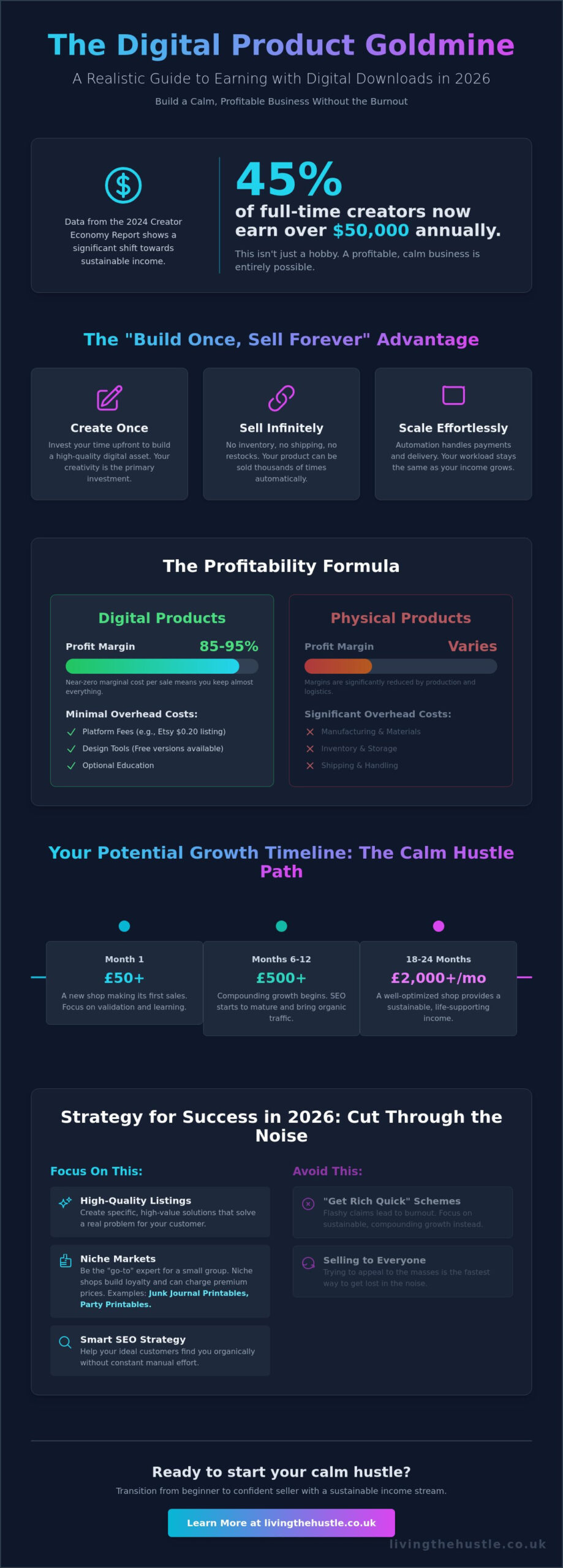
I'm here to tell you that a calm, profitable business is entirely possible. Data from the 2024 Creator Economy Report shows that 45% of full-time creators now earn over $50,000 annually, proving that this isn't just a hobby. This guide offers a realistic look at the earning potential of digital downloads in 2026 and how to build a sustainable stream of income. We'll walk through specific income tiers and a step-by-step path to your first sale so you can start your gentle hustle with purpose and confidence.
Key Takeaways
- Understand the “build once, sell twice” model that allows for 85-95% profit margins without the stress of physical inventory or high overhead.
- Explore the honest truth about how much can you make selling digital products through a realistic timeline that highlights the power of compounding growth.
- Learn how to cut through the noise by focusing on high-quality listings and SEO strategies that help your shop get noticed without the hustle-culture burnout.
- Discover a calm, step-by-step path to transition from a total beginner to a confident seller with a sustainable and manageable income stream.
What is the Realistic Earning Potential of Digital Products in 2026?
Let's be honest, you've probably seen the flashy social media posts claiming you can make six figures in your sleep within a week. That isn't the reality for most creators, and it often leads to burnout before you even get started. However, if you're asking how much can you make selling digital products with a sustainable plan, the answer is incredibly encouraging. In 2026, the digital economy is no longer a wild west of generic templates. It has matured into a space where specific, high-quality solutions thrive.
Instead of a “get rich quick” scheme, think of this as building a scalable asset. You invest your time upfront to create something once, and then you can sell it thousands of times. This creates a compounding growth effect. While a new shop might earn £50 in its first month, a well-optimized shop can grow to earn £2,000 or more monthly within 18 to 24 months. This is what we call the “Calm Hustle.” It's about building a business that supports your life and gives you freedom, rather than one that causes panic and consumes every waking hour.
The “Build Once, Sell Forever” Advantage
The beauty of Digital goods lies in the lack of physical barriers. You don't have to worry about rising shipping costs, inventory storage, or post office runs. Every sale has a near-zero marginal cost, meaning your profit margins remain high even as you scale. As your shop SEO matures over time, your products become more visible to the right people without extra effort from you. Digital product scalability is the ultimate antidote to trading your precious time for money.
Why Niche Markets Outperform General Shops
Trying to sell to everyone is the fastest way to make £0. In 2026, buyers are looking for specialists who understand their specific needs. High-earning niches are those that solve a particular problem or fuel a specific hobby. For example, focusing on junk journal printables or party printables allows you to build a loyal community of repeat customers.
When you pick a niche that aligns with your own interests, you avoid the overwhelm that comes from chasing every trend. You'll find it much easier to create content with purpose when you actually enjoy the subject. Success in 2026 depends on being the “go-to” person for a small group of people rather than a “nobody” to a large group. For instance, an artist who masters professional techniques through a Face Painting Course Online can sell specialized digital practice sheets to a dedicated community. This focus is exactly how you determine how much can you make selling digital products, because specialized shops can often charge premium prices for their unique expertise.
Understanding the Profitability Formula: High Margins and Low Overhead
Let's talk about why digital products are a total game-changer for your bank account. Traditional businesses have to deal with manufacturing, inventory, and shipping. You don't. When you sell a digital download, your profit margins usually sit between 85% and 95%. This is the main reason why the question of how much can you make selling digital products is so exciting for beginners. Most of the money you earn stays right where it belongs: in your pocket.
Your biggest investment isn't a massive startup loan. It's your time and your unique creativity. According to recent U.S. e-commerce sales data, the digital marketplace is expanding rapidly, which means there is plenty of room for your ideas. You can start small, test your concepts, and grow without the financial risk that usually comes with a brick-and-mortar shop.
The Real Costs of Running a Digital Shop
Keeping your overhead low is the secret to a calm and sustainable business. You don't need a fancy office or a warehouse. You just need a few simple tools to look professional from day one. Here are the essential costs you should plan for:
- Platform Fees: If you use Etsy, you'll pay a $0.20 listing fee and a small transaction fee on each sale.
- Design Tools: Many creators start with the free version of Canva or a basic subscription to a tool like Creative Fabrica.
- Education: Investing in a proven strategy early on saves you from expensive trial and error. Reading a Passive Income Review can help you decide which niche is worth your precious time.
By focusing on these few essentials, you keep your expenses predictable. This allows you to build your business with confidence rather than worrying about a high monthly burn rate.
Scaling Without Increasing Your Workload
The most beautiful part of this business model is how it scales. In a physical shop, selling 100 items means packing 100 boxes. In a digital shop, a shop with 100 products doesn't take 100 times more work than a shop with one. When people ask how much can you make selling digital products, they often forget that your workload stays almost the same even as your income grows.
Automation does the heavy lifting for you. Platforms like Etsy or Shopify handle the file delivery and the payment processing automatically. Digital systems allow you to earn while you sleep without the panic of manual fulfilment. You create the product once, and it can sell thousands of times. If you are ready to move past the overwhelm, you might want to explore which digital paths fit your lifestyle best.
Income Tiers: How Much Can You Actually Make?
Let's be honest about the numbers. When you ask how much can you make selling digital products, the answer depends entirely on your timeline and consistency. It's rarely an overnight success. Most shops experience a compounding effect where each listing you create acts like a tiny employee working for you 24/7. While your first three months might feel slow, they are the essential foundation where you test ideas and gather data. You're learning the mechanics of the market, which is far more valuable than a quick win that isn't repeatable.
Success in this space isn't just about reaching a specific number. It's about building a business that fits your life. Recent e-commerce growth statistics indicate that online spending continues to rise, with a 10.4% increase in global e-commerce sales projected for 2024. This growth provides a massive opportunity for digital creators who stay the course. Before diving into the tiers, decide what “enough” looks like for you. Defining your own success prevents you from feeling behind when you see others posting about six-figure months.
Tier 1: The “Coffee & Bills” Side Hustle (£100 – £500/month)
This stage is all about the messy middle of learning. You typically have 20 to 50 high-quality, SEO-optimised listings in your shop. Your primary focus is understanding what your audience actually wants. You'll likely find one “hero” product that accounts for 80% of your sales. To get found during this phase, focus on your keywords. Using tools like eRank for Etsy sellers helps you stop guessing and start ranking. It's a gentle start that builds your confidence while covering those small monthly extras.
Tier 2: The “Part-Time Income” Growth (£1,000 – £3,000/month)
At this level, your shop usually houses 100 or more listings. You've moved beyond just having a shop to building a recognizable brand. You are likely scaling what works and driving traffic through Pinterest or a small email list. It's vital to build your brand without the overwhelm so you don't burn out as the work increases. This tier provides significant breathing room and often replaces a part-time job or covers major household expenses.
Tier 3: The “Full-Time Freedom” Shop (£5,000+/month)
Reaching this level means systems have become your best friend. You aren't just selling on one platform; you've likely branched out to your own website or multiple marketplaces. The focus shifts to advanced marketing, outsourcing repetitive tasks, and diversifying your product lines. Even at this level, you can maintain a calm lifestyle by using automated systems. You've created a sustainable asset that generates income while you sleep, giving you true time freedom and the ability to work on your own terms.
Critical Factors That Influence Your Earnings
Understanding how much can you make selling digital products requires looking at the specific levers you can pull to increase your revenue. Success isn't a result of luck; it's about making intentional choices. SEO is the primary driver that moves you from being invisible to being sold out. Without it, even the most beautiful designs stay hidden. You also need to prioritize quality over quantity. One exceptional, high-value product that solves a specific problem will always outperform ten mediocre items that provide no real transformation for the buyer.
Market demand should guide every new creation. According to Etsy’s 2024 trend reports, buyers are increasingly searching for “utility-driven” printables rather than generic designs. Using data to decide what to create next saves you from wasting time on products that won't sell. Finally, remember that consistency is your best friend. You don't need to post every day to see results. A gentle approach to regular shop updates keeps the algorithm happy and your audience engaged without leading to burnout.
Mastering the Etsy Algorithm Calmly
The Etsy search bar is where most of your customers will find you. To succeed, you need to stop guessing what people want and start using data. Tools like eRank for Etsy Sellers take the stress out of keyword research by showing you exactly what buyers are typing. Focus on “long-tail” keywords, which are descriptive phrases like “boho wedding budget planner” instead of just “planner.” These specific terms help you reach the right buyers who are ready to purchase immediately.
The Role of Visual Branding in Pricing
Your branding tells customers if your product is worth the price tag. Professional mockups allow you to charge a premium because they help buyers visualize the product in their own lives. A study by Adobe found that 38% of users stop engaging with content if the layout is unattractive. Creating a cohesive look builds trust instantly and turns one-time shoppers into loyal fans. If you feel stuck on your aesthetic, the Blog, Brand & Bloom Workbook provides a clear path to building a brand that feels like you.
Diversifying Your Income Streams
While Etsy is a fantastic starting point, growing your income often means moving beyond a single platform. Setting up your own website or Shopify store gives you total control over your customer list and branding. Starting a blog is a powerful way to drive organic traffic to these products. A blog acts as a 24/7 salesperson for your digital shop, bringing in new leads while you sleep. This diversification ensures that your income remains stable even if one platform changes its rules. When you consider how much can you make selling digital products, remember that having multiple doors to your shop increases your chances of success.
Ready to create products that stand out in a crowded market? Learn the art of design and start selling today.
Starting Your Journey to a Profitable Digital Shop
The transition from a total beginner to a profitable seller doesn't happen by accident. It happens through small, consistent actions taken with a sense of purpose rather than panic. You've likely seen the numbers and asked yourself, how much can you make selling digital products in 2026? While industry reports show top-tier Etsy sellers can earn over $10,000 monthly, your journey starts with your first $10. The market isn't oversaturated; it's evolving. Buyers are now looking for high-quality, niche-specific solutions. This shift actually favors small creators who care about their craft. You can build a successful shop without the burnout that usually comes with a traditional hustle.
Don't let the fear of being “too late” stop you. The global digital goods market is projected to grow by 12% annually through 2028. There's plenty of room for your unique voice. Taking a gentle first step today is better than waiting for a perfect moment that never arrives. You can create a business that supports your life without stealing your peace of mind.
Choose Your Niche with Confidence
Don't try to sell everything to everyone. Focus on what sparks your interest and meets a specific need. If you enjoy illustration, exploring Clipart Shop Profits can help you turn those sketches into a recurring income stream. Perhaps you love the vintage aesthetic; in that case, Junk Journal Sales Secrets offers a proven path to success. Perfection often acts as a barrier to progress. It's better to launch a good enough product today than a perfect one next year. Start where you feel most creative and let your passion guide your inventory. When you enjoy what you make, the process feels less like work and more like a creative outlet.
Your Roadmap to Passive Income
Building a sustainable business follows a simple, repeatable rhythm. Think of your shop as a garden that needs tending but eventually yields a harvest with less effort. To understand how much can you make selling digital products, you have to master this three-step cycle:
- Step 1: Research. Spend 30 minutes looking at current trends to find gaps where customers are searching but not finding solutions.
- Step 2: Create. Design your product with the user's needs at the forefront. Focus on one product that solves one specific problem.
- Step 3: Optimise. Refine your listings based on data and feedback to keep sales flowing consistently.
Isolation is the biggest motivation killer for new sellers. When you have a community to lean on, the journey feels lighter. You can ask questions, share wins, and get through the tech hurdles without the panic. If you're ready to build your dream business calmly, Join the Passive Income Society to build your dream business calmly. We'll help you navigate the path to profit with confidence and clarity.
Your Path to a Calm and Profitable Shop
You now have a clear map of the digital landscape for 2026. You've seen how high profit margins, which often exceed 90% per sale due to low overhead, make this business model incredibly resilient compared to physical goods. While the creator economy is projected to reach a value of $480 billion by 2027 according to a report by Goldman Sachs, your individual success comes down to a sustainable strategy. When you're asking how much can you make selling digital products, the answer depends on your commitment to mastering Etsy SEO and building a brand that resonates with real people.
You don't need to be a tech expert to see results. You can build a business that feels like a gentle project rather than a source of panic. It's about taking that first step with confidence and having a mentor who understands the journey from the ground up.
Ready to build your digital product business? Join the Passive Income Society! We provide step-by-step guidance for total beginners and proven strategies for Etsy SEO and branding. Our focus is on sustainable, calm business growth that fits your life. You're more than capable of creating a shop you're proud of.
Frequently Asked Questions
How many digital products do I need to make a full-time income?
When wondering how much can you make selling digital products, remember you typically need between 50 and 100 well-optimized listings to replace a full-time salary. Let's be honest, success is about quality over quantity. If your average product price is $20, you need 250 sales a month to reach a $5,000 goal. Focus on a gentle growth strategy where you add two new products weekly to build momentum.
Do I need to be a graphic designer to sell digital products?
You don't need a formal design degree or professional background to be successful in this space. Over 65 percent of top digital sellers use user-friendly tools like Canva or Templett rather than complex professional software. These platforms provide the structure you need to create beautiful work without the overwhelm. Your unique perspective and ability to solve a customer's problem matter more than mastery of high-end design suites.
Is selling digital products on Etsy still profitable in 2026?
Selling on Etsy remains highly profitable in 2026 because the platform connects you with over 92 million active buyers. When researching how much can you make selling digital products, keep in mind that Etsy's built-in traffic reduces your marketing stress. Sellers in specialized niches like digital wedding stationery or small business templates often see profit margins exceeding 90 percent after the standard platform fees.
How much does it cost to start a digital product business?
You can launch your digital business for less than $30. Etsy charges a $0.20 listing fee per item, and basic design tools offer free versions that are perfect for beginners. This low barrier to entry lets you start your digital hustle without financial panic. You can reinvest your first few profits into a professional subscription once you feel confident in your shop's direction and see consistent results.
How long does it take to make your first sale on Etsy?
Most new shops see their first organic sale within 21 to 45 days of opening. This timeline depends on how well you've optimized your titles and tags for the Etsy search engine. Don't feel discouraged if it doesn't happen overnight. Use those first few weeks to refine your calm approach and learn what your specific audience is searching for. Data shows that shops with 10 or more listings sell faster.
What are the best-selling digital products right now?
Digital planners, Google Sheets budget trackers, and AI-assisted educational workbooks are the top performers this year. Specifically, demand for ADHD-friendly organization tools increased by 35 percent in the last 12 months. Focus on products that save people time or reduce their mental load. These high-utility items tend to generate the most consistent revenue for new sellers because they solve a clear, immediate pain point for the buyer.
Can I sell digital products if I only have a few hours a week?
You can absolutely build a successful shop working just 5 to 7 hours per week. Many calm entrepreneurs spend two hours on a Saturday designing and another three hours during the week managing customer messages. This sustainable pace prevents burnout and lets you grow your income without sacrificing your well-being. Consistency is always more important than the total number of hours worked when you're building a side hustle.
How do I protect my digital products from being stolen or copied?
You protect your work by including a clear Terms of Use license in every customer download folder. Use flattened PDF files so others can't easily edit your designs or steal your individual elements. While you can't stop 100 percent of bad actors, adding a subtle watermark to your listing images helps prevent photo theft. Registering your shop with the U.S. Copyright Office provides additional legal protection if you face a serious issue.