

What if your etsy keyword research for digital products was a bridge of empathy rather than a technical hurdle? It's easy to feel overwhelmed by SEO jargon or worry that you're shouting into a saturated market. You might have spent hours creating a beautiful digital product, only to feel stuck when nobody finds it. I understand that frustration. It feels like wasted time when your creative joy doesn't lead to the sales you hoped for.
You already know that being seen is the first step to success. You want a way to connect with customers that doesn't involve complex spreadsheets or constant stress. This guide offers a peaceful, step-by-step framework to help you find high-demand keywords with confidence. We'll strip away the confusion and focus on a manageable strategy that fits your life and your creative rhythm.
You're going to learn how to identify exactly what your buyers are searching for in 2026. We will look at how to use natural language and simple tools to create a sustainable path toward consistent passive income. By the end, you'll have a clear, actionable plan to help your shop bloom with minimal daily maintenance.
Key Takeaways
- Discover how to match your digital files to a shopper's specific needs using a simple, empathy-based approach to search optimization.
- Master a 5-step framework for etsy keyword research for digital products that replaces technical overwhelm with a peaceful, creative brainstorming process.
- Use free tools like Etsy Autocomplete and trend-tracking software to spot high-demand niches without getting lost in complex spreadsheets.
- Learn to craft human-friendly titles and strategic tags that help your products stand out in a busy marketplace.
- Find the perfect balance between passive growth and minimal maintenance through a gentle quarterly audit of your shop's performance.
Understanding Etsy SEO for Digital Products in 2026
Many people think of SEO as a scary technical monster, but I want you to see it differently. To get started, Understanding Search Engine Optimization (SEO) is helpful for seeing the big picture. It is simply the process of making your content visible to people who are looking for it. When you start your journey with etsy keyword research for digital products, it's easy to feel like you're learning a confusing new language. In reality, SEO for digital downloads is the art of matching your file to a shopper’s specific problem.
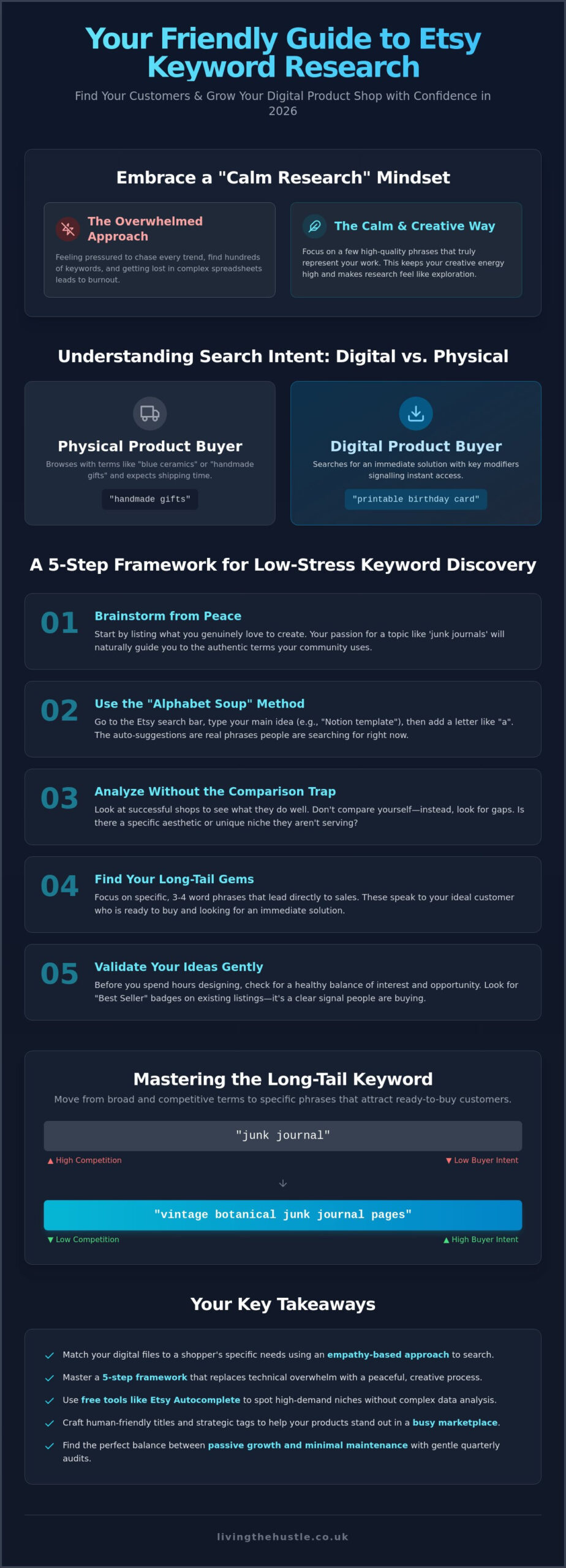
I want you to embrace a “Calm Research” mindset. Instead of feeling pressured to find hundreds of keywords or chasing every fleeting trend, focus on a few high-quality phrases that truly represent your work. This approach prevents burnout and keeps your creative energy high. Etsy's algorithm in 2026 has moved away from simple keyword matching. It now relies heavily on natural language processing and AI to understand the context and intent behind a search. This means that keyword stuffing is now ineffective and can even trigger spam filters. Today, the algorithm prioritizes relevance and a positive customer experience over repetitive tags.
The Difference Between Physical and Digital Search Intent
Why does digital need a different approach? A person buying a physical mug might browse for “blue ceramics” or “handmade gifts” with the expectation of waiting for shipping. A digital buyer is often looking for an immediate fix. They might need a last-minute birthday card or a way to organize their messy schedule right now. Modifiers like “printable,” “instant download,” or “digital template” are essential because they signal clearly that the solution is available immediately. Search intent for digital products is the bridge between a problem and an immediate solution. By focusing on the art of design alongside your research, you ensure your product actually solves the problem the customer is searching for.
How Etsy Search Works: A Gentle Overview
Etsy's search bar is your most powerful ally. When a buyer types a query, the system looks at your titles, tags, and categories to find a match. In 2026, the “relevancy score” for your listings is more important than ever. This score measures how well your product fits what the user wants based on their search terms and how previous shoppers interacted with your shop. The algorithm also considers user experience signals, such as how long a buyer views a listing. Using tools like eRank for Etsy sellers can help you track these shifts without feeling overwhelmed by the data. Remember, the goal of etsy keyword research for digital products is to help the right person find your helpful solution at the exact moment they need it.
A 5-Step Framework for Low-Stress Keyword Discovery
How do you find the right words without feeling lost in a sea of data? I recommend a gentle, five-step approach that keeps your well-being at the center of your business. This framework ensures your etsy keyword research for digital products feels like a creative exploration rather than a heavy chore. It's about finding where your joy meets a customer's need.
- Step 1: Brainstorm from peace. Start by listing what you actually love to create. If you find joy in making junk journals, your passion will naturally help you identify the terms your community uses.
- Step 2: The Alphabet Soup method. Go to the Etsy search bar and type your main idea, like “Notion template.” Then, type the letter “a” and see what Etsy suggests. These are real phrases people are typing right now.
- Step 3: Analyze without the trap. Look at successful shops to see what they're doing well. Don't fall into the comparison trap. Instead, look for gaps they might have missed, like a specific aesthetic or a unique niche they aren't serving.
- Step 4: Find your long-tail gems. These are the specific phrases that lead directly to sales.
- Step 5: Validate your ideas. Before you spend hours designing, make sure there is a healthy balance of interest and opportunity.
If you're looking for a structured path to follow, the Passive Income Society offers a clear roadmap for beginners. Many broader ecommerce marketing strategies emphasize that finding a specific niche is the best way to stand out in a busy market.
Mastering the Long-Tail Keyword
A long-tail keyword is a specific phrase, usually three or four words long. Think of “vintage botanical junk journal pages” instead of just “junk journal.” Why does this matter? Broad terms are often too competitive for new shops. Specific phrases speak directly to your ideal customer. When someone searches for something very specific, they're usually ready to buy. They aren't just browsing; they're looking for an immediate solution to their problem. Using these phrases helps you show up exactly when they need you most.
Validating Demand Without the Data Headache
How do you know if a niche is worth your time? Look for “Best Seller” badges on existing listings in your category. This is a clear signal from Etsy that people are actively buying those types of products. You don't need to be a data scientist to see what's working. If you want to dive a bit deeper without the stress, you can use this erank for etsy guide to simplify the process. It helps you see if a term is “too quiet” or “just right” for your shop's current stage. Remember, you're looking for a manageable niche where your unique voice can shine.
Essential Tools for the Calm Etsy Researcher
Choosing the right tools for your etsy keyword research for digital products shouldn't feel like a high-pressure business decision. You don't need every expensive subscription to find success. In fact, some of the most powerful resources are completely free and already at your fingertips. Etsy Autocomplete is a prime example. By simply typing into the search bar, you're seeing exactly what the algorithm prioritizes based on real-time buyer behavior. It's an honest, direct look at what people want right now.
While manual methods are wonderful for building intuition, sometimes you want a bit more data to feel confident. This is where tools like eRank come in. I recommend using it as a gentle guide rather than a source of stress. If you want to dive deeper into how this tool works, you can explore my guide on eRank for Etsy sellers. Beyond Etsy itself, platforms like Pinterest and Marmalead are fantastic for spotting upcoming aesthetic trends. Pinterest, in particular, is a visual search engine that can show you what colors and styles are becoming popular in the digital planning or journaling communities.
Once you've gathered these insights, you need a central place to store them so they don't just live in your head. Keeping your ideas organized helps maintain that sense of peace we're aiming for. A dedicated content planner is a perfect way to track your keywords and product ideas without feeling scattered. It allows you to move from the research phase to the creative phase with a clear mind.
eRank for Beginners: Focus on These 3 Metrics
When you're looking at data, it's easy to get lost in the numbers. I want you to focus on just three simple metrics to keep things manageable. First, look at Search Volume. This tells you if a crowd exists for your idea. Second, check the Competition. Is there room for a new shop like yours to bloom? Finally, look at the CTR (Click-Through Rate). This helps you understand if people are actually clicking on the results they see. If the CTR is high but competition is low, you've found a beautiful opportunity for your digital products.
Manual Research: The “Shopper Perspective” Method
There's a special kind of magic in browsing Etsy as a customer. This manual research builds an intuition that tools simply cannot replace. Start by searching for your product and then scroll to the very bottom of the page. You'll find a section called “People Also Searched For.” These are related terms that Etsy’s AI has linked to your original search. Pay attention to the “Suggested Searches” that appear as you type, too. By putting yourself in the shopper's shoes, you'll discover the emotional language they use to describe their problems. This human-centered approach ensures your etsy keyword research for digital products remains grounded in real needs.
Implementing Keywords into Your Digital Listings
Now that you've gathered your gems, how do you place them in your shop without feeling cluttered? The way you apply your etsy keyword research for digital products determines whether a customer sees your work or scrolls past it. Your goal is to create a listing that feels welcoming to humans while remaining clear to the search robots. It’s about being helpful and descriptive rather than repetitive and robotic.
Start with your titles. In 2026, Etsy favors titles that are conversational and descriptive. Research shows that listings with titles under the 70-character soft cap have seen a 34% increase in mobile click-through rates. Instead of a long string of disconnected words, try a short, impactful phrase that tells the buyer exactly what they’re getting. Use your most important keyword at the very beginning where it’s easiest to see on a small screen. This approach builds trust and clarity from the first second.
Next, you have 13 tags to use. I call this the 13 Tags Rule. Use every single slot, but don’t repeat yourself. If “printable planner” is in your title, you don't need it as a standalone tag. Use that space for synonyms or specific uses like “daily habit tracker” or “productivity tool.” Don't forget to use attributes. These are the specific dropdown menus Etsy provides for things like color, occasion, or file type. Attributes act as powerful filters, helping shoppers find your digital products even if they don't type the exact keyword into the search bar.
Niche-Specific SEO Strategies
Every digital niche has its own unique language. If you’re focusing on Junk Journal printables, your keywords should focus on specific eras or themes, like “Victorian ephemera” or “botanical textures.” For those creating Party Printables, focus on the event and the age group, such as “toddler dinosaur birthday” or “minimalist wedding invite.” If you sell clipart, prioritize the artistic style and usage rights, using terms like “boho watercolour” or “commercial use graphics.” These specific details help you find the exact person looking for your unique style.
Writing Descriptions That Convert
Your description is where you turn a browser into a buyer. While the first 150 characters are important for SEO, the rest of the text is for the human reader. Use a “Benefit-First” approach. Instead of just listing file sizes, tell them how your product makes their life easier or more beautiful. Here is a sample sentence you might use: “This digital planner is available as an instant download, allowing you to organize your day with peace and purpose the moment you purchase.”
If you're ready to turn these keywords into a thriving, low-stress shop, the Passive Income Society Course provides the structured, supportive path you need to succeed with confidence.
Scaling Your Shop: From Research to Passive Income
Once you've laid the groundwork for your etsy keyword research for digital products, you might worry that the hard work never ends. Is it possible to have a shop that grows while you sleep? Yes, but we need to be honest about the “set and forget” myth. Most digital shops are beautifully passive, yet they still require a tiny bit of seasonal care. I recommend a gentle quarterly audit. Every three months, take a quiet hour to see which listings are blooming and which ones need a little water.
A sustainable approach to etsy keyword research for digital products means you don't have to chase every tiny algorithm shift. Instead, look at your shop's data to see what your specific customers love. If a certain set of “vintage botanical” printables is selling well, you don't need to reinvent the wheel. You can simply expand on that success. This methodical rhythm prevents the technical overwhelm that stops so many talented creators from reaching their full potential. You're building a business that supports your life, not one that drains your energy.
Building Your Brand Beyond the Search Bar
While keywords get people into your shop, your brand identity is what keeps them coming back. Repeat customers are the heartbeat of a successful digital business. You can use the Blog, Brand & Bloom Workbook to help you create a cohesive shop identity that feels like a warm invitation. Did you know your shop name and “About” section are secret SEO weapons? Etsy uses these areas to understand the overall authority and niche of your shop. When your branding and your keywords match, you create a sense of trust that search engines and humans both love. View your SEO as just one piece of a beautiful, sustainable puzzle.
The Path to a Full-Time Passive Income
Are you ready to move from guessing to a proven system? It's completely normal to feel a bit stuck when you're starting out. Your creative journey is worth the effort, and you don't have to navigate it alone. I want to offer a gentle invitation to join the Passive Income Society. This community is designed for beginners who want a structured, low-stress path to success. When you follow a step-by-step framework, you save months of trial and error. You gain the confidence to know that every product you create has a purpose and a place in the market. You've already taken the first step by learning the art of research. Now, it's time to let your shop truly bloom.
Your Path to a Peaceful and Profitable Shop
You now have the foundation to make etsy keyword research for digital products a natural part of your creative process. By focusing on empathy and solving real problems for your customers, you move away from technical stress and toward genuine connection. Remember to prioritize those specific long-tail keywords and keep your titles human friendly. These small, intentional steps create a sustainable business that respects your time and your well being.
You don't have to figure everything out by yourself. The Passive Income Society has helped hundreds of beginners launch successful shops with step by step guidance that removes the fear of technology. This structured approach focuses on calm, sustainable growth, allowing you to build your dream business with confidence and clarity. It's about finding that perfect balance between your creative joy and consistent passive income.
Join the Passive Income Society and build your dream shop today!
Your journey as a digital creator is just beginning, and it's full of beautiful possibilities. Trust in your vision and keep moving forward at your own pace.
Frequently Asked Questions
Do I need to change my Etsy keywords every month?
No, you don't need to change your keywords that frequently. Monthly changes can actually disrupt your progress because the Etsy algorithm needs time to collect data and understand your listing. A gentle quarterly audit is a much better rhythm for a calm business. You should only update your keywords if a listing hasn't seen any views or sales after several months of being active.
Is it better to have high search volume or low competition for digital products?
It's best to find a healthy balance, but beginners should usually prioritize low competition. High search volume often means you're competing with thousands of established shops, making it harder to be seen. By focusing your etsy keyword research for digital products on specific phrases with fewer results, you have a much better chance of appearing on the first page and reaching a ready to buy audience.
How many tags should I use for a digital download on Etsy?
You should use all 13 tags available for every single digital listing. Each tag is a fresh opportunity for a customer to discover your work. Don't leave any slots empty, and avoid repeating the exact phrases you've already used in your title. Using all 13 slots helps the algorithm categorize your file correctly and show it to the shoppers who need it most.
Can I use the same keywords for all my digital listings?
No, you shouldn't use identical keywords for every item in your shop. If all your products target the same terms, they'll end up competing against each other in search results. Try to vary your phrases so each listing targets a slightly different niche or aesthetic. This broadens your reach and helps a wider variety of people discover your creative digital products.
Does Etsy SEO still matter in 2026 with all the new AI features?
Yes, SEO is still vital, though it has become more conversational and intent focused. Etsy’s AI now uses natural language processing to understand the context behind a search. This means your etsy keyword research for digital products should focus on descriptive, human centered language. Good SEO ensures the AI can accurately match your helpful digital solution to the right shopper's specific problem.
What is the most common keyword mistake Etsy beginners make?
The most common mistake is using terms that are far too broad, like “planner” or “clipart.” Many new sellers get lost in millions of search results because they don't use specific modifiers. Another frequent error is repeating the same word multiple times in your tags. Focus on being specific and descriptive to help you stand out and connect with buyers who want your unique style.
Should I put my main keyword at the beginning of my title?
Yes, you should place your most important keyword at the very start of your title. This is helpful for both the search algorithm and the human shopper. Since many people browse on mobile devices, the first few words are often the only ones they see before deciding to click. Starting with your strongest phrase ensures they immediately know your digital product is exactly what they're looking for.