

What if your shop policies weren't just a legal chore, but the gentle boundaries that actually protect your creative energy? It's common to feel a sense of dread when you think about “scammers” downloading your files and then asking for a refund. You might even feel stuck trying to decode 2026 EU digital tax laws or setting up etsy shop policies for digital products that actually hold up. If the Shop Manager feels like a maze of technical jargon, you aren't alone.
You deserve an online business that brings you peace of mind rather than a headache. This guide shows you how to establish professional policies that act as a silent protector for your hard work. We'll explore how to handle refund requests gracefully and stay legally compliant with the latest originality standards without losing your joy. By the end of this post, you'll have a clear, set-it-and-forget-it strategy that builds trust with your customers and lets you focus on what you love most.
Key Takeaways
- Understand why a clear refund stance is essential for instant downloads and how it protects your creative energy.
- Learn how to configure etsy shop policies for digital products in the Shop Manager to create a professional, trustworthy storefront.
- Simplify your privacy and legal obligations so you can feel confident about compliance without the technical overwhelm.
- Discover how well-crafted policies act as your silent assistant, answering customer questions before they even reach your inbox.
- Reframing your shop rules as a promise of quality to improve your Shop Quality Score and build lasting customer trust.
What are Etsy Shop Policies and Why Do Digital Sellers Need Them?
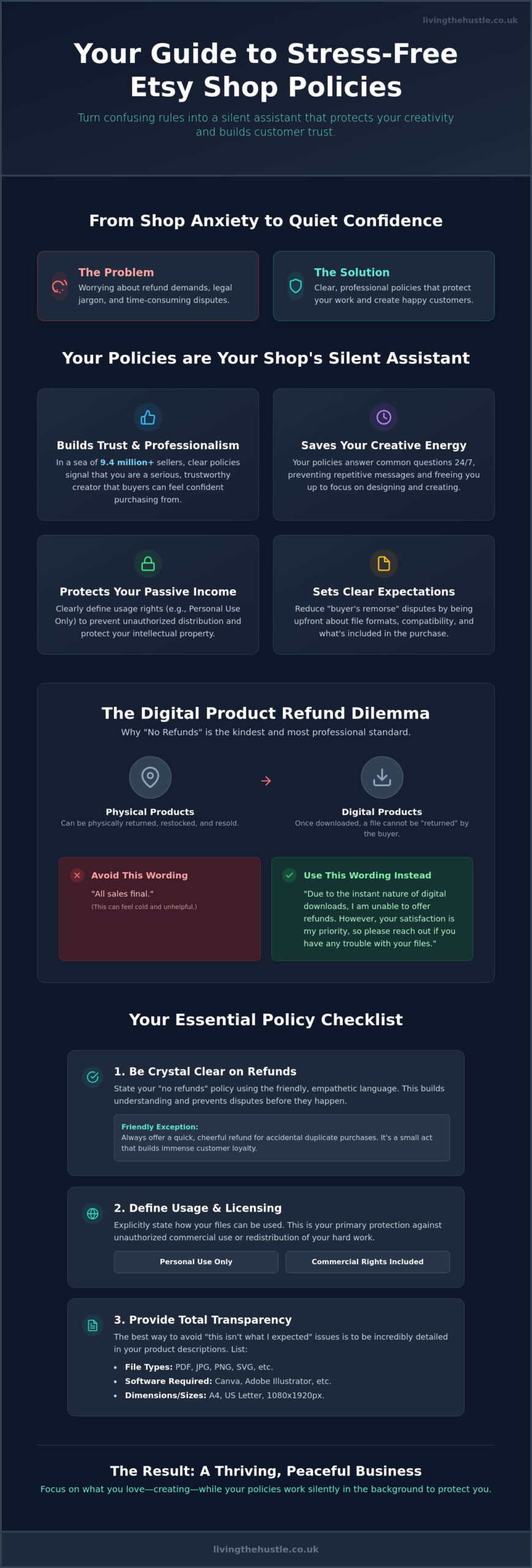
Imagine opening your shop manager and feeling a sense of quiet confidence rather than a wave of worry. That's the power of having a solid foundation. Etsy shop policies are essentially a friendly, transparent agreement between you and your buyer. They outline exactly how you do business, what customers can expect after they click “purchase,” and how you handle the unexpected. For digital creators, these aren't just blocks of legal text. They are your “silent assistant.” They work for you 24/7, answering common questions about file formats, compatibility, or usage rights before a customer ever feels the need to message you. In a marketplace that now hosts approximately 9.4 million active sellers, having professional etsy shop policies for digital products signals that you are an established professional who values both your creative work and your customers' time.
Think of your policies as a tool for building a trustworthy shop front. In 2026, buyers are more savvy than ever. They look for clarity before they commit their hard-earned money. When your policies are clear, you significantly reduce the risk of “buyer’s remorse” disputes. If a customer knows ahead of time that a digital file cannot be “un-downloaded,” they are more likely to double-check their purchase. This transparency protects your peace and ensures that your interactions with customers remain positive and encouraging.
Protecting Your Passive Income Stream
The beauty of selling digital items is the freedom and flexibility it brings to your life. You want to spend your energy creating beautiful things, not trapped in draining customer service loops. Clear rules prevent those time-consuming back-and-forth conversations that can quickly turn a passive income project into a high-stress job. Because understanding what are digital products often involves complex ideas about licensing versus ownership, your policy needs to be firm about intellectual property. You must clearly state if your designs are for personal use only or if they include specific commercial rights. Shop policies are the protective fence around your creative garden. They ensure your hard work stays where it belongs while allowing your business to bloom without the fear of unauthorized distribution or messy disputes.
Setting Expectations for a Calm Experience
Have you ever felt “shop anxiety” when a new message notification pops up? Well-defined policies are the antidote to that stress. When a buyer knows exactly how the delivery process works and what they are receiving, they feel safe and supported. This sense of security is directly linked to those coveted five-star reviews. People appreciate transparency and honesty. By setting these boundaries, you are actually being kind to your customers. You are removing the guesswork and replacing it with clarity. Remember, you are the CEO of your creative space. You have full control over your shop’s rules. Setting them up thoughtfully today means a much more peaceful and sustainable path forward for your business tomorrow.
The Digital Product Refund Dilemma: Returns and Exchanges
One of the biggest hurdles for digital creators is figuring out how to handle refund requests without feeling like they are being taken advantage of. It's a delicate balance to strike. You want to be a kind and helpful seller, but your business relies on protecting your time and creative assets. In 2026, Etsy's platform continues to allow sellers to set their own specific refund terms. However, the industry standard for etsy shop policies for digital products remains a firm “no refunds” policy for instant downloads. This isn't about being mean. It's about the technical reality of the product you are selling.
Unlike a physical sweater that can be mailed back and restocked, a digital file is in the customer's possession the moment they click download. There is no way for a buyer to truly “return” the data. Because of this, maintaining a no-refund standard is vital for a sustainable passive income model. To stay on the right side of consumer protection, ensure your product descriptions are incredibly detailed. Following the FTC's online advertising rules means being completely honest about what is included in the file, which file types are provided, and any software requirements. When you are transparent, you eliminate the common “this isn't what I thought it was” excuse that often leads to disputes.
Why “No Refunds” is the Standard for Digital Downloads
You might worry that a strict policy will lead to negative reviews. In reality, most buyers understand the nature of digital goods. The key is in your wording. Instead of using a cold “All sales final” statement, try something more empathetic. You could say: “Due to the instant nature of digital downloads, I am unable to offer refunds. However, your satisfaction is my priority, so please reach out if you have any trouble with your files.” This approach feels like an invitation to chat rather than a door slamming shut. It signals that you are a supportive mentor who cares about their success.
Handling Exceptions Without the Stress
There are rare moments where a refund might actually protect your peace more than a “no” would. Duplicate purchases are the most common example. If a customer accidentally buys the same item twice, a quick refund for the second transaction builds immense goodwill. You can also use the Art of Design to ensure your products are so high-quality that the idea of a refund never even crosses your customer's mind. If you're ready to see how a well-structured shop can change your life, you might enjoy reading our passive income review for more inspiration. Developing a “peace-first” customer service script for these moments allows you to handle requests quickly and get back to your creative work.
Navigating Privacy and Legal Requirements in 2026
Opening your shop to the world is an exciting milestone. However, selling globally means meeting international standards. Legal compliance sounds heavy, but it's really about being a good neighbor in the global marketplace. When you set up your etsy shop policies for digital products, you're creating a safe space for your customers. In 2026, transparency is your best branding tool. This is especially true with the General Product Safety Regulation (GPSR). While this regulation took effect on December 13, 2024, its enforcement in 2026 is a standard part of doing business. For digital sellers, this means providing clear manufacturer or contact information so EU buyers know who created the product. It's a small step that builds massive trust.
The Privacy Policy section in your Etsy Shop Manager is often the most skipped part of setup. Don't let it overwhelm you. You aren't expected to write a 50-page legal document. You're simply telling people how you handle their personal details. Do you use their email to send a newsletter? Do you share their name with your accounting software? Being honest about these interactions keeps you compliant with UK and EU consumer laws. When you treat data with respect, your customers feel more comfortable returning to your shop.
The Anatomy of a Simple Privacy Policy
A helpful privacy policy covers three main things. First, list what information you collect, such as a name and email address. Next, explain why you need it, which is usually just to fulfill the order. Finally, mention any third-party sharing. For most of us, this is limited to Etsy's platform and perhaps our tax software. GDPR isn't scary if you are transparent about these simple, necessary steps. It’s about showing your customers that you value their privacy as much as your own.
The EU Right of Withdrawal for Digital Content
In the EU and UK, buyers usually have a 14-day right of withdrawal to return an item for any reason. For digital content, this works differently. Once a customer clicks “download,” they lose this right because they have already accessed the product. Etsy handles the legal “waiver” checkbox automatically during the checkout process. To protect your peace, it is wise to add a quick explanation in your FAQ section. This helps international buyers understand the process before they buy. You can use eRank for Etsy to see how top global shops handle their international policies. Learning from successful sellers helps you stay compliant while keeping your shop’s vibe calm and professional.
Step-by-Step: Setting Up Your Policies in Etsy Shop Manager
Ready to turn your dashboard into a sanctuary? Setting up your etsy shop policies for digital products is a straightforward process that pays off in long-term tranquility. First, log into your Etsy Shop Manager. Look for the “Settings” tab on the left-hand sidebar. From there, select “Policy Settings.” This is the heart of your shop's operations. It's where you define the boundaries that keep your creative energy protected.
Once you're inside, you'll see options for returns and exchanges. Since we've already established why digital items are unique, select the “No” option for both. This sets a clear, professional boundary from the start. Next, move to the Privacy Policy section. Etsy provides a wonderful template here. Use it as your foundation. You don't need to be a lawyer to fill this out. Simply follow the prompts to explain how you handle customer data. Once you're finished, always click save and preview. Does it look approachable? Is the tone helpful? Seeing your policies through a buyer's eyes helps you refine them for maximum trust. With over 9.4 million active sellers on the platform as of early 2026, these small professional touches help you stand out.
Utilising Etsy’s Template System
Etsy encourages sellers to use their “Fixed” policy format. Why? Because it's readable and consistent. When buyers see a familiar layout, their trust in your shop grows. These templates also help with your “Shop Quality Score.” Etsy's system can easily scan these structured policies to ensure you meet their baseline requirements. Sticking to the standard templates is a “set-it-and-forget-it” win for your productivity. If you're feeling overwhelmed by the setup process, you can find a gentle path forward in our guide on how to build and scale a digital business with confidence.
The Power of the FAQ Section
Think of your FAQ as a supportive buffer. While your main policies handle the big rules, the FAQ is where you can get specific. Do you allow customers to use your designs on physical products for sale? Explain it here. This section is perfect for addressing the technical side of your digital goods. Every digital seller should include three core FAQs: commercial usage rights, software requirements, and basic troubleshooting for downloads. By answering these early, you reduce your inbox volume and keep your creative flow uninterrupted. Your policies and FAQs should feel like a cohesive extension of your brand. If you want to master the art of selling online without the stress, our Template Creators Society provides the perfect community to help you grow.
Building Trust: Policies as a Sales and Branding Tool
What if your shop policies were your best salesperson? It is easy to view these settings as a technical hurdle, but they're actually a bridge of trust. When a buyer visits your shop, they're looking for signs that you're a reliable professional. Complete and clear etsy shop policies for digital products directly contribute to your “Shop Quality Score.” Etsy uses this internal metric to determine how well you serve your customers, and a finished policy section signals that your shop is ready for business. By taking the time to fill these out, you aren't just checking a box; you're increasing your visibility in search results and making it easier for customers to say yes to your designs.
You can reframe your policies as a “Promise of Quality.” Instead of focusing on what a customer can't do, focus on the care you've put into your work. Use friendly, warm language to explain your standards. For example, instead of saying “No returns under any circumstances,” you might say, “Because these files are delivered instantly to your inbox, I don't offer returns. I do, however, want you to love your purchase, so please message me with any questions.” This shift turns a legal requirement into a branding win. It shows you're a supportive mentor who cares about their success, which has a massive psychological impact on a buyer's decision. Clarity removes the friction that often stops a sale before it starts.
Policies as a Sales Conversion Tool
Transparency is a powerful tool for removing risk. A first-time buyer might feel hesitant about purchasing a digital file if they aren't sure how it works. When your policies clearly outline the download process and usage rights, that hesitation disappears. This is the “Calm Creator” approach. You're handling customer inquiries before they even happen by providing a peaceful and organized storefront. This customer-first mindset is a core part of what we explore in the Passive Income Society. When you build your business on a foundation of trust and clarity, you create a sustainable income stream that doesn't rely on high-pressure tactics or constant damage control.
Your Next Steps for a Profitable Etsy Shop
Don't feel like you have to get everything perfect on the first day. Perfect is the enemy of done. Start with the standard Etsy templates and customize them as you grow. It's a good habit to review and update your policies quarterly. Your business will evolve, and your rules should evolve with it. Perhaps you'll decide to offer different commercial licenses or expand into new file types. Keeping your policies fresh ensures you're always protected and your customers are always informed. If you're ready for the full roadmap to success, check out our guide on building and scaling a digital business. You've got the tools and the talent. Now, let those professional boundaries give you the peace of mind to keep creating.
Your Path to a Peaceful and Protected Shop
Establishing your etsy shop policies for digital products is more than just a task on a checklist; it's a gift of clarity to yourself and your future customers. You've learned how these simple house rules act as a silent assistant, handling common questions so you don't have to. By setting firm boundaries on refunds and staying transparent about your data practices, you're building a professional foundation that lasts. These policies are the protective fence around your creative garden. They allow you to focus on the joy of designing while your shop runs smoothly in the background.
If you're ready to take the next step toward a sustainable business, we're here to help. Our community has already served over 1,000 students, providing a simplified and calm approach to entrepreneurship. You don't have to navigate technical barriers alone. We offer step-by-step guidance for beginners to help you bloom with confidence. Ready to build a profitable shop without the stress? Join the Passive Income Society today! You have the talent and now you have the plan. Keep creating, keep growing, and protect your peace every step of the way.
Frequently Asked Questions
Do I really need a privacy policy for my Etsy shop?
Yes, you absolutely need a privacy policy to comply with global legal requirements and Etsy's seller standards. It tells your buyers that you value their personal data and only use it for order fulfillment. Having this in place creates a sense of security for your customers. It is a simple way to show you run a professional, trustworthy business that respects buyer boundaries.
Can I change my shop policies after I have made a sale?
You can update your policies at any time, but the version active at the moment of purchase is what applies to that specific order. Etsy archives the policy version that was live when the buyer checked out. This ensures fairness for both you and your customer. Always try to keep your rules consistent to avoid confusion, but feel free to evolve as your shop grows.
What happens if a buyer opens a case against me for a digital download?
If a buyer opens a case, Etsy reviews your shop settings to see if you have clearly stated your terms. Having well-defined etsy shop policies for digital products is your best defense in these situations. Since digital downloads are generally non-refundable once accessed, Etsy often sides with the seller if your no-refund policy was visible and clear before the purchase was made.
How do I handle “Commercial Use” in my Etsy policies?
Clearly define your commercial use terms in the FAQ section of your shop manager to avoid any misunderstandings. You should specify whether the buyer can use your design on physical products for sale or if it is for personal use only. Being specific about usage limits or whether credit is required prevents future disputes. This clarity helps you build a sustainable, stress-free creative business.
Is it okay to copy another Etsy shop’s policies?
It is never a good idea to copy another shop's policies directly. Doing so can lead to intellectual property issues and might not reflect your specific business needs. Instead, use Etsy's provided templates as a helpful starting point. Tailor the language to match your unique brand voice. Creating your own rules ensures you are fully protected and your customers receive an authentic experience.
Does having “No Refunds” hurt my Etsy SEO?
Having a “No Refunds” policy does not negatively impact your Etsy SEO or search ranking. Etsy understands that digital goods are unique and allows sellers to set these necessary boundaries. What truly matters for your ranking is your overall Shop Quality Score and customer satisfaction. Clear policies actually help SEO by reducing negative reviews and disputes that could lower your shop's standing.
How do I explain that my products are digital, not physical, in my policies?
Use your product descriptions and shop announcements to state clearly that no physical item will be shipped. You can also include a specific note in your etsy shop policies for digital products under the delivery section. Many successful sellers also use a graphic in their listing photos that says “Instant Download.” This simple step prevents accidental purchases and keeps your shop experience calm and positive.
What is the most important policy for a digital seller to have?
The most important policy for any digital seller is a clear statement on returns and exchanges. Since you cannot get a file back once it is downloaded, you must be firm yet friendly about your no-refund stance. This single boundary protects your passive income and prevents the majority of customer service headaches. It allows you to focus on creating rather than managing endless refund requests.