

What if the most profitable thing you could sell online didn't require a single minute of Photoshop or a degree in graphic design? It's common to feel like you've already fallen behind because you aren't an artist or tech-savvy enough to master complex software. You might even feel a sense of anxiety when you think about starting a side hustle while working a full-time job, especially if you believe you have to learn an entirely new trade first.
I understand that feeling of being stuck, but here is the truth: your value lies in your knowledge and your ability to solve problems, not your eye for aesthetics. This guide will show you exactly how to create digital products that require no design skills by using your existing strengths. We are going to explore how tools you already use every day can help you build a peaceful, manageable business. You'll discover a variety of high-value products you can launch in 2026 that focus on utility and organization, allowing you to transition into entrepreneurship with total confidence and a quiet mind.
Key Takeaways
- Shift your mindset from creating “art” to building functional solutions that solve specific, everyday problems for your customers.
- Learn how to identify and create digital products that require no design skills, such as automated spreadsheets, budget trackers, and simple checklists.
- Discover how to leverage familiar tools like Google Workspace and Canva templates to produce professional results without learning complex software.
- Start your journey by auditing the digital files you've already created for yourself to find hidden gems ready for the marketplace.
- Embrace a sustainable pace by using platforms like Etsy to build your side project through manageable, consistent steps rather than high-pressure hustle.
Why You Don’t Need to Be an Artist to Sell Digital Products
Many people hesitate to start an online business because they believe they lack “artistic” talent. They see beautiful, intricate planners on Pinterest and assume that is the only way to succeed. But here is a secret that might bring you some peace: the most successful sellers often focus on solving problems rather than creating masterpieces. When we look at What are digital products?, we see they are simply intangible items that provide value to a customer. In the current market, that value often comes from organization, data, and sheer utility.
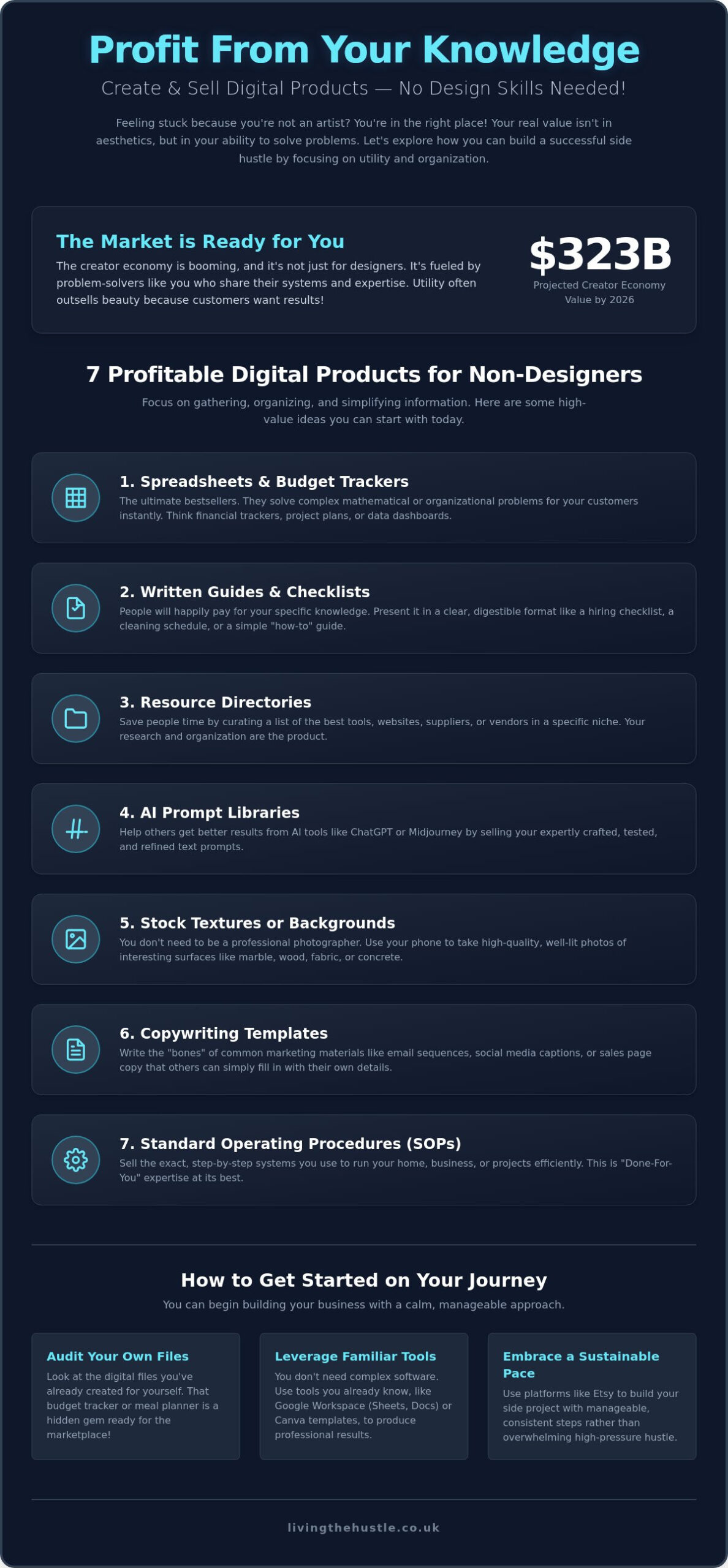
By 2026, the global creator economy is projected to reach $323.48 billion. This massive growth isn't just driven by illustrators and photographers. It's fueled by everyday people sharing their systems. You don't need to be an artist when you are a problem solver. In fact, “utility” often outsells “beauty” because customers are usually looking for a shortcut to a specific result. They want to save time, reduce stress, or organize their lives. If your product does that, they won't care if it isn't a hand-painted work of art. This shift from creation to curation means your ability to organize information is your greatest strength when building digital products that require no design skills.
The Functional Design Mindset
Think about the tools you use to keep your own life on track. Is it a simple budget tracker? A cleaning schedule? A spreadsheet is a perfect example of a high-value digital product that requires zero drawing. Simplicity is actually a major selling point for busy customers who feel overwhelmed by cluttered, “over-designed” files. They want clarity. You can identify “pain point” products by looking at the tasks you've already simplified for yourself. If you've made a list or a tracker that works, you've already done the hard part. The design is just the vessel for your logic.
Reframing Creativity for Non-Designers
It's time to move away from the myth that you must be a “creative” in the traditional sense. You can build your blog brand without the overwhelm by focusing on your professional background instead. Do you have experience in HR? Create a hiring checklist. Are you great at meal planning? Sell a simple grocery list system. The power of “Done-For-You” (DFY) content is that it removes the heavy lifting for your customer. By 2026, tools have become so intuitive that the technical barrier has vanished. You are no longer limited by what you can draw, but only by the solutions you can provide. Creating digital products that require no design skills is about sharing your expertise in a way that makes someone else's life easier.
7 Profitable Digital Products for Non-Designers
If you've been worried that you need a degree in fine arts to start an online shop, you can breathe a sigh of relief. Success in the digital marketplace is often about the “Art of Curation” rather than the “Art of Creation.” While many creators focus on making things look pretty, you can find your niche by gathering, organizing, and simplifying information. Building Your Passive Income Business is often more about being helpful than being trendy. Here are seven digital products that require no design skills but offer massive value to your future customers.
- Spreadsheets and Budget Trackers: These are the ultimate bestsellers because they solve complex mathematical or organizational problems instantly.
- Written Guides and Checklists: People will pay for your specific knowledge if you can present it in a clear, digestible format.
- Resource Directories: Curate a list of the best tools, websites, or vendors in a specific niche.
- AI Prompt Libraries: Help others get better results from AI by selling your tested and refined text prompts.
- Stock Textures or Backgrounds: You can use your phone to take high-quality photos of interesting surfaces like marble, wood, or fabric.
- Copywriting Templates: Write the “bones” of email sequences or social media captions that others can simply fill in.
- Standard Operating Procedures (SOPs): Sell the exact step-by-step systems you use to run your home or business efficiently.
Organization-Based Products
Small business owners are constantly looking for ways to reclaim their time. Google Sheets templates and Notion dashboards are perfect examples of utility products. A utility product is an item that saves the user time through a pre-built structure. You don't need fancy graphics here; you just need a layout that works. If you've mastered a system for tracking inventory or managing a content calendar, you have a product ready to sell. If you want to learn how to turn these simple ideas into a sustainable income stream, the Passive Income Society Course provides a gentle, step-by-step path.
Information-Based Products
Your professional background is a goldmine for digital inventory. Whether you are an expert at project management or a pro at organizing school events, your “how-to” knowledge is valuable. You can package this into step-by-step workbooks or SOPs that remove the guesswork for someone else. Once you've created your first guide, you'll need a place to host it. I've found that learning how to sell digital products on etsy is the best way for non-designers to start because the platform already has a massive audience looking for helpful solutions. Focus on making your information clear and your instructions easy to follow. Your customers will value the results you give them far more than the font you choose.
Essential Tools That Do the Design Work for You
Starting a side project shouldn't feel like a battle with complicated software. If you've ever felt overwhelmed by the thought of learning Photoshop or Illustrator, you're not alone. The good news is that the toolkit for 2026 is built specifically for people who want to create digital products that require no design skills. You don't need to be a technical wizard to produce professional results. Instead, you can rely on intuitive platforms that handle the heavy lifting for you, allowing you to focus on the value you provide.
Canva is perhaps the most famous ally for non-designers. It offers thousands of pre-made templates that serve as a solid foundation. You aren't staring at a blank canvas; you're simply adjusting colors, fonts, and text to fit your vision. Similarly, Google Workspace is a hidden gem. Turning a well-organized Google Sheet into a premium budget tracker or a Google Doc into a comprehensive guide is a straightforward way to build inventory. These tools are already familiar to most of us, which lowers the technical barrier significantly.
AI has also stepped in as a powerful creative assistant. You can use tools like ChatGPT to outline your product structure or write the initial draft of your guidebook's copy. Once your product is ready, mockup generators become essential. Since digital goods are “invisible,” these generators create realistic images of your product on a tablet or computer screen. This helps your customers visualize exactly what they're buying, making your shop look established and trustworthy from day one.
The Power of Templates
Using templates is a smart, ethical way to grow your shop quickly. The key is to use them as a starting point rather than the final product. By customizing a template for a specific niche, you add unique value that a generic file lacks. For example, a standard checklist becomes much more valuable when it's tailored specifically for wedding photographers or first-time homebuyers. If you want to refine your eye for what looks good, you can explore the art of design to ensure your finished items truly stand out in a crowded market.
Market Research Tools
Success isn't about guessing what might sell; it's about looking at the numbers. Data-driven creation is the secret weapon for anyone making digital products that require no design skills. Tools like eRank allow you to see exactly what terms people are typing into search bars. This removes the anxiety of “what if nobody wants this?” You can check out this guide on erank for etsy sellers to learn how to spot trends before they peak. When you follow the data, you can build your business with a sense of calm, knowing there is a real audience waiting for your solution.
How to Choose Your First Product Without the Overwhelm
Do you ever feel like you're staring at a blank page, unsure which direction to take? This is the point where many potential entrepreneurs stop before they've even begun. Choosing digital products that require no design skills doesn't have to be a high-stakes gamble. You can move forward with a sense of peace by following a methodical, step-by-step approach that prioritizes your existing strengths.
To find your first profitable idea, follow this calm five-step framework:
- Step 1: Audit your existing digital files. Look through your own computer or cloud storage. What spreadsheets, checklists, or trackers have you already built to make your own life easier?
- Step 2: Identify a “Boring” problem. Flashy trends are often crowded. Instead, look for mundane tasks that people find frustrating, like organizing household chores or tracking small business expenses.
- Step 3: Validate demand. Use simple search tools to confirm that people are actually looking for these solutions. You want to see consistent interest rather than a passing fad.
- Step 4: Create a Minimum Viable Product (MVP). Give yourself a strict time limit of one afternoon. Produce the simplest version of your solution that still provides real value.
- Step 5: Gather feedback and iterate calmly. Once you release your MVP, listen to what your customers say. Success is a process of making small, consistent improvements over time.
The “What I Use” Method
The most authentic and successful products often come from your own needs. When you share a system that has actually worked for you, your confidence and expertise shine through naturally. You don't need to invent something entirely new; you just need to package your own solutions. If you're looking for more ways to diversify your income without the stress, you can explore these 5 realistic passive income ideas. Your personal experience is a unique asset that no design software can replicate.
Validating with Data
Data acts as a reassuring guide that removes the emotional weight of decision-making. Instead of relying on a “gut feeling” that might lead to anxiety, use keyword search volume to confirm that your effort will be rewarded. Aim for small wins to build your momentum. Seeing that first sale come in from a simple, helpful resource will give you the boost you need to keep going. When you focus on digital products that require no design skills that also have proven demand, you're setting yourself up for a sustainable and peaceful business.
To help you map out your ideas and move from confusion to clarity, the Blog, Brand & Bloom Workbook offers a supportive framework to get started on the right foot.
Building Your Passive Income Business with Confidence
How do you move from reading about a business to actually owning one? The transition from learning to doing is often where the most resistance lives. It's completely normal to feel a bit of “imposter syndrome” when you first start listing digital products that require no design skills. You might wonder if your simple checklist or spreadsheet is truly enough. I want to reassure you that your ability to solve a problem is exactly what your customers are looking for. They aren't looking for a gallery-quality painting; they're looking for a way to make their Tuesday afternoon a little easier.
Etsy is a wonderful training ground for this journey. It simplifies the technical side of entrepreneurship by handling the storefront and the traffic for you. It even helps with the heavy lifting of international regulations. For example, Etsy is considered a “deemed supplier” for EU VAT, meaning they handle the collection and remittance of those taxes so you don't have to. This allows you to focus on your products rather than paperwork. With a listing fee of only $0.20 as of 2026, the barrier to entry is incredibly low. You can test your ideas with very little risk, allowing you to grow at a pace that feels safe and sustainable.
The secret to long-term success isn't “hustling” until you're exhausted. It's about consistent, small actions. If you can commit to just one small task a day, you'll find that your shop grows almost effortlessly over time. Scaling from your first sale to a full-time income is simply a matter of repeating the process. Each new listing is a new seed planted in your digital garden. Before you know it, you'll have a diverse inventory of digital products that require no design skills that work for you while you sleep, spend time with family, or simply enjoy a quiet morning.
Transitioning to a Calm Business
I encourage you to set realistic goals for your first 90 days. Don't worry about having fifty products ready on day one. Instead, aim to understand your customers and refine your “utility” mindset. Having a support system can make this transition feel much lighter. If you're looking for a structured path that removes the guesswork, you might find this Passive Income Society Review helpful. It outlines how a community of like-minded creators can help you stay motivated without the pressure of traditional “grind” culture.
Your Next Steps
Your journey to entrepreneurship doesn't have to be loud or stressful. It can be a quiet, purposeful transition into a life with more freedom. I invite you to open your first shop today, even if it's just with one simple product. If you want a comprehensive guide to walk you through every step, the Passive Income Society is designed to help you build your business with confidence and tranquility. Remember that the only true failure is never starting. You already have the strengths you need to succeed, and the world is waiting for the solutions only you can provide.
Your Journey to a Peaceful Side Business Starts Here
You now have a clear map to navigate the world of online sales without the stress of becoming a graphic designer. Remember that your most valuable assets are the systems and solutions you already use every day. By focusing on utility and organization, you can create digital products that require no design skills that truly help people. Whether you're turning a simple spreadsheet into a bestseller or packaging your professional expertise into a checklist, your path forward is manageable and full of potential.
Building a business should add peace to your life, not more noise. You don't have to figure everything out on your own. With a focus on calm, sustainable growth, I've helped over 1,000 students launch their own ventures with no technical experience required. If you're ready to take that first gentle step toward entrepreneurship, join the Passive Income Society and build your dream shop today.
The transition to a more flexible lifestyle is closer than you think. Trust in your ability to provide value, stay consistent with small actions, and watch your new project bloom into something beautiful.
Frequently Asked Questions
Do I need to pay for expensive software like Photoshop?
No, you don't need to pay for expensive software like Photoshop to build a successful shop. Most digital products that require no design skills can be created using free or low-cost tools like Google Workspace or Canva. These platforms are designed for everyday users rather than professional artists. By focusing on utility and organization, you can produce high-quality resources without the steep learning curve or monthly cost of professional design suites.
Can I really sell Google Sheets as a digital product?
Yes, Google Sheets are some of the most profitable digital products you can sell because they provide instant functionality. Customers value automated trackers, budget planners, and inventory logs that save them time and effort. You aren't selling the cells themselves; you're selling the logic and the system you've built within them. A well-organized spreadsheet is a premium solution that helps others manage their lives or businesses with greater ease and clarity.
Is it legal to use Canva templates to create products to sell?
It is legal to use Canva templates to create products for sale, provided you follow their specific licensing terms. You generally cannot sell an unaltered template as your own work. Instead, you should use the template as a foundation and add your unique content, colors, and specific niche information. This customization ensures you are providing original value to your customers while staying within legal boundaries and ethical standards.
How much time does it take to create a digital product if I have no design skills?
You can create your first “Minimum Viable Product” in just one afternoon. Since you are focusing on digital products that require no design skills, you won't spend hours perfecting graphics or layouts. If you use a tool you already know, like Google Docs, you can package your existing knowledge into a checklist or guide very quickly. The key is to start small and iterate based on the feedback you receive from your first few customers.
Where is the best place to sell digital products for beginners in 2026?
Etsy remains the best place for beginners to start selling in 2026 because of its built-in audience and simplified tax handling. It functions as a “deemed supplier” for many international taxes; this removes a massive administrative burden from your shoulders. While platforms like Shopify or Gumroad offer more control, Etsy provides the easiest path to your first sale with minimal upfront costs and a very gentle learning curve for new entrepreneurs.
What if my product looks “too simple” to sell?
If your product looks simple, it might actually be more appealing to a busy customer. People often pay for “simple” because it means “easy to use.” A cluttered, over-designed planner can feel overwhelming, whereas a clean, straightforward checklist provides immediate clarity. Your goal is to solve a problem efficiently. If your product helps someone reach their goal faster, they will value that simplicity as a premium feature rather than a flaw.
How do I know if my product idea is actually good?
You can confirm your idea is good by looking at search data and competitor trends. Tools like eRank show you exactly what customers are searching for right now. If you see high search volume and manageable competition for a specific “boring” problem, you've found a winner. Validating your idea with data before you start creating helps you move forward with confidence and prevents the anxiety of wondering if anyone will buy your work.
Do I need a business license to start selling digital products on Etsy?
Whether you need a business license depends entirely on your local government and state regulations. In many regions, you can start as a sole proprietor using your own name. However, some areas require a general business license even for online sales. It's best to check your local city or county website for specific requirements. Taking this small administrative step early on will give you peace of mind as your side project grows.