

Let's be honest-writing Etsy titles can feel completely overwhelming. You've heard a dozen different SEO strategies, you're terrified of choosing the wrong keywords and getting zero views, and the thought of doing this for all your listings is enough to make you want to close the laptop for the day. Sound familiar?
What if you had a simple, repeatable formula that cuts through the confusing advice? A gentle method that helps you connect with your ideal customers-the ones actively searching for exactly what you sell-without sounding like a robot stuffing in keywords?
In this guide, we're ditching the panic for a calm, strategic approach. You're about to learn my go-to formula for crafting titles that please both the Etsy algorithm and real, human shoppers. Get ready to feel confident that your listings will be found, attract more clicks, and lead to more sales, all without feeling spammy. It's time to make your titles work *for* you.
Key Takeaways
- Discover a simple formula to take the guesswork and stress out of writing your product titles.
- Uncover the exact words your customers are using, turning keyword research into a calm, simple process.
- Learn how to write powerful etsy titles that satisfy both the search algorithm and capture a shopper's attention.
- Understand how your title, tags, and attributes work together for a complete and effective SEO strategy.
Why Your Etsy Title Is So Important (And Why It's So Confusing)
Let's be honest-writing Etsy titles can feel like a total guessing game. You've probably seen conflicting advice online, leaving you stuck between writing for a real person and writing for a search algorithm. The truth is, your title is your single most important piece of real estate in Etsy search. It's your first handshake with a potential buyer, and it's a huge signal that tells Etsy exactly what you're selling.
But here's the good news: most of the confusion comes from an outdated way of thinking. Etsy has changed for the better, and this new approach is actually much calmer and more intuitive once you understand it.
The ‘Old Way' vs. The ‘New Way' of Etsy Titles
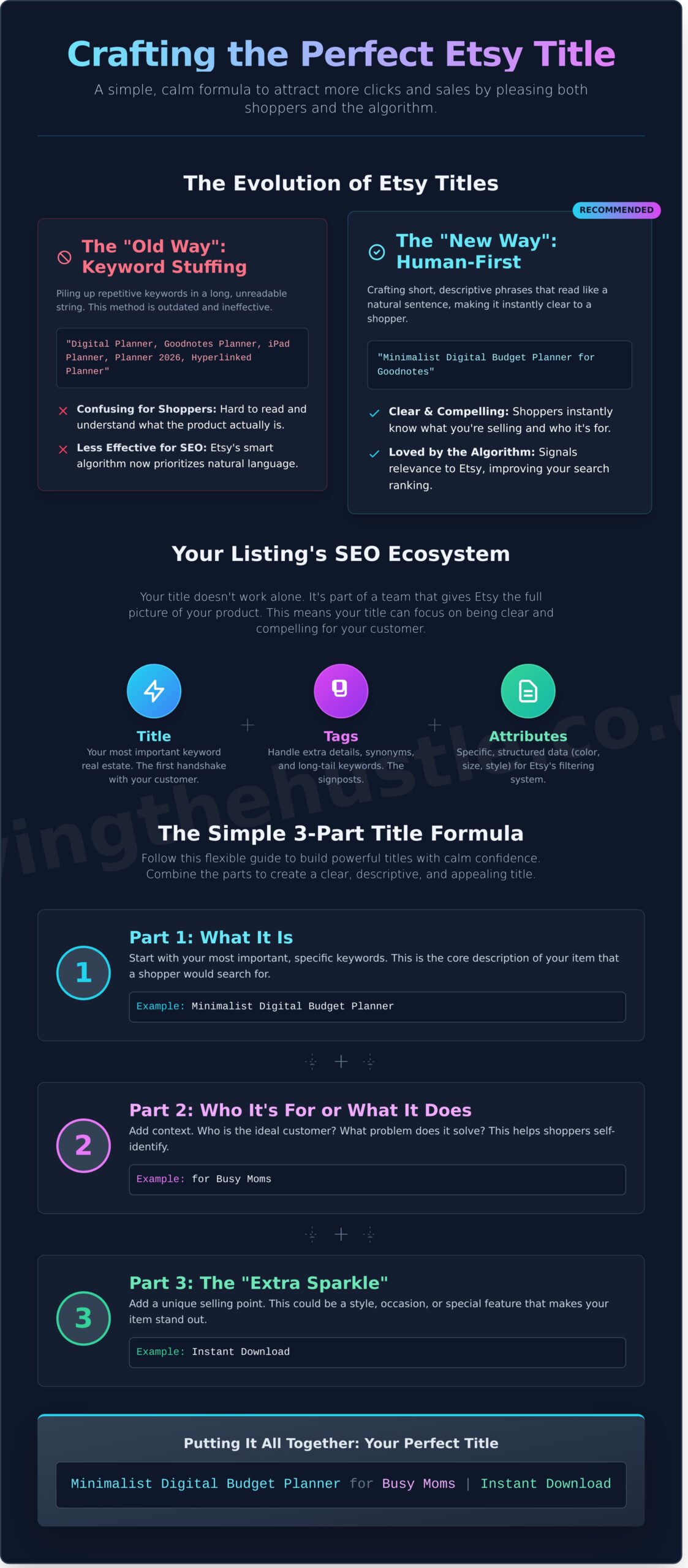
Remember seeing titles packed with repetitive keywords separated by commas? Think of something like this:
- ‘Digital Planner, Goodnotes Planner, iPad Planner, Planner 2026, Hyperlinked Planner'
That was the “old way”-stuffing as many terms as possible to try and rank for everything. Now, Etsy's algorithm is much smarter and prioritizes a great customer experience. The “new way” focuses on short, descriptive phrases that read like a natural sentence, making it easy for a shopper to understand exactly what you're offering at a single glance.
How Etsy Search Understands Your Listings Now
Here's why you can feel confident leaving keyword-stuffing behind. Etsy now takes a holistic view of your entire listing. This shift mirrors a broader trend in digital marketing, often called SEO. If you're new to the concept, this overview of What is Search Engine Optimization (SEO) provides excellent background. For your shop, this means your title, tags, attributes, and categories all work together as a team to give Etsy the full picture. Your title no longer has to do all the heavy lifting, freeing you to focus on clarity for your customer.
This is a huge relief, right? Instead of panicking about fitting in every last keyword, you can focus on writing clear, compelling Etsy titles that connect with real people. Let your tags and attributes handle the extra details while your title shines as a welcoming introduction to your amazing product.
The Simple 3-Part Formula for a Perfect Etsy Title
Feeling overwhelmed by that blank title field? Let's be honest-staring at it can feel like the hardest part of creating a listing. But it doesn't have to be a source of panic. Instead of guessing what might work, you can follow a simple, repeatable formula to write effective Etsy titles with calm confidence.
The goal is to create a title that is specific, descriptive, and instantly appealing to your ideal customer. Think of it as a clear, friendly signpost that guides the right shoppers directly to your product. This 3-part formula is a flexible guide, not a rigid rule, designed to give you a strong and strategic starting point.
Part 1: The ‘What It Is' – Your Most Important Keywords
Start with the most important and accurate description of your product. This is the core of your title and should match what a shopper would type into the search bar if they were looking for your exact item. Finding these core phrases is the foundation of solid Etsy SEO strategies. Use keyword research to discover what your customers are actually searching for.
- Example: ‘Minimalist Digital Budget Planner'
- Example: ‘Printable Wedding Invitation Template'
Part 2: The ‘Who It's For or What It Does' – The Benefit or Audience
Next, add context. Who is this product for? What problem does it solve? This part of the title helps shoppers immediately self-identify and understand your product's value. It answers the silent question, “Is this for me?” By clearly stating the benefit or the target audience, you make a stronger connection and increase the likelihood of a click.
- Example: ‘for Goodnotes & Notability'
- Example: ‘for Busy Moms'
- Example: ‘for Small Business Owners'
Part 3: The ‘Extra Sparkle' – Style, Occasion, or Unique Feature
Finally, add a descriptor that captures a specific style, theme, or unique selling point. This is your chance to stand out from the competition and attract niche buyers who are looking for something special. This little bit of “sparkle” can be the detail that turns a browser into a buyer. Think about what makes your product unique.
- Example: ‘Boho Aesthetic'
- Example: ‘Modern Script Font'
- Example: ‘Instant Download'
By combining these three elements, you build powerful Etsy titles that work for both the algorithm and for real, human shoppers. Example: Minimalist Digital Budget Planner for Busy Moms | Instant Download.
Finding the Right Keywords for Your Titles (Without the Overwhelm)
Let's be honest, the term “keyword research” can sound technical and a little overwhelming. But what if we reframe it? Instead of a tech task, think of it as listening to your customers. The goal is simply to find the exact words and phrases they are typing into Etsy to find products just like yours. Great Etsy titles are built on this foundation.
We'll focus on finding long-tail keywords (phrases of three or more words) because they are less competitive and attract shoppers who are much closer to making a purchase. If you want to go deeper on this topic, our guide to Etsy keyword research for finding profitable niches walks you through the entire process step by step. Here are a few calm, simple ways to start.
Start with the Etsy Search Bar
This is your most direct line to shopper behavior. Open Etsy and begin typing a basic description of your product into the search bar. Don't hit enter! Pay close attention to the list of suggestions that automatically appears. These aren't random guesses; they are the most popular, recent searches shoppers are actually making. For example, typing “digital planner” might suggest “digital planner for goodnotes” or “digital planner for students.” Explore these to find specific phrases your ideal customer is using.
Use a Gentle Keyword Tool like eRank
Ready to go a little deeper without the data-panic? Tools like eRank for Etsy analyze real Etsy data to show you what's trending, how much competition a keyword has, and other useful insights. The key is to use them for ideas and validation, not to get lost in a sea of spreadsheets. They can help you spot a popular niche or confirm that a keyword you found is worth using. If you're new to this, we have a simple guide to get you started. Learn how to get started with our beginner's guide to eRank for Etsy.
Think Like Your Customer
Finally, step away from the computer and put on your customer's hat. What problem does your digital product solve? What feeling does it create? Brainstorm all the words someone might use to find your item. Think beyond the obvious and consider:
This principle of deeply understanding your customer's problem applies to any online business, not just creative ones. For instance, a highly specialized service like mrsatest.co.uk succeeds by focusing entirely on the specific concerns and search terms of its target audience.
Similarly, an online marketplace like Adamase demonstrates this by creating targeted digital guides to serve the needs of niche communities, such as new parents.
- The Occasion: Is it for a baby shower, a bachelorette party, or a birthday?
- The Style: Is it minimalist, rustic, modern, or boho?
- The Recipient: Is it a gift for a teacher, a new mom, or a best friend?
- The Solution: Is it a “budget tracker,” “meal planner,” or a “social media template”?
This simple exercise is one of the most powerful ways to build effective Etsy titles that connect and convert.
Etsy Title Examples: Good vs. Bad (For Digital Products)
Theory is one thing, but seeing our formula in action is where the real confidence comes from. Let's move from overwhelm to clarity by looking at a few side-by-side examples. Notice how the “bad” examples are just a jumble of keywords, while the “good” examples tell a story and attract a specific buyer. This is the secret to writing Etsy titles that truly convert.
Example 1: Digital Planner
BAD: Digital Planner, Goodnotes Planner, iPad Planner, 2026 Planner, Digital Sticker
This title is a classic case of keyword stuffing. It reads like a list for a robot, not a description for a person. It's repetitive and doesn't highlight what makes this specific planner special.
GOOD: Undated Digital Life Planner for Goodnotes | Daily & Weekly Layouts
See how much clearer that is? It's descriptive and immediately answers a shopper's key questions. Here's the breakdown:
- Core Keyword: “Undated Digital Life Planner” tells the shopper exactly what the product is and that they can use it any year.
- Key Feature: “for Goodnotes” specifies the primary app, preventing confusion and saving the customer a click.
- Niche/Benefit: “Daily & Weekly Layouts” highlights a major selling point for someone looking for a comprehensive organization tool.
Example 2: Social Media Templates
BAD: Instagram Template, Canva Template, Social Media, Post Template, IG Post
This title is vague and generic. A shopper has no idea about the style, quantity, or target audience, forcing them to click to find out more-which they often won't do.
GOOD: 100 Boho Instagram Post Templates for Canva | Editable Small Business Branding
This title speaks directly to a niche buyer. It's packed with value and instantly communicates the product's purpose and style.
- Core Keyword: “100 Boho Instagram Post Templates” defines the quantity, aesthetic, and platform.
- Key Feature: “for Canva” confirms the editing software needed.
- Niche/Benefit: “Editable Small Business Branding” targets a specific customer (a small business owner) and highlights a key benefit (creating a cohesive brand).
Example 3: Printable Wall Art
BAD: Wall Art, Printable Art, Home Decor, Digital Download, Poster, Art Print
Again, this is just a list of synonyms. It does nothing to describe the actual art, failing to attract buyers with a specific aesthetic in mind.
GOOD: Abstract Neutral Wall Art Set of 3 | Printable Japandi Home Decor
This title is perfect for a shopper searching for a very specific style. It uses descriptive keywords to paint a picture before the customer even sees the listing image.
- Core Keyword: “Abstract Neutral Wall Art Set of 3” describes the style, color palette, and quantity.
- Key Feature: “Printable” clarifies that it's a digital download.
- Niche/Benefit: “Japandi Home Decor” targets a popular and specific interior design trend, attracting buyers who know exactly what they want.
These principles apply universally, not just to digital downloads. An online store selling physical goods, like pop-culture apparel, must use the same specific, descriptive language to connect with dedicated fans. For instance, a store like McLaren Tee Hub succeeds by creating clear, targeted collections for specific interests like anime and sci-fi, ensuring the right customers find the exact products they're looking for.
Beyond the Title: How Tags and Attributes Complete Your SEO
Let's be honest-trying to fit every possible keyword into your 140-character title can feel overwhelming. But here's the good news: you don't have to. Your title is the star of the show, but it has a powerful supporting cast in your tags and attributes. A truly effective listing uses all of these elements together, creating a complete SEO picture that tells Etsy exactly what you're selling.
Thinking of your listing this way removes the pressure to create perfect, all-encompassing Etsy titles. Instead, you can focus on building a smart, interconnected web of keywords that work together to attract your ideal customer.
Using All 13 Tags Effectively
Think of your tags as 13 extra chances to be discovered. This is where you can get creative and cover all the keyword variations you couldn't fit in your title. Instead of repeating exact phrases, use your tags to capture synonyms and related long-tail keywords. A few tips to remember:
- Use multi-word phrases. A tag like “digital budget planner” is far more powerful than “digital,” “budget,” and “planner” used separately.
- Think like a shopper. What other terms might someone use to find your product? If your title says “Minimalist Weekly Planner,” your tags could include “Undated Digital Journal,” “Goodnotes Productivity Tool,” or “Printable Student Organizer.” Pairing this approach with thorough Etsy keyword research to uncover profitable niches ensures you're targeting terms shoppers are actively using.
- Use them all. Don't leave any of your 13 tags empty. Each one is a valuable opportunity to match with a different search query.
The Power of Attributes
Have you ever noticed the filters on the left side of an Etsy search page? Those are powered by attributes. When you fill out details like color, style, or occasion in your listing, you are giving Etsy specific data points that help shoppers narrow down their search. Leaving these blank is one of the biggest missed opportunities in Etsy SEO.
Filling out attributes is non-negotiable. They act as free, powerful keywords that get your product in front of highly motivated buyers who know exactly what they want. Your title, tags, and attributes should tell a complete and consistent story about your item.
Connecting Titles to Descriptions
Your title and SEO work get the shopper to click, but your description is what secures the sale. A compelling title makes a promise, and your description needs to expand on it with confidence and clarity. If your title highlights a key benefit, your description should explain it in more detail, answer potential questions, and guide your customer toward making a purchase.
A great title is only half the battle. To turn those clicks into customers, you also need to master the art of writing Etsy descriptions that sell.
From Confusing Titles to Confident Sales
Let's be honest, Etsy SEO can feel like a puzzle. But you now hold the most important piece. By focusing on a simple, keyword-driven formula and understanding how your title works with your tags and attributes, you can move from confusion to clarity. The goal isn't just to write good etsy titles; it's to create clear signposts that guide your ideal customer directly to your products.
Mastering your titles is a game-changer, but it's just one part of building a sustainable business. If you're ready to stop the guesswork and follow a complete roadmap, I invite you to explore the Passive Income Society. It's so much more than a course; it's step-by-step guidance for total beginners and a supportive community of calm and confident creators who are all building their businesses with purpose. We believe in proven results, not panic.
You've got this. Your calm and confident hustle is waiting.
Frequently Asked Questions
What is the maximum character limit for an Etsy title?
Etsy gives you 140 characters for your title, and it's a great idea to use as much of that space as you can. Think of it as valuable real estate for telling both Etsy and your customers exactly what your product is. A longer, descriptive title packed with relevant keywords has a much better chance of being discovered in search than a short one. Don't be shy-fill it up with terms your ideal buyer would use!
Should I repeat keywords in my titles and tags?
There's no need to repeat the exact same keywords in your titles and your tags. Etsy's search engine is smart and pulls from both places, so repeating a term doesn't give you an extra boost. Instead, use your tag space to add different keywords, synonyms, and related search terms. This gives you more opportunities to show up in a wider variety of searches and reach more shoppers without wasting precious space.
Is it okay to use my brand name in my Etsy title?
This depends on your shop's stage. If you have a well-known brand that customers might be searching for by name, then absolutely include it! However, if your shop is newer, that valuable title space is better used for descriptive keywords that shoppers are actively searching for. You can always place your brand name at the very end of the title if you feel it's important, after you've included all your high-priority keywords.
Should I go back and change all the titles on my old listings?
The thought of updating every old listing can feel overwhelming, so let's take a calm approach. You don't need to change everything at once! Start by focusing on your most important listings-either your best-sellers that could perform even better, or your underperforming items that need a boost. Prioritizing allows you to improve your Etsy titles with purpose, not panic, and see results without getting burnt out. A gentle, step-by-step update is always better than none at all.
Can I use special characters like commas, pipes (|), or hyphens in my titles?
Yes, you can and should use certain special characters to make your titles easier for shoppers to read! Punctuation like vertical bars (|), hyphens (-), and commas (,) are excellent for separating keyword phrases and improving clarity. For example, “Digital Planner | Goodnotes Template | iPad Journal” is much clearer than a long string of words. Just avoid using characters that don't add value or could confuse shoppers, like excessive symbols.
How often should I update my Etsy titles?
You don't need to constantly change your titles. A good rule of thumb is to review them every few months or if you notice a listing's performance has dropped. The main exception is for seasonal items. You'll want to update those Etsy titles to reflect upcoming holidays or events, like adding “Mother's Day Gift.” Otherwise, if a title is performing well and bringing in consistent traffic, it's best to let it continue working its magic.